




Weather Widget for Education Website: Smart Solution for Schools


Weather widget for education websites helps schools share real-time, local weather updates that support safer planning, better engagement, and smarter daily decisions. A well-placed weather widget gives students, teachers, and parents quick access to useful forecasts. It can improve the user experience, support event planning, and make school websites more informative and helpful.
Understanding weather widget for education websites
- What is a weather widget for education website?
- Why schools and educational platforms use weather widget?
- Common types of weather widgets for education websites
- Key benefits of a weather widget for education websites
- Enhances Weather and Climate Education
- Improves Student and Staff Safety
- Increases User Engagement on School Websites
- Supports Smart Campus and Digital Learning Initiatives
- Where should place a weather widget for education websites?
What is a weather widget for education website?
A weather widget for education websites is a small online tool that shows real-time weather information on a school, college, or university website.
It helps students, parents, and staff check local conditions quickly before classes, events, or travel.
It also improves the website by making it more useful, engaging, and updated.
This is a practical example of weather widgets by industry because schools need weather data for safety and planning.

An example of a weather widget on educational websites
Why schools and educational platforms use weather widget?
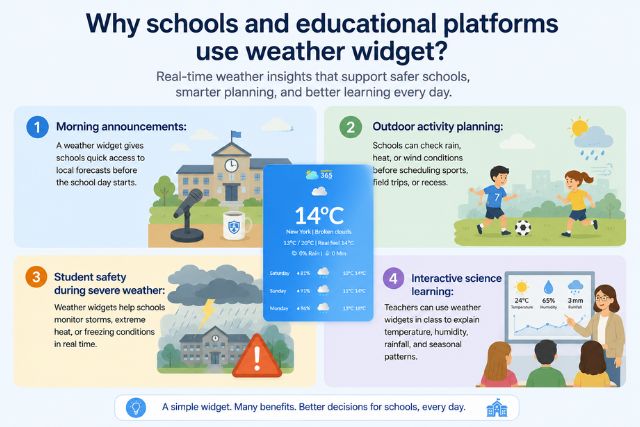
Schools and educational platforms use weather widgets for several practical reasons that improve safety, planning, and learning.
Morning announcements: A weather widget gives schools quick access to local forecasts before the school day starts. This helps staff share accurate weather updates with students and parents.
Outdoor activity planning: Schools can check rain, heat, or wind conditions before scheduling sports, field trips, or recess. This reduces last-minute cancellations and helps activities run more smoothly.
Student safety during severe weather: Weather widgets help schools monitor storms, extreme heat, or freezing conditions in real time. For example, a school can delay outdoor dismissal if heavy rain or lightning is expected.
Interactive science learning: Teachers can use weather widgets in class to explain temperature, humidity, rainfall, and seasonal patterns. This makes science lessons more practical and engaging for students.
Overall, weather widgets make school websites more useful, informative, and safety-focused.
Why should education sites use weather widget?
Common types of weather widgets for education websites
Common types of weather widgets for education websites help schools share useful weather information in simple, student-friendly ways.
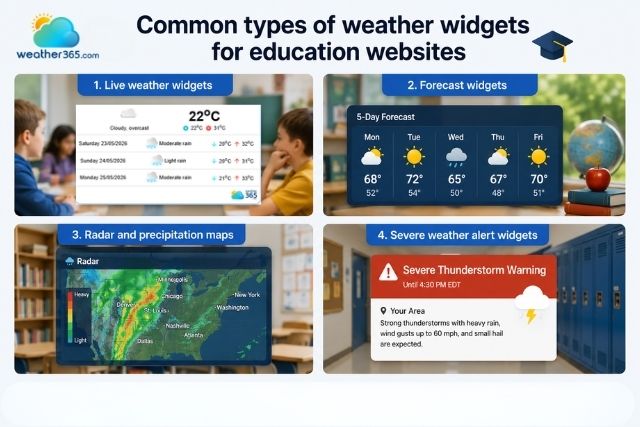
Live weather widgets show current temperature, humidity, wind, and conditions in real time. A school homepage can use one to keep families updated before classes begin.
Forecast widgets display hourly or daily weather predictions. These are useful for planning sports days, field trips, and outdoor events.
Radar and precipitation maps show rain, storms, and moving weather systems. They help staff and parents see what is happening nearby.
Severe weather alert widgets warn users about storms, heatwaves, or freezing conditions. For example, a school in a storm-prone area can use alerts to improve safety and communication.
These widgets make school websites more informative, more interactive, and more helpful for daily decision-making.
Types of weather widgets for education websites
Key benefits of a weather widget for education websites
A weather widget for education websites provides far more than basic temperature updates. Modern schools, universities, and online learning platforms increasingly use weather tools to improve student safety, support STEM education, and create more engaging digital experiences.
As educational institutions continue investing in smart campus technologies, integrating a reliable weather widget has become a practical and valuable feature.
According to the U.S. National Weather Service, weather-related disruptions affect thousands of schools every year due to storms, extreme heat, snow, and flooding.
Real-time weather widget helps educational institutions make faster decisions while also creating learning opportunities for students.
Enhances Weather and Climate Education
One of the biggest advantages of a weather widget for education websites is its educational value. Teachers can use live weather data to support lessons in:
Geography
Environmental Science
Climate Studies
Stem Education
Earth Science
Instead of relying only on textbook examples, students can analyze real-world weather patterns directly from the school website.
For example, students may track:
daily temperature changes
rainfall patterns
wind speed
humidity levels
storm development
Interactive weather data encourages critical thinking and helps students better understand climate systems. Some schools even use weather dashboards during classroom activities and science projects.
This approach is similar to how a Weather Widget for Bussiness helps companies monitor weather risks for logistics and operations. In education, however, the focus shifts toward learning and awareness rather than commercial planning.
Additionally, weather widgets can support discussions about climate change, seasonal weather patterns, and extreme weather events. This makes educational websites more dynamic and informative for both students and teachers.

Weather widgets enhance weather and climate lessons
Improves Student and Staff Safety
Safety is another major reason schools integrate weather widgets into their websites. Severe weather conditions can quickly affect:
School Transportation
Outdoor Sports
Field Trips
After-School Activities
Emergency Planning
Fast access to weather warnings helps administrators make informed decisions and communicate updates efficiently to students, staff, and parents.
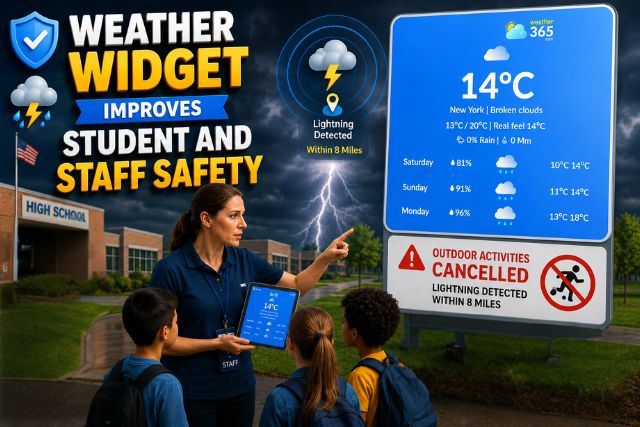
For example, many U.S. school districts temporarily suspend outdoor activities when lightning is detected within a specific radius. Real-time weather monitoring can significantly reduce weather-related risks on campus.
Mobile-friendly weather widgets are especially important because parents and students increasingly access school websites through smartphones. A responsive weather interface ensures important alerts remain visible and easy to understand.
Weather Widgets Improve Student and Staff Safety
The same concept is commonly used in a Weather Widget for Event platform, where organizers monitor weather conditions to protect attendees during concerts, sports events, or outdoor festivals.
Increases User Engagement on School Websites
Educational websites often struggle with repeat engagement outside of announcements and academic updates. Adding a weather widget introduces useful daily content that encourages regular visits.
Parents may check:
| Students may use the widget before:
|
This repeated interaction can significantly improve website traffic, session duration, user retention, and mobile engagement.
When students, parents, and staff regularly visit a school website to check weather updates, they are more likely to spend additional time exploring announcements, schedules, and other resources.
In SEO terms, these stronger engagement signals can positively influence overall website performance and user experience metrics.
Many modern educational websites now combine calendars, announcements, lunch menus, and weather information into a centralized digital hub.
A well-designed Weather Widget for Education supports this trend by making school websites more functional, informative, and user-friendly for daily visitors.
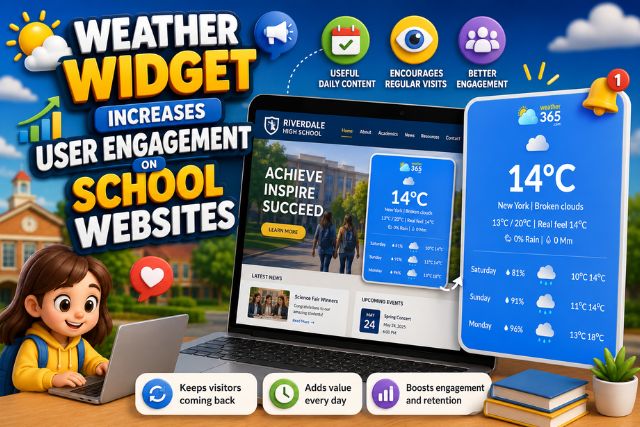
A weather widget on an educational website can increase user engagement
Supports Smart Campus and Digital Learning Initiatives
As schools continue adopting digital learning technologies, weather widgets play a role in smart campus ecosystems.
Some institutions integrate weather systems with:
Smart Classroom Displays
Digital Signage
Transportation Systems
Campus Notification Tools
For example, universities may automatically display weather alerts on campus screens during severe weather events. Schools can also integrate weather APIs into learning platforms and mobile apps.
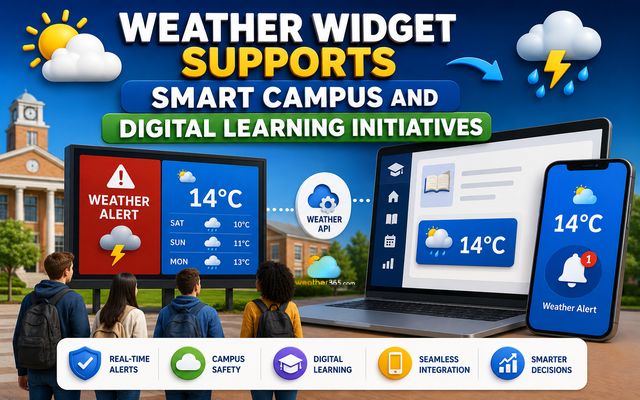
Weather widgets support smart campus and digital learning initiatives
Cloud-based weather widgets are now easier to install than ever, with many solutions offering:
Simple embed codes
WordPress compatibility
Customizable layouts
Multilingual support
Mobile optimization
This flexibility allows schools of all sizes to implement weather tools without advanced technical expertise.
Ultimately, a weather widget for education websites combines practical functionality with educational value.
From improving safety to supporting STEM learning and increasing engagement, weather widgets have become an important feature for modern educational platforms.
Where should place a weather widget for education websites?
The placement of a Weather Widget for Education plays an important role in improving usability, safety communication, and website engagement.
Studies show that users spend nearly 80% of their time viewing content above the fold, making homepage placement one of the most effective options for visibility.
Schools, colleges, and universities should place weather widgets in high-traffic areas where students, parents, and staff can quickly access real-time forecasts and severe weather alerts.
The best locations for a weather widget include:
homepage headers or top banners
student and parent portals
athletics and outdoor activity pages
emergency notification sections
mobile-friendly sidebars
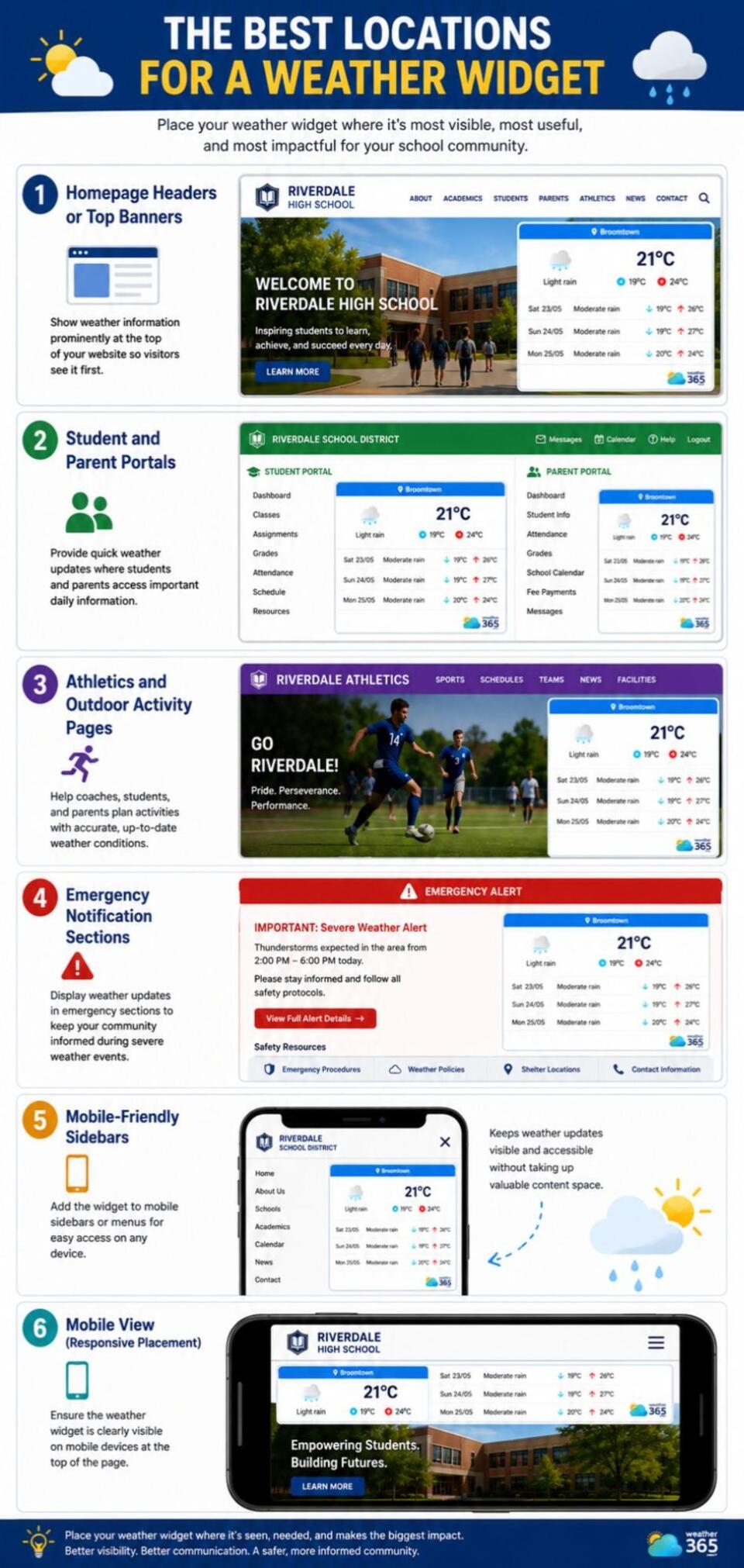
Best places to add a weather widget on education websites
For example, schools in regions affected by snowstorms, hurricanes, or heatwaves often place weather widgets near announcement sections to improve emergency communication. Universities may also integrate weather tools into campus dashboards and digital signage systems.
The key benefits of a weather widget for education websites, such as improving student safety, increasing engagement, and supporting STEM learning, are most effective when the widget is easy to find and access.
Strategic placement helps users check weather conditions daily, increasing website traffic, session duration, and mobile engagement.
Understanding how to add weather widget to website platforms is also important. Most modern weather widgets offer simple embed codes, WordPress plugins. You can install those widgets to educational websites quickly without advanced technical knowledge.
In conclusion
As schools continue adopting smart digital tools, integrating real-time weather data can improve safety, engagement, and learning experiences. A well-designed weather widget for education helps educational websites become more interactive, informative, and user-friendly for students, parents, and staff.
Frequently Asked Questions (FAQs)
Related post
Weather Widget for Construction: Top Tools and How To Embed One
 141
141
 8
8
 4.9
4.9
 27/05/2026
Weather Widget for Agriculture: Embed a Live Farming Track in Seconds
121
8
4.7
02/06/2026
Weather Widget for Outdoor Business: Free Live Forecasts for Your Site
116
8
5.0
02/06/2026

8 Comment
Nyla Briggs
Would this work for a school website built with WordPress? We'd prefer something that doesn't require much technical work.
weather365
Yes, you can add a weather widget to WordPress using a Custom HTML block. You can also preview the layout before publishing to make sure it fits your website.
Winter Floyd
We've been looking for small features to make our school website more useful for parents. A weather widget could be a nice addition, especially for outdoor events.
weather365
That sounds like a practical use case! Having local weather information available on the school website can help families prepare for outdoor activities and school events.
Gabrielle Floyd
I like the idea of letting students observe weather changes over several days. It could be a simple but engaging classroom activity.
weather365
Absolutely! Students can track temperature, precipitation, and other conditions to spot patterns and practice recording data.
Stella Fleming
I can see this being useful in science classes. Students could check daily weather conditions and compare them with what they're learning in class.
weather365
That's a great way to use it! Connecting real weather data with classroom lessons can make science concepts easier for students to understand.
Leave a comment
Your email address will not be published. Required fields are marked *