




What Is Fog? Understand Its Formation, Causes, and Impacts


Have you ever seen the world outside wrapped in a soft, white mist and wondered what is fog? That’s one of nature’s most fascinating weather phenomena. In this guide, we will explain what fog really is, how it forms, where it occurs most often, and why it can sometimes cause serious visibility problems.

What Causes Fog?
What is Fog
Fog is essentially a cloud that forms at ground level, made up of countless tiny water droplets or ice crystals suspended in the air.
Meteorologists define fog as a visible mass that reduces horizontal visibility to less than one kilometer (0.6 miles).
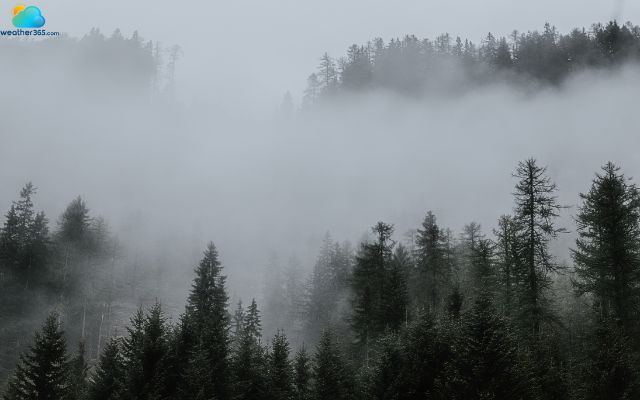
Fog is a cloud at ground level
Fog can form through various physical processes; therefore, there are many different types of fog. Meteorologists typically categorize fog into several main types, each with its own conditions and appearance:
Radiation fog (also called ground or valley fog)
Advection fog
Unslope fog (hill fog)
Steam fog (evaporation fog)
Frontal fog (precipitation fog)
Ice fog
Freeze fog
Learn details about each type in our full guide Types of fog!
What causes fog in the morning?
Now you know what is fog, yet you might wonder why fog is most common in the early morning hours. That is all due to temperature and timing!
During the night, the ground cools as it loses heat to the atmosphere. The air above it cools too, sometimes reaching its dew point just before sunrise. That’s when fog forms.
After sunrise, sunlight warms the air, lowering relative humidity and gradually dispersing the fog.

Fog often occurs in the morning
Morning fog is especially common in areas with clear skies, calm winds, and high humidity, such as valleys and low-lying fields.
The phenomenon can also be influenced by local geography, such as water bodies, hills, and soil moisture all play a role:
Valleys and low-lying areas: Cold, dense air tends to sink and become trapped, encouraging fog formation.
Lakes, rivers, and ponds: Water surfaces provide abundant humidity overnight.
Moist ground or recent rainfall: Adds extra moisture to the air close to the surface, making condensation easier.
How Fog Forms
Fog forms through a series of atmospheric processes involving the cooling of air, condensation of water vapor, and its close contact with the ground.
Cooling Air
Fog formation begins when the air near the ground cools down.
After sunset, the Earth’s surface releases heat through radiation, especially under clear skies and light winds.
As the ground loses heat, it cools the layer of air directly above it. This process is known as radiative cooling.
When the temperature of this air drops enough to reach its dew point (the temperature at which air can no longer hold all its vapor), the conditions become ideal for fog to form.
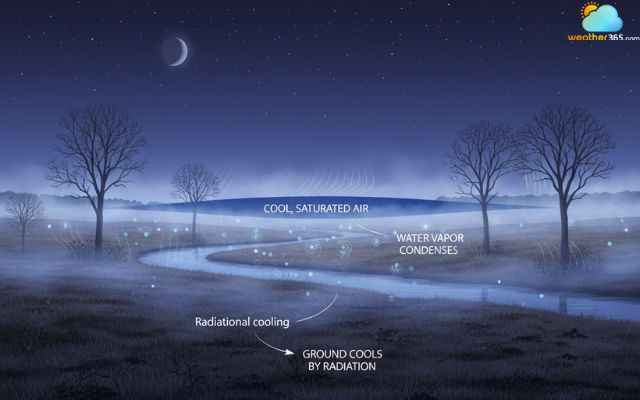
How is fog formed?
Condensation
Once the air reaches its dew point, condensation begins.
Water vapor in the air turns into tiny liquid droplets, forming around microscopic particles such as dust, smoke, or sea salt known as condensation nuclei.
These droplets are so small that they remain suspended in the air, creating the dense, cloud-like appearance we recognize as fog.

Water vapor in the air, through condensation, turns into tiny liquid droplets
The process is similar to how clouds form in the sky, but instead of floating high above, fog develops close to the ground.
The higher the humidity, the more moisture is available to condense, making the fog thicker and more persistent.
Proximity to the ground
What makes fog different from clouds is its proximity to the Earth’s surface.
As the cooling and condensation occur near the ground, fog typically forms at very low altitudes.
The air near the surface becomes saturated, and visibility drops significantly as the fine droplets scatter light.
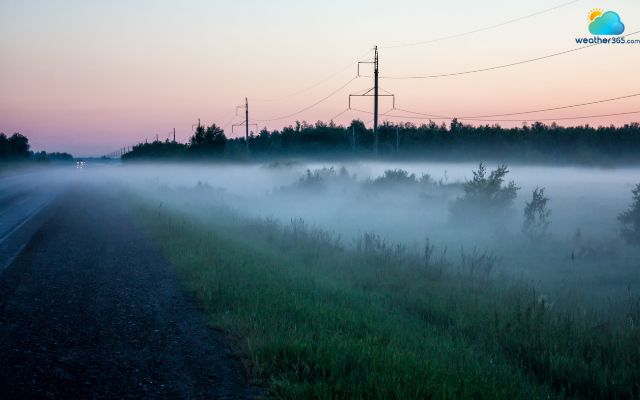
Fog forms at very low altitudes
On calm mornings, this fog layer can help mix the saturated air, spreading the fog slightly higher.
When the sun rises, the warming ground heats the air, increasing its capacity to hold moisture again.
As a result, the droplets evaporate, and the fog gradually lifts or dissipates.
Where is fog most likely to occur
Fog tends to form more readily in locations where the environment supports cooling, moisture retention, and limited air mixing.
Coastal areas
Coastal zones are among the foggiest places on Earth. Here, warm, moist air moving over a colder ocean surface cools to its dew point and condenses, producing advection fog that often drifts inland.
In regions like the California coast, this marine fog is a regular summer phenomenon and helps moderate coastal temperatures.
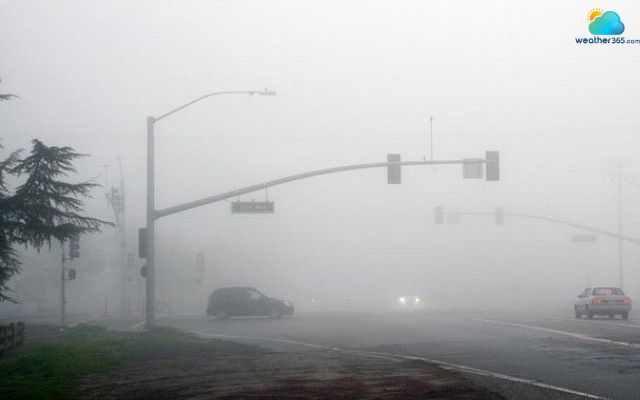
Dense fog in Hanford, California
Valleys and Low-Lying Areas
Valleys and depressions trap cooler air, especially at night. When the ground cools and moisture is present, fog (often radiation fog) forms and lingers in the low ground.
As the surrounding terrain blocks airflow, the fog remains concentrated and can persist until the sun warms the valley floor.
The Central Valley of California experiences frequent dense fog events - locally called “Tule fog”.
During winter months, visibility can drop below ¼ miles for several consecutive days, causing transportation hazards.
Mountainous Regions
Fog also forms in mountains when moist air is forced uphill and cools as it rises, creating upslope fog.
The combination of high elevation and constant moisture makes these areas natural fog factories.
For instance, the Appalachian Mountains experience fog nearly 250 days a year in certain areas, particularly around Mount Mitchell, North Carolina.
The Swiss Plateau, lying between the Jura and the Alps, also sees extended fog episodes during winter.
These high-altitude examples are often featured in reports on the foggiest cities in the US and Europe alike.
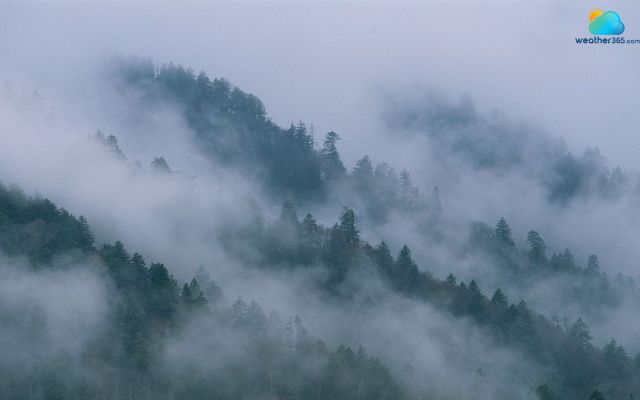
Fog in the Appalachian Mountains
Over Water Bodies in Cold Weather
In colder seasons, fog frequently develops over lakes, rivers, or coastal waters when frigid air moves across warmer surfaces - forming steam fog (also known as evaporation fog).
The Lake Superior, where cold Arctic air passing over relatively warm water in late fall creates dramatic fog plumes visible for miles.
Similar “sea smoke” often forms in the Gulf of Maine, where visibility can drop below 500 meters during winter mornings.
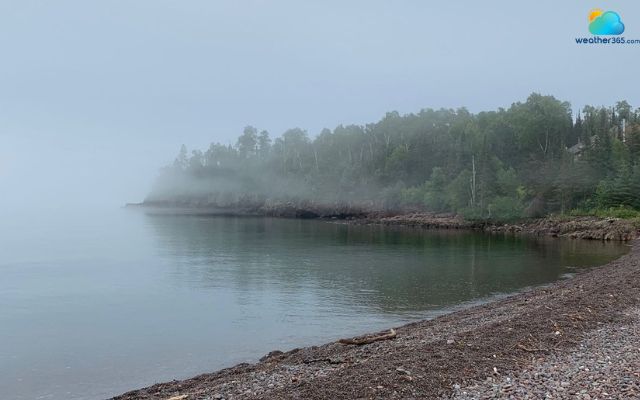
Lake Superior experiences “sea smoke”
Northern Plains
In very cold environments, moisture in the air can directly turn into ice crystals, producing ice fog or freezing fog.
These types of fog occur when the temperature falls below -30°C (-22°F) and are unique to Arctic or subpolar climates.
Fairbanks, Alaska, experiences over 40 days of ice fog each winter, especially when high pressure traps cold, moist air near the ground.
Similar scenes occur in Yellowknife, Canada, where freezing fog crystals shimmer under the polar sun.
Mist, Fog, and Clouds: What’s the Difference?
It is easy to confuse mist, fog, and clouds, as all are made of water droplets or ice crystals suspended in the air.
However, they do differ in density, elevation, and visibility.
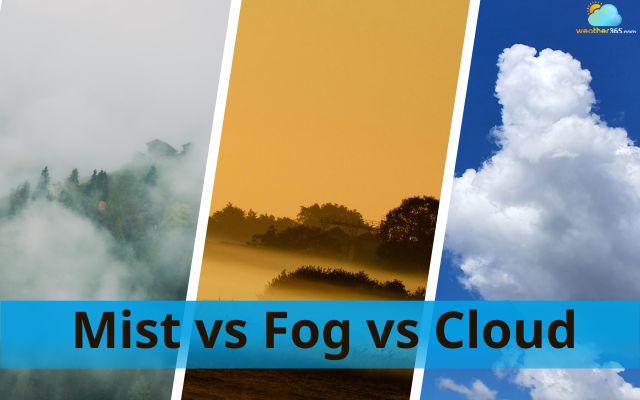
Difference among mist, fog, and cloud
Altitude
In terms of altitude, mist and fog both form close to the ground, but mist tends to hover just a few meters above the surface, while fog can extend a bit higher yet remains at ground level.
Clouds, by contrast, form much higher in the atmosphere, often hundreds or even thousands of feet above the Earth’s surface.
Visibility
Visibility is another important factor in differentiating these three types.
Fog significantly reduces horizontal visibility, often to less than 1 kilometer (0.6 miles), making it the most obstructive of the three.
Mist reduces visibility slightly, usually allowing more than 1 kilometer of clear sight.
Clouds do not directly affect surface visibility in the same way because they form higher in the atmosphere.
Size and density
The size and density of droplets also differ. Mist droplets are small and sparsely packed, creating a thin, light haze.
Fog droplets are small as well but densely packed, producing a thick, cloud-like layer at the surface.
In the meantime, cloud droplets can vary more in size and may include ice crystals, with vertical and horizontal extent far greater than either mist or fog.
Formation process
Regarding the formation process, while mist forms when air is near saturation, fog forms when the air reaches the dew point, causing widespread condensation near the ground.
Clouds form through the upward movement of moist air that cools and condenses at higher altitudes, often growing large enough to produce precipitation such as rain or snow.
Feature | Mist | Fog | Cloud |
Altitude | Near ground | At ground level | High above ground |
Visibility | >1 km | <1 km | Not applicable |
Droplet Size | Smaller | Larger | Varies by type |
Formation | Cooling + humidity | Cooling + saturation | Uplifted moist air |
Fog Impacts
Fog seems to be harmless; however, it has significant effects on people’s daily lives, as well as various sectors.
Health
Fog can exacerbate respiratory and cardiovascular conditions due to the high concentration of fine particulate matter (PM2.5) and other pollutants it often carries.
These pollutants can penetrate deep into the lungs, increasing the risk of heart attacks, strokes, and chronic respiratory diseases.
Older adults and individuals with pre-existing health conditions are particularly vulnerable.

Older adults are particularly vulnerable to fog’s impacts
Transportation
Fog significantly reduces visibility, leading to hazardous driving conditions. In the US, it is estimated that over 38,700 vehicle crashes occur annually in foggy conditions, resulting in more than 600 fatalities and over 16,000 injuries.
Fog also complicates air and maritime navigation, increasing the risk of accidents and delays.
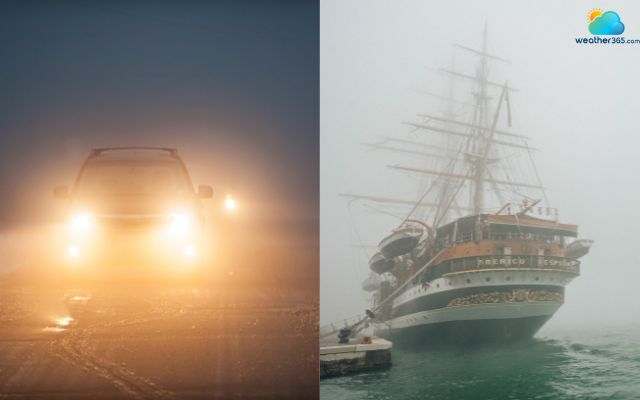
Fog impacts transportation by significantly reducing visibility
Agriculture
In agriculture, fog can be both beneficial and detrimental.
On the positive side, coastal fog provides moisture to crops, reducing the need for irrigation and protecting plants from heat stress.
However, persistent fog can limit sunlight, hindering photosynthesis and potentially affecting crop yields.
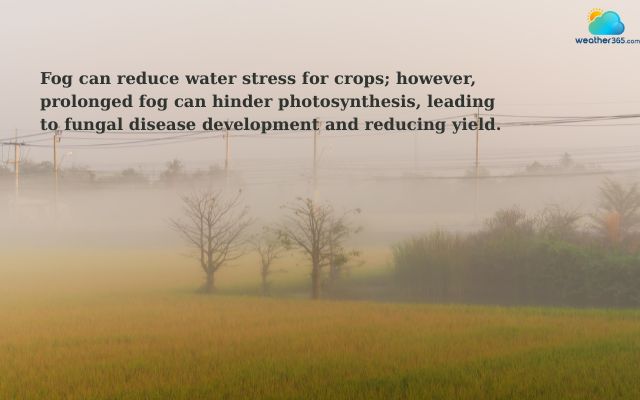
Fog can be both beneficial and detrimental to crops
Energy
Fog can impact energy production in several ways.
In power generation, fog can reduce the efficiency of solar panels by blocking sunlight.
Conversely, fog harvesting technologies are being developed to capture water from fog, providing a sustainable water source in arid regions.
Additionally, fog-based power augmentation systems have been tested to increase the output of gas turbines, offering a potential method to enhance energy production.
Aerospace and defense
In aerospace and defense, fog poses challenges to visibility and radar detection. Reduced visibility can hinder surveillance, reconnaissance, and combat operations.
Additionally, fog can cause radar beams to bend back toward the ground, leading to significant ground clutter and complicating detection efforts.
Discover more facts about fog here!
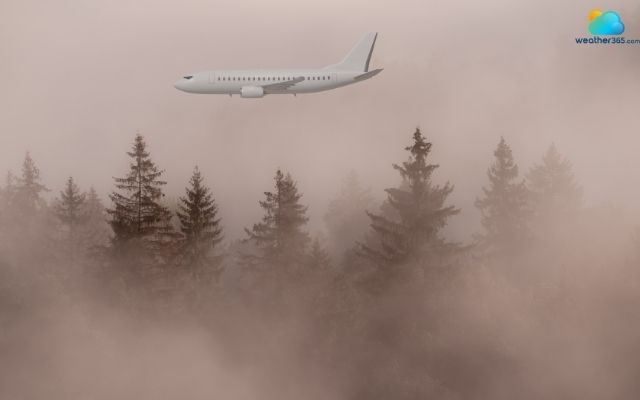
Fog poses challenges to visibility and radar detection
How to prepare for fog?
Understanding what is fog is not enough since fog can appear unexpectedly and create hazardous conditions for travelers, drivers, and boaters. That’s why we need to learn how to prepare for this phenomenon.
Proper preparation and awareness can significantly reduce risks and enhance safety. Here's how to prepare for fog across different scenarios.
Before travel
In case there is fog outside, before going anywhere, remember to
Check weather forecasts for fog advisories and plan accordingly.
Consider postponing travel or choosing routes less prone to dense fog.
Ensure vehicle low-beam headlights and fog lights are functional.
Verify windshield wipers and defrosters are working.
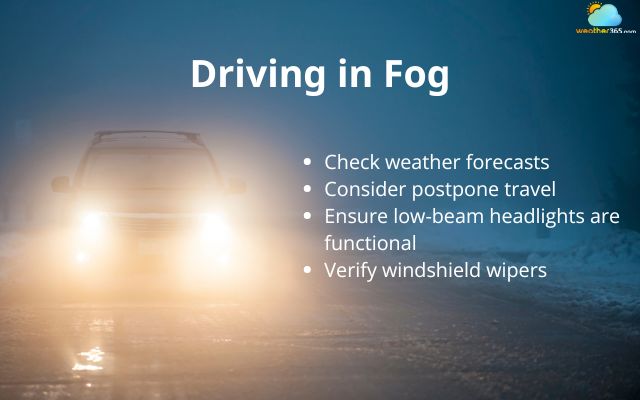
Check your vehicle before driving in dense fog
While driving
Driving in fog is potentially dangerous as fog can significantly reduce visibility. Follow these tips below to minimize risks while driving in fog:
Reduce speed to allow more reaction time.
Maintain a safe distance from other vehicles.
Use low-beam headlights and fog lights; avoid high beams.
Pull over to a safe area with hazard lights on if visibility becomes too low.
Remember: safety over speed, it’s better to arrive late than risk an accident.
Learn more safety tips in our guide How to drive in fog.
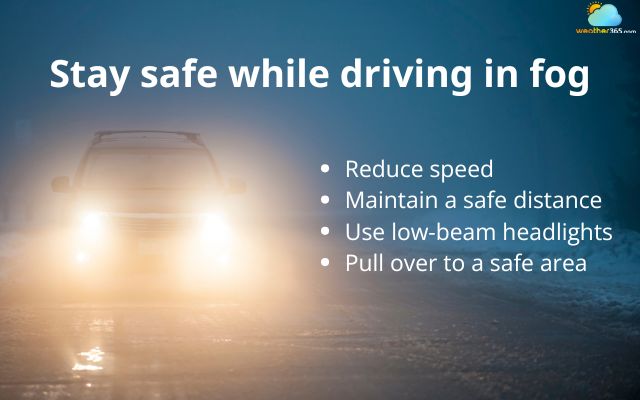
Stay safe while driving in fog
Boating in fog
Fog also makes it difficult for sailors to navigate. In the condition of dense fog, sailors might get lost, or worse is go into a crash with other boats. To stay safe, it is recommended to:
Reduce speed to increase reaction time.
Turn on all running lights, even during the day.
Use sound signals (horn blasts every two minutes) to alert others.
Use radar if available to detect nearby objects.
Listen for fog horns, bells, or other signals from buoys.
Consider anchoring in a safe area if fog worsens
Find more useful tips in Boating in fog!
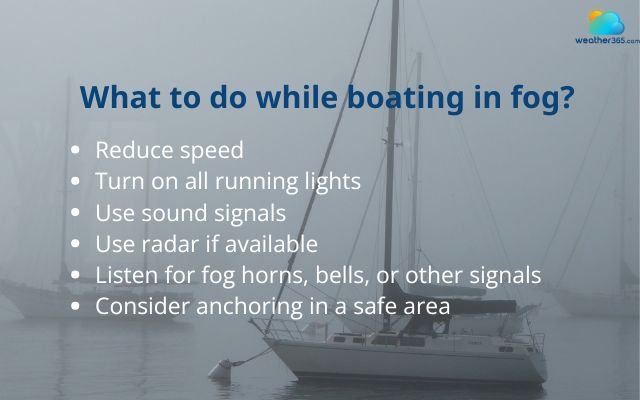
How to boat safely in fog?
Conclusion
Knowing what is fog helps you recognize its effects on travel, agriculture, and energy. Awareness of its formation, impacts, and safety strategies allows you to navigate foggy conditions confidently and reduce potential risks.
Frequently Asked Questions (FAQs)
Related post
7 Common Types of Fog and What Makes Each One Unique
 266
266
 8
8
 4.7
4.7
 13/04/2026

13 Interesting Fact about Fog: You Will Be Surprised At The Last One
246
8
4.9
13/04/2026
What is Freezing Fog: Understand Its Formation and Hazards Clearly
202
8
4.8
13/04/2026

8 Comment
Angela Kelly
Can fog really form over a lake in cold weather?
weather365
Yes. Cold air moving over relatively warmer water can create steam fog, sometimes called sea smoke.
Grace Wright
Why does sunlight make morning fog disappear?
weather365
Sunlight warms the air and gives it more capacity to hold moisture, so the tiny water droplets gradually evaporate.
Gabrielle Mccarty
Is mist basically the same thing as fog?
weather365
They’re similar, but fog reduces visibility to less than 1 km, while mist usually allows visibility beyond 1 km.
Nina Fuller
Why does fog seem to happen so often in the early morning?
weather365
The ground cools overnight, which can bring the air down to its dew point. After sunrise, warming usually makes the fog disappear.
Leave a comment
Your email address will not be published. Required fields are marked *