




13 Interesting Fact about Fog: You Will Be Surprised At The Last One


Every fact about fog reveals something unexpected. From glowing fogbows to water-harvesting tricks, this everyday weather wonder hides more science and mystery than you would imagine. Let’s dive into its foggy world of surprises.

Interesting Fact about fog
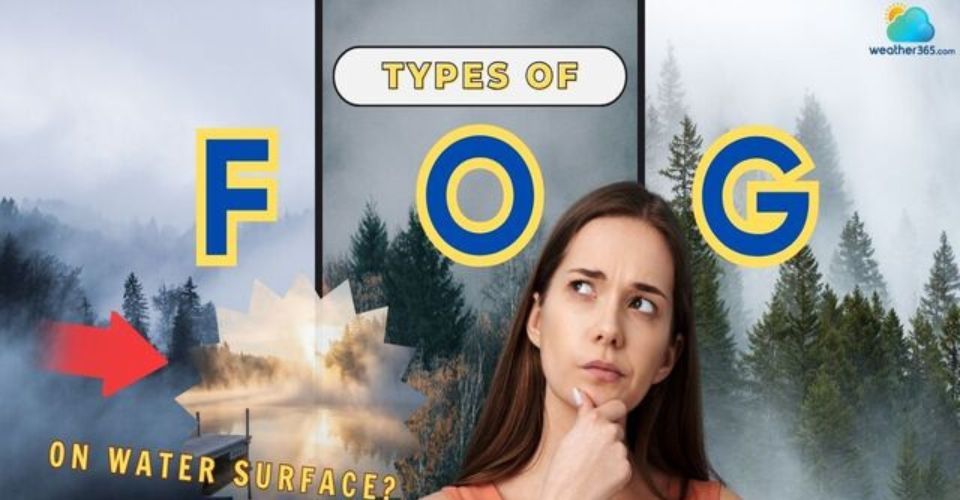
- Fact about fog: 7 common types of fog
- Fog is simply a cloud on the ground
- Fog contains very little water
- Fact about fog: Fog and Mist are different
- You can harvest water from fog
- Fog messes with your perception of speed
- Fog can influence history
- Fact about fog: Fog is difficult to forecast
- Fog lifts from bottom up
- The aviation impact is huge
- Fog is highly localized and seasonal
- Fact about fog: Fog can glow at night
- Fogbow
Fact about fog: 7 common types of fog
One surprising fact about fog is that it’s not all the same. What you see outside your window could be one of seven different types that are born from unique weather conditions.
Let’s take a look at 7 types of fog:
Radiation fog: This fog forms when the ground cools overnight under clear skies. The air close to the surface cools until it meets its dew point, causing moisture to condense. This type often appears in valleys or low-lying areas.
Advection fog: Occurs when warm, humid air moves horizontally over a colder surface (land or water). The lower layer of air is chilled and moisture condenses. Common in coastal zones or over cold ground.
Unslope fog: When moist air is pushed upward along sloping terrain (like hills or mountains), it cools adiabatically (i.e., from expansion), reaching saturation and forming fog.
Steam fog: Cold air moves over warmer water, causing water vapor to evaporate into the air. As it mixes and cools, it condenses into fog. Often seen over lakes or warm bodies of water in cool air.
Frontal fog: This fog forms near weather fronts. Rain falling through a colder air mass may evaporate and saturate the air, leading to fog formation at the surface.
Ice fog: In very cold conditions, water droplets in fog become supercooled. When they touch surfaces, they freeze, forming rime ice - that’s freezing fog. When fog itself is made of ice crystals, it’s called ice fog.
Freeze fog: When rain falls into a layer of cooler air near the ground, evaporation from that rain can saturate the air and create fog. This type often accompanies slow-moving fronts.
Wonder why there are even 7 types of fog? Discover details here!
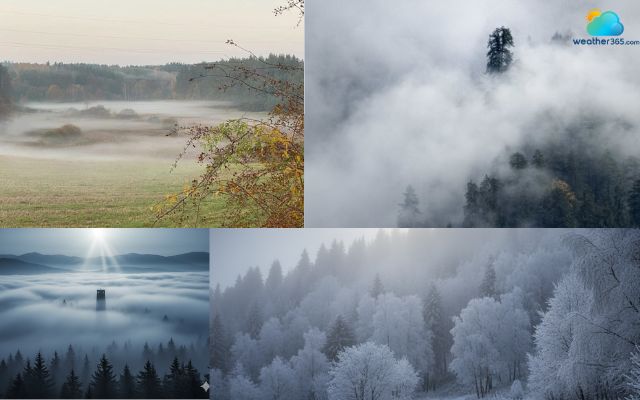
Not all the fog is the same
Fog is simply a cloud on the ground
A fascinating fact about fog is that it’s essentially a cloud that forms at ground level.
Both clouds and fog are made of countless microscopic water droplets suspended in the air.
They form through the same process of condensation, which happens when humid air cools to the point where it can no longer hold all its moisture.
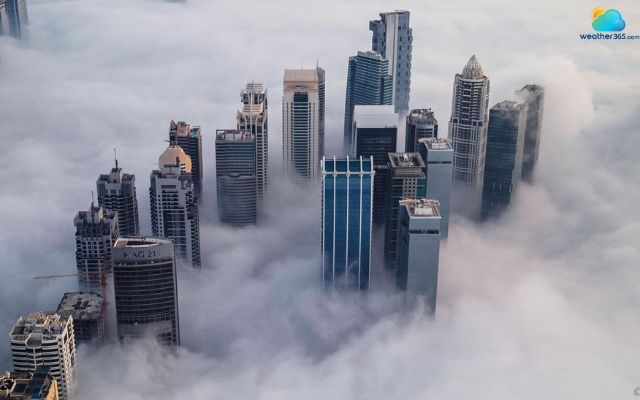
Fog is a cloud that forms at ground level
The main difference lies in where this process occurs. Clouds float high in the sky, while fog develops close to the surface, usually when the air near the ground cools faster than the air above.
This cooling can happen overnight under clear skies, near coastlines, or after rain when moisture levels are high.
Even though fog looks thick and heavy, it contains very little actual water. Each droplet is tiny which is less than a hundredth of a millimeter wide, but together they scatter light and make visibility drop sharply.
That’s why driving or flying through fog can feel like moving through a white wall.
So in simple terms, fog is what happens when the sky comes down to meet the earth.
To learn details about how fog forms, and how it differs from clouds, check out our detailed guide on What is fog!
Fog contains very little water
Here’s another striking fact about fog: despite its dense appearance, fog carries only a tiny amount of liquid water.
It is calculated that fog may hold up to 0.5 milliliters of water per cubic meter of air.
Visualize it this way: if you filled an Olympic-sized swimming pool with fog and then condensed all its droplets, you’d end up with just over one liter of water.
Why is the water content so low? Because fog droplets are microscopic, each droplet is well under 0.01 mm in diameter.
While there are billions of them, their combined mass remains small.
Also, fog formation depends on the saturation of moisture in the air, not heavy precipitation.
The air only needs enough humidity to reach its dew point for condensation to begin.
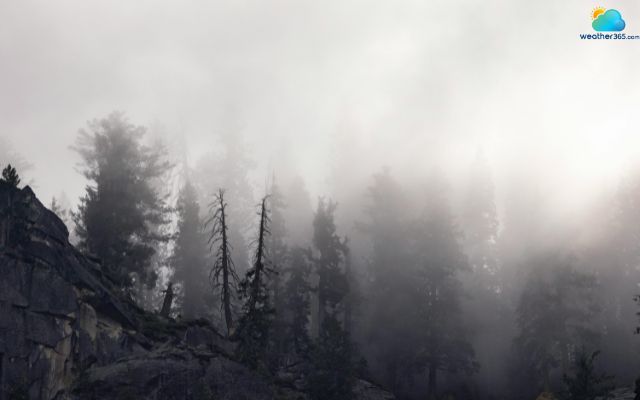
Fog may hold up to 0.5 milliliters of water per cubic meter of air
Fact about fog: Fog and Mist are different
Many people often use “fog” and “mist” interchangeably; however, these are two different terms.
The main difference between fog and mist lies in visibility. Fog significantly reduces visibility to less than 1 kilometer, making it challenging to see objects even a short distance away.
On the other hand, mist allows visibility between 1 and 2 kilometers.
Besides, fog is often denser, leading to more pronounced obscuration of surroundings, while mist is lighter and less opaque.
In terms of duration, fog tends to persist longer, especially under calm and cool conditions, whereas mist can dissipate more quickly with slight changes in temperature or wind.
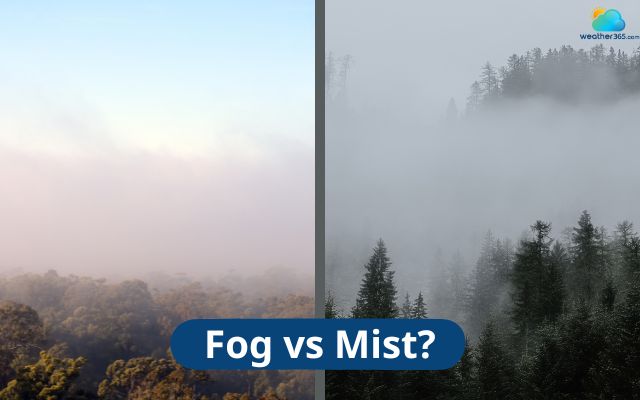
Are fog and mist the same?
You can harvest water from fog
A surprising fact about fog is that it can be a source of clean, drinkable water.
In regions where traditional water sources are scarce, fog harvesting offers a sustainable solution.
By capturing the tiny water droplets suspended in fog, communities can collect significant amounts of water without relying on electricity or complex infrastructure.
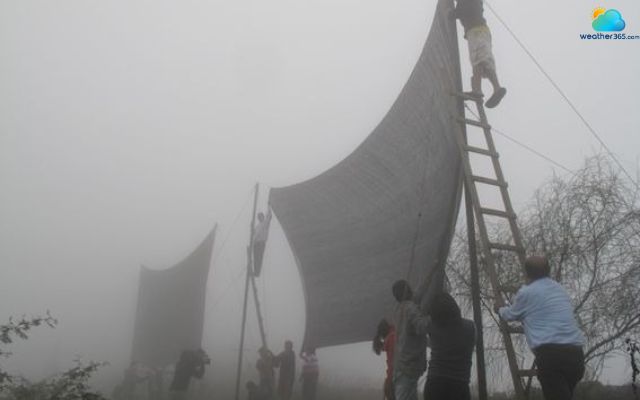
Catching fog in Lia, Latin America
Fog harvest is particularly effective in coastal or mountainous regions where fog is prevalent.
For instance, in Chile's Atacama Desert, fog collectors have been successfully used to grow crops like lettuce and lemons, even in areas with minimal rainfall.
The technique yields between 1,000 to 1,400 liters of water in extremely arid conditions, with the fog-derived water being notably pure and free of minerals and chlorine, enhancing the organic quality of the crops.
Fog messes with your perception of speed
An intriguing fact about fog is that it can distort your sense of speed, making you feel as though you're moving slower than you actually are.
This phenomenon is due to how fog affects visual cues and depth perception.

Fog can distort your driving speed
Fog reduces contrast and blurs the environment, limiting the visual information your brain uses to gauge speed. With fewer reference points, you might misjudge your velocity.
Research indicates that drivers often overestimate their speed in foggy conditions, leading them to slow down more than necessary.
That’s the reason why we need to learn how to drive in fog to minimize risks and stay safe.
In fact, this altered perception can be dangerous. While you might feel you're driving cautiously, you could still be traveling at unsafe speeds.
It's crucial to rely on your vehicle's speedometer and adjust your driving to the actual conditions, not just how they feel.
Fog can influence history
Can you believe that fog can even influence history?
During the 1776 Battle of Long Island, General George Washington utilized the dense fog to facilitate a covert nighttime retreat, evading capture by British forces.
Similarly, on June 6, 1944, the D-Day landings in Normandy occurred under foggy conditions, which, while hindering visibility, also provided some concealment for the Allied forces.
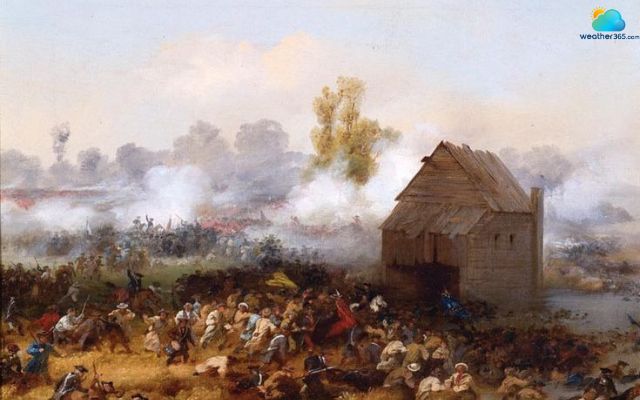
Dense fog during the Battle of Long Island 1776
Moreover, the Great Smog of London in December 1952, a severe air pollution event exacerbated by fog, led to thousands of fatalities and brought the city to a near standstill.
This tragedy prompted the British government to enact the Clean Air Act of 1956, marking a significant shift in environmental legislation.
Fact about fog: Fog is difficult to forecast
You may not know about this, but fog is quite unpredictable, making accurate forecasting a significant challenge for meteorologists.
The reason is that fog forms through a complex mix of factors.
It is a microscale phenomenon, often affecting only small, localized areas. Standard weather models, which focus on larger regions, may miss these subtle variations.

Accurate fog forecast is difficult
Fog can also develop and dissipate quickly, sometimes within hours, leaving little time for accurate predictions.
Its formation is highly sensitive to small changes in temperature, humidity, wind, and cloud cover. Even minor fluctuations can determine whether fog forms or vanishes.
Additionally, traditional radar systems struggle to detect fog because the droplets are so tiny.
While local weather stations and balloons can measure fog in specific spots, they cannot track its full spread or rapid changes.
Fog lifts from bottom up
A fascinating fact about fog is that it rarely disappears all at once; instead, it usually lifts from the ground upward.
Fog is made of tiny water droplets suspended close to the surface. When the sun warms the ground, the air near it heats first.
This causes the lower layers of fog to evaporate while the upper layers linger. Light winds and rising temperatures gradually mix the air, dispersing the remaining droplets.
This bottom-up lifting explains why mornings often start with thick fog that clears gradually, leaving higher areas visible first.
It also shows why driving in early fog can be especially dangerous as the road may remain obscured even as visibility improves above.

Fog lifts from the ground upward
The aviation impact is huge
A significant fact about fog is its profound effect on aviation safety and operations.
Fog is one of the most common visibility restrictors in aviation, often leading to delays, diversions, and cancellations.
Fog reduces horizontal visibility to less than 1,000 meters, making it challenging for pilots to navigate, especially during takeoff and landing phases.
This limitation often necessitates the use of Instrument Flight Rules (IFR), requiring pilots to rely on instruments rather than visual cues.

Fog significant affects aviation
During the 1950 Heathrow BEA Vickers Viking crash, thick fog contributed to a tragic accident, underscoring the dangers of reduced visibility in aviation.
Similarly, the 2001 Linate Airport runway collision occurred in dense fog, highlighting the critical need for clear visibility in preventing accidents.
Fog is highly localized and seasonal
A fascinating fact about fog is that it often forms in very specific areas and during certain times of the year. Its formation depends heavily on local geography and atmospheric conditions.
Valleys, mountain slopes, and areas near lakes or rivers are especially prone to fog because cool air can settle and mix with moisture close to the ground.
Cities can also experience localized fog due to temperature differences and humidity influenced by human activity.

Mountain slopes and valley are usually prone to fog
Fog is also seasonal. In many regions, it is most common from late autumn through early spring, when cooler temperatures and higher humidity create ideal conditions.
Specific weather events, such as rainfall following a dry period, can trigger sudden fog formation.
This localized and seasonal nature makes fog unpredictable in some places while a regular feature in others, affecting travel, agriculture, and daily life.
Fact about fog: Fog can glow at night
Did you know that fog’s ability is that it can glow under certain conditions?
Fog itself doesn't emit light; instead, it scatters and reflects existing light sources.
When artificial lights, such as street lamps or vehicle headlights, shine through foggy conditions, the tiny water droplets in the fog scatter the light in various directions.
This scattering effect causes the fog to appear illuminated, often with a halo-like glow around light sources.
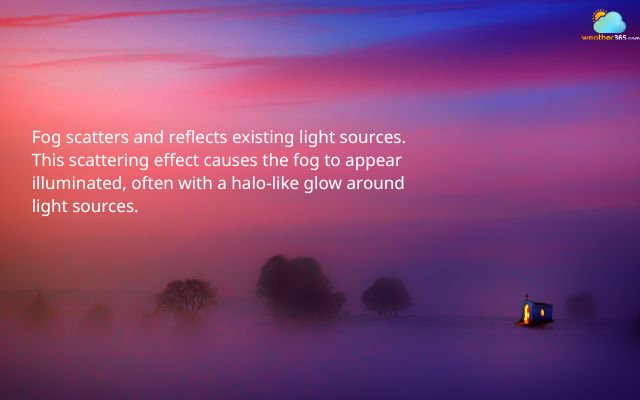
Scattering effect causes the fog to appear illuminated
Additionally, natural phenomena like bioluminescence can contribute to glowing fog. Certain marine organisms, such as bioluminescent algae, emit light when disturbed.
When these organisms are present in coastal waters, their glow can reflect off fog, creating an ethereal blue or greenish hue in the foggy atmosphere.
Fogbow
The last fact about fog is that fog can create a phenomenon called “fogbow”.
Unlike traditional rainbows, which are formed by larger water droplets, fogbows occur when sunlight interacts with the minuscule droplets found in fog, mist, or clouds.
When sunlight passes through water droplets smaller than 0.1 mm in diameter, the tiny droplets cause light to diffract, rather than refract as in larger raindrops.
This diffraction results in a pale, often colorless arc, with a faint red outer edge and a bluish inner edge.
The lack of vibrant colors is due to the overlapping of diffracted light waves, which diminishes the intensity of individual colors.
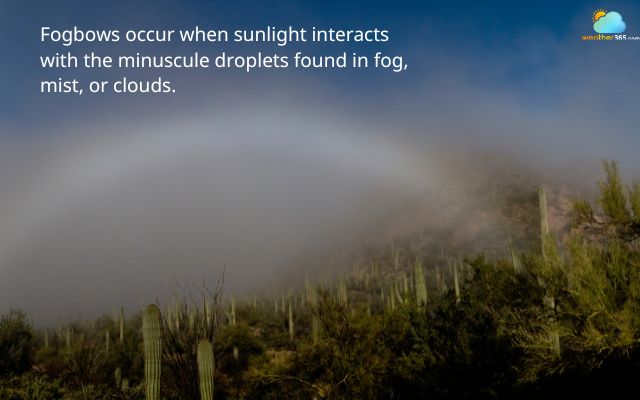
Fogbows occur when sunlight interacts with the minuscule droplets
To witness a fogbow, one must be positioned with the sun at their back, facing a foggy or misty area. The best conditions occur when sunlight illuminates dissipating fog, typically in the early morning or late afternoon.
Fogbows are most commonly observed in open fields, mountain valleys, or along coastlines where fog is prevalent.
Fogbows differ from traditional rainbows in several ways. They are generally wider and span a larger area of the sky. The colors are much fainter, often appearing as a white or pale arc.
In some cases, when the droplets are nearly uniform in size, multiple inner arcs or supernumerary bows may appear, displaying slightly stronger colors.
Conclusion
Now that you know fun fact about fog, you can see why it’s one of the most fascinating weather events to study. If you’re a weather enthusiast or just curious about cloudy mornings, get more updates and forecasts at Weather365.
Frequently Asked Questions (FAQs)
Related post
7 Common Types of Fog and What Makes Each One Unique
 266
266
 8
8
 4.7
4.7
 13/04/2026

What Is Fog? Understand Its Formation, Causes, and Impacts
229
8
4.6
06/04/2026

Boating in Fog: How to Navigate a Boat in Foggy Conditions and Stay Safe
205
8
4.7
01/04/2026

8 Comment
Ayden Cooper
The part about fog affecting your sense of speed is interesting. I can definitely see how driving in thick fog could mess with your perception.
Hunter Perez
I had no idea fog contains so little actual water. It looks so dense that I always assumed it was full of moisture.
Adonis Hill
Does fog always disappear from the ground upward?
weather365
Usually, yes. As the sun warms the ground, the lower part of the fog evaporates first while the upper layers can linger.
Nicholas Jackson
Why is fog so difficult to forecast compared with rain?
weather365
Fog can form in very small areas and change quickly with tiny shifts in temperature, humidity, wind, and cloud cover.
Derek Green
Can fog really provide enough water to be useful?
weather365
Yes. Fog collectors can capture tiny droplets, and they’ve been used in dry regions to provide water for communities and crops.
Leave a comment
Your email address will not be published. Required fields are marked *