




Weather Underground Alternative: Top Picks for Accurate Forecasts & Better Features


Ever felt like your weather app just isn’t as reliable as it used to be? You’re not alone. Many users are now looking for a better Weather Underground Alternative that offers more accurate forecasts and modern features. Scrolling down, we’ll help you find the right one without overcomplicating things.
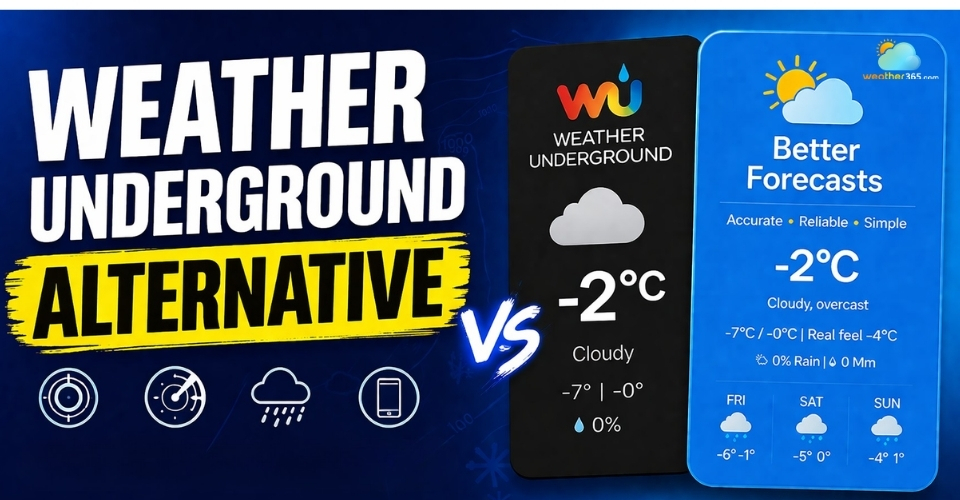
Weather Underground Alternative
Why is Weather Underground no longer a good choice?
For a long time, Weather Underground was a go-to platform for weather data. But in recent years, many users have started looking elsewhere, and not without reason.
One of the biggest turning points came when its free API was discontinued in 2018. This left many developers stuck, especially those running small projects or testing ideas.
What used to be an accessible tool suddenly became expensive and less flexible to work with.
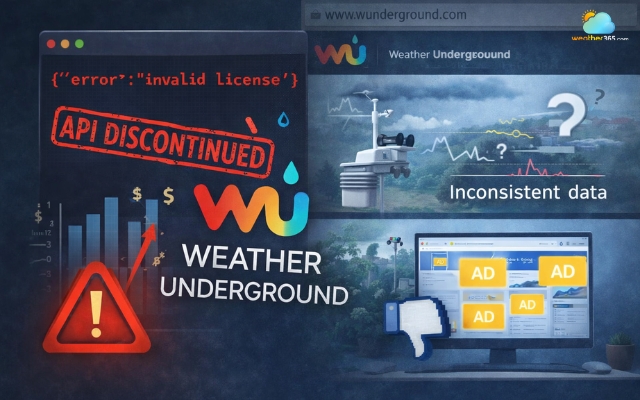
Weather Underground focused more on ads and less on usability
Another issue lies in how the platform handles data.
Weather Underground relies heavily on crowdsourced data from personal weather stations (PWS).
While this can be useful in dense urban areas, it often leads to inconsistent accuracy, especially in regions with fewer stations or uneven data quality.
On top of that, the user experience hasn’t aged particularly well.
Many users feel that the platform has become more focused on ads and less on usability, making it harder to access the detailed insights it was once known for.
Top Weather Underground Alternative
If you’re searching for a better option, the good news is you’re no longer limited to just one platform.
Today’s weather tools are more diverse, meaning the “best” Weather Underground Alternative really depends on what you need, whether that’s building an app, checking daily forecasts, or sharing data from your own weather station.
For developers
If you’re building an app or integrating weather data into a product, APIs matter more than anything else.
Ambee
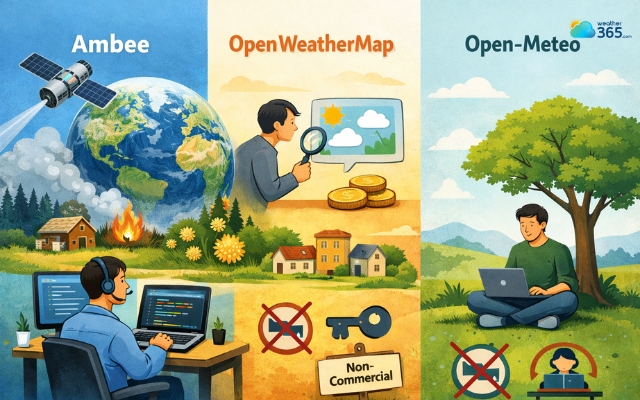
Ambee stands out for its high-precision, hyperlocal data (down to ~500 meters) and modern API structure.
It combines multiple data sources like satellites and AI models, which helps maintain consistent accuracy globally.
OpenWeatherMap
OpenWeatherMap is often the first choice for beginners thanks to its generous free tier and simple integration, though it may fall short when you need production-level accuracy.
Open-Meteo
Open-Meteo is a solid pick if you want something completely free and lightweight, especially for learning or small-scale projects.
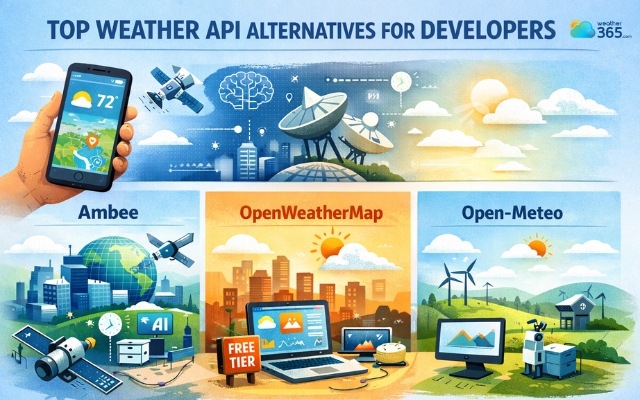
Three options for a weather underground alternative
If you’re still exploring more options beyond this list, you can also check out our guide to Weather Channel Alternative to compare even more tools side by side.
For Weather lovers
Not everyone needs APIs. If you just want a better way to track weather, usability and visualization become more important.
Platforms like WeatherCloud or tools built on modern APIs tend to offer cleaner dashboards, real-time updates, and better visualization compared to older systems.
They focus more on user experience rather than raw data access.
If you run a website, this is where tools like Weather365 come in. Instead of complex APIs, it focuses on ready-to-use weather widgets.
Moreover, features like auto-detect location and multi-location tracking can make a big difference, explore how they work in our Multi-Location & Auto-Detect Weather Widget guide.
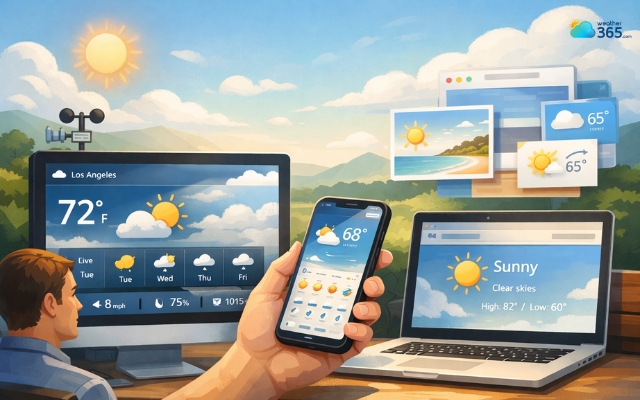
Some alternatives for weather lovers
For PWS owners
If your main goal is to upload and share data from your own weather station, you’ll need a completely different type of platform.
PWSweather and WeatherCloud are designed specifically for this purpose
They support direct data uploads from personal stations
They maintain active communities of weather enthusiasts
These platforms focus less on APIs and more on community-driven data sharing, which is exactly what many Weather Underground users originally loved.
For quick consideration, check the table below:
Platform | Best for | Key strengths | Limitations |
Ambee | Developers, businesses | Hyperlocal accuracy, multi-source data | API-focused, not for PWS uploads |
OpenWeatherMap | Hobby developers | Easy to use, large community | Accuracy varies by region |
Open-Meteo | Students, non-commercial projects | Free, no API key required | Limited support |
Visual Crossing | Analysts, researchers | Strong historical data | Less precise than specialized APIs |
WeatherCloud | Weather enthusiasts, PWS owners | Clean UI, community-driven | Limited API access |
Making your decision
The right Weather Underground Alternative really comes down to how you plan to use it and what matters most to you: accuracy, cost, or simplicity.
Choose Ambee if:
You need high-precision data for real-world applications
Your project requires global coverage, including rural areas
You want more than weather (air quality, pollen, wildfires)
You prefer a modern API with reliable support
Choose OpenWeatherMap if:
You’re working on a small project or learning
Budget is your main concern
You don’t need extremely detailed, hyperlocal data
Choose Open-Meteo if:
Your project is non-commercial
You want to skip API key setup entirely
You’re okay without dedicated support
Choose a suitable weather underground alternative
Sum up
Have you decided on your weather underground alternative? If you’re still unsure, try starting with the one that fits your current needs best. You can always switch later as your project or expectations grow.
Frequently Asked Questions (FAQs)
Related post
Multi-Location & Auto-Detect Weather Widget: A Must-Have for Modern Websites
 262
262
 8
8
 4.8
4.8
 17/08/2026
How to Embed Weather Widget on Any Site: Step-by-Step Guide
253
8
4.7
17/08/2026
Best Customizable Weather Widget To Add To Your Site
220
8
5.0
13/08/2026

8 Comment
Gracelyn Briggs
Accuracy is the biggest thing for me, especially when checking rain before cycling or planning outdoor activities. A forecast that looks good but misses local conditions isn't very useful.
weather365
I agree. It's worth comparing forecasts with actual conditions in your area over time. Local station coverage, forecast timing, and the weather variable you're checking can all make a difference.
Remington Hughes
The API options are useful to know about. I'm working on a small website project, but I'm still learning how APIs work. Is a free weather API usually enough to get started?
weather365
For a learning project, it often is. Just check the request limits, attribution requirements, and commercial-use terms before choosing a provider. You can always upgrade if your project grows.
Annabelle Meyer
I think the personal weather station side deserves more attention. For people who have invested in their own equipment, being able to share readings and compare them with nearby stations is a big part of the experience.
weather365
Absolutely. A replacement should ideally preserve that community aspect, not just provide another forecast. Platforms designed for uploading and sharing station data are worth exploring.
Blair Hill
I've used Weather Underground for years, so switching to another platform feels a bit strange. This guide is helpful because it explains that the best alternative really depends on what you use it for.
weather365
That's true! Someone who checks the daily forecast has very different needs from someone who manages a personal weather station. It's worth comparing tools based on your main use case first.
Leave a comment
Your email address will not be published. Required fields are marked *