




What Causes Thunderstorms? Explore the Science Behind Intense Events


Thunderstorms are some of nature’s most powerful displays, bringing lightning, heavy rain, strong winds, and even hail. But what causes thunderstorms to form? In this guide, we shall break down the key ingredients behind thunderstorms, their life cycle, and the regions and times they strike most often.
What causes a thunderstorm?
- What is Thunderstorm?
- What Causes Thunderstorms?
- Warm, Moist Air Near the Ground
- Unstable Air
- A Lifting Mechanism
- Cycle of a thunderstorm
- Cumulus Stage (Developing Stage)
- Mature Stage (Most Intense Stage)
- Dissipating Stage (Final Stage)
- Where Do Thunderstorms Occur Most Frequently?
- When Are Thunderstorms Most Likely to Occur?
- Over Land
- Over Oceans
- Spring and Fall
What is Thunderstorm?
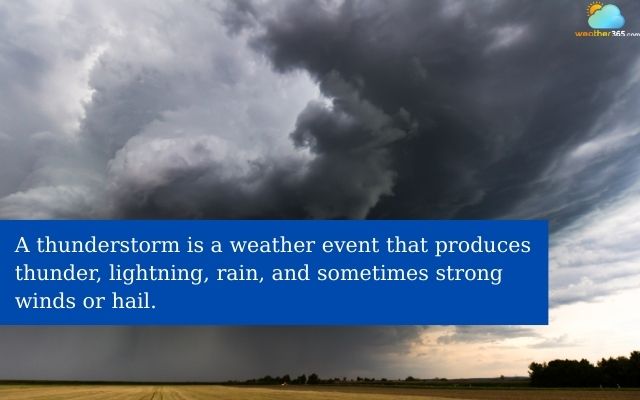
A thunderstorm is a weather event that produces thunder, lightning, rain, and sometimes strong winds or hail.
It happens when warm, moist air rises quickly into the atmosphere and forms large, towering clouds. Inside these clouds, water droplets and ice particles collide, creating electrical charges that result in lightning and thunder.
What is Thunderstorm?
Thunderstorms can vary in size and strength. Some are short and mild, while others grow into severe systems capable of causing heavy rain, damaging winds, or even tornadoes.
There are also different types of thunderstorms, such as single-cell storms, multi-cell clusters, squall lines, and supercells.
Each type forms under slightly different conditions and can bring different levels of intensity. You can explore these in detail in our guide on Types of Thunderstorms.
What Causes Thunderstorms?
Thunderstorms do not appear out of nowhere.
To form, they need a few essential elements in the air.
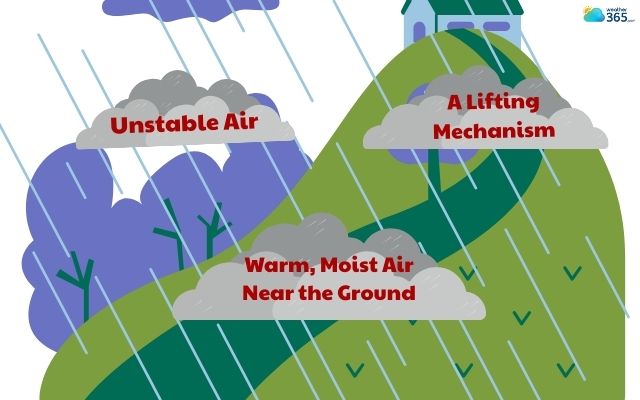
The main factors are warm, moist air near the ground, unstable air, and a lifting mechanism that pushes the air upward.
When these elements come together, towering storm clouds can quickly develop.
What are the causes of a thunderstorm?
Warm, Moist Air Near the Ground
The first ingredient for a thunderstorm is warm and humid air close to the Earth’s surface.
This moisture often comes from oceans, lakes, rivers, or humid land areas. It provides the “fuel” needed for clouds to grow and for rain to eventually fall.
Without enough heat and moisture near the ground, thunderstorms are unlikely to form.
Unstable Air
The second factor is unstable air.
This happens when warm air at the surface rises and cools quickly as it moves higher into the sky.
Because the air is lighter and less stable, it continues to move upward.

Warm air rises
This vertical movement helps storm clouds grow taller and stronger, leading to thunder, lightning, and heavy rain.
A Lifting Mechanism
Even with warm, moist, and unstable air, thunderstorms need a trigger to get started.
A lifting mechanism pushes the air upward into cooler layers of the atmosphere.
In fact, moisture, instability, and lift combine to produce heavy rain on Texas thunderstorm weather maps.
This can happen in different ways:
Frontal lifting
When a cold air mass collides with a warm air mass, the denser cold air wedges itself underneath the lighter warm air.
This forces the warm air to rise quickly, often creating strong thunderstorms along cold fronts.
Warm fronts can also lift air, but the process is slower and usually produces gentler but widespread storms.
Orographic lift
Geography can play a role, too.
When winds blow toward a mountain range or even large hills, the terrain forces the air upward.
As the air climbs higher, it cools and condenses, forming clouds and sometimes intense thunderstorms on the windward side of the slope.
Convection
On hot days, the sun warms the ground, and in turn, the air just above it.
Warmer air is lighter and starts to rise, creating strong upward currents.
If the air is moist and unstable, these rising parcels of air can rapidly grow into towering thunderclouds.
This is why summer afternoons, when the sun’s heating is strongest, often bring short but powerful thunderstorms.
Cycle of a thunderstorm
Every thunderstorm goes through a natural life cycle.
From the first signs of cloud growth to the moment the storm fades away, this process usually lasts less than an hour.
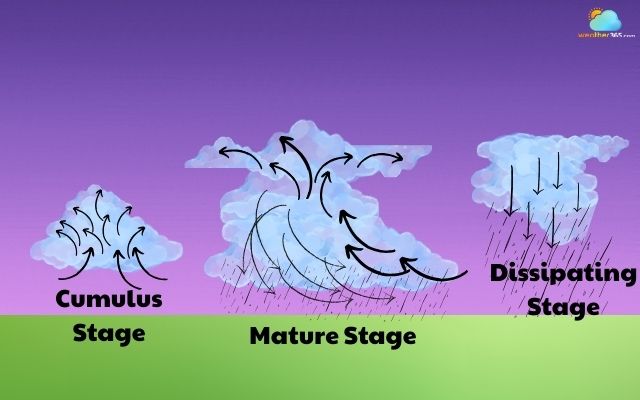
The cycle of a thunderstorm has three primary stages: the Cumulus Stage, the Mature Stage, and the Dissipating Stage.
Three stages of a thunderstorm
Cumulus Stage (Developing Stage)
The storm begins when warm, moist air near the ground starts rising, usually lasting about 10-20 minutes.
As this air ascends, it cools and condenses, forming cumulus clouds that grow taller with time.
At this early stage, there is no rain yet, and the weather may still feel calm, but the vertical growth of clouds sets the foundation for the storm.
Mature Stage (Most Intense Stage)
During the mature stage, which can last around 20-40 minutes, the cloud develops into a towering cumulonimbus.
Updrafts push warm, moist air upward while downdrafts of cooler air descend, causing heavy rain, lightning, thunder, and strong winds.
Sometimes hail forms as well.
This stage often lasts around 20-40 minutes, and is considered to be the most intense stage of a thunderstorm, since it combines all the storm’s energy in one place - intense winds, heavy rain, lightning, and hail.
Dissipating Stage (Final Stage)
In the final stage, lasting roughly 20 minutes or longer, downdrafts dominate, cutting off the supply of warm, moist air.
Rainfall slows and eventually stops, and the cloud gradually breaks apart.
The storm weakens but can still produce occasional lightning until it fully dissipates.
You may also like this: Difference between thunder and lightning
Where Do Thunderstorms Occur Most Frequently?
Thunderstorms are not evenly distributed around the world.
Certain regions experience them far more often due to the combination of heat, moisture, and atmospheric conditions.
Thunderstorms are most common in tropical and subtropical regions, where warm, moist air is abundant.
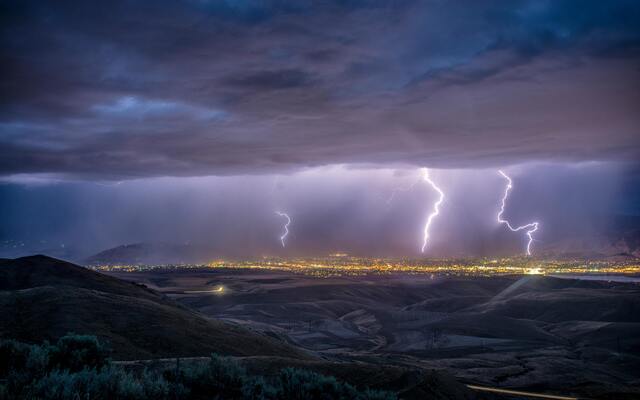
Where Do Thunderstorms Occur Most Frequently?
For example, Florida in the United States, Central Africa, the Amazon Basin in South America, and Southeast Asia see frequent thunderstorms throughout the year.
These areas provide the ideal conditions for clouds to build rapidly and produce storms.
When Are Thunderstorms Most Likely to Occur?
Thunderstorms also follow seasonal trends.
They are most frequent in the summer months, when temperatures are high and the air holds more moisture.
For example, the Gulf Coast and across the southeastern and western United States, particularly Florida, experience daily afternoon thunderstorms in summer.
Florida has even earned the nickname “Lightning Capital of the U.S.”
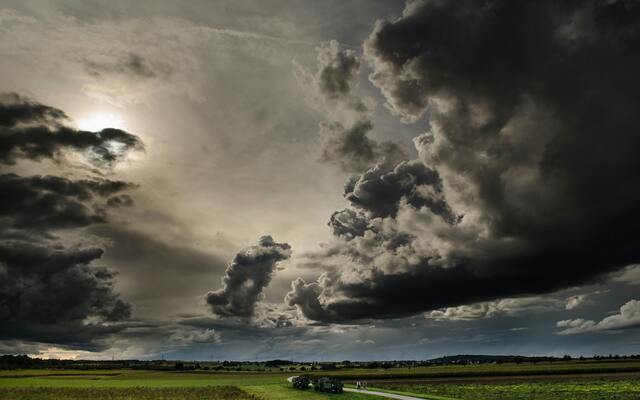
When Do Thunderstorms Most Likely to Occur?
Over Land
Thunderstorms are most likely in the afternoon and early evening, when the ground has absorbed maximum heat from the sun.
This heating creates powerful convection currents that lift moist air upward.
Regions like the Great Plains in the U.S. or central Africa near the Congo Basin often experience intense afternoon storms.
Over Oceans
Thunderstorms often peak just before sunrise, when atmospheric conditions allow rising moist air to create tall cloud systems.
The tropical Atlantic Ocean and the western Pacific near Southeast Asia are prime examples where early-morning oceanic storms are common.
Spring and Fall
While less frequent than summer storms, spring and autumn can still produce strong thunderstorms.
These are usually tied to cold fronts that sweep through and destabilize the atmosphere.
The U.S. Midwest and Tornado Alley, for instance, often see severe storms during spring, while southern Europe can experience autumn thunderstorms triggered by cooler air moving over warm seas.
Final thought
Learning what causes thunderstorms gives us clearer insight into how nature works. Thunderstorms form when warm, moist air rises and creates powerful atmospheric energy. Knowing these causes not only helps us stay safe during severe weather but also sparks a deeper appreciation for the forces driving our skies.
Frequently Asked Questions (FAQs)
Related post
What Is an Isolated Thunderstorm Compared to a Scattered One?
 1691
1691
 8
8
 4.7
4.7
 15/09/2026
Exploring Types of Thunderstorms and Their Unpredictable Impacts
1687
8
4.7
15/09/2026

What Is a Supercell Thunderstorm? Key Features and How It Forms
1385
8
4.8
15/09/2026

8 Comment
Bella Smith
What triggers a thunderstorm to form?
weather365
Warm, moist air rising into an unstable atmosphere is a key ingredient.
Ariel Webster
How long does it take for a thunderstorm to form?
weather365
Some can develop quite quickly when conditions are favorable.
Emma Green
Can thunderstorms form without hot weather?
weather365
Yes, if the atmosphere has enough moisture and instability.
Wynter Mills
I didn’t know wind shear could affect how thunderstorms develop. There’s more happening in the atmosphere than I thought.
Callie Horton
I never realized thunderstorms need several ingredients to develop. The combination of heat and moisture makes a lot of sense.
Leave a comment
Your email address will not be published. Required fields are marked *