




What Is the Heat Index and Why Does Humidity Make Heat Feel Worse?


What is the heat index, and why does a sunny day sometimes feel far hotter than the thermometer suggests? If you’ve ever struggled in sticky, humid heat, this hidden factor is the reason. Scrolling down this guide, you’ll discover how heat index works, and why it matters for your safety.
What is the heat index?
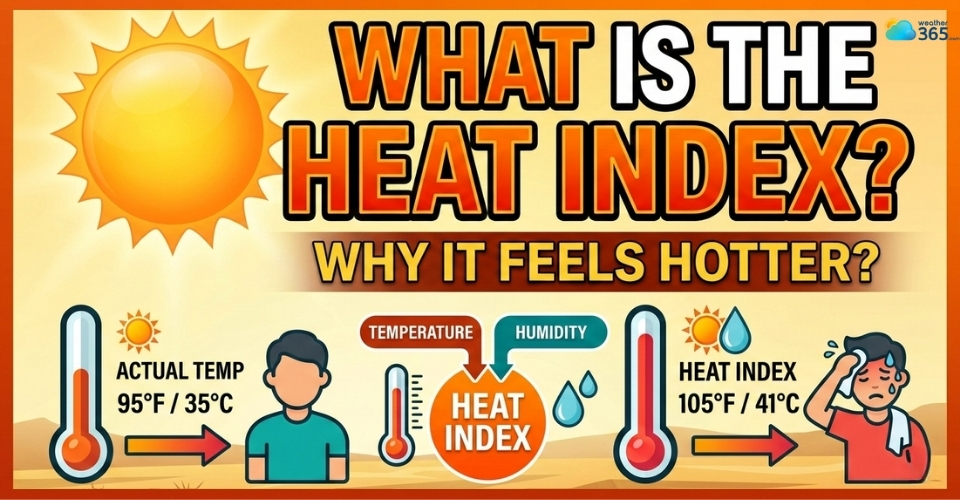
What Is The Heat Index?
Heat index is a way to describe how hot the weather actually feels to your body, not just what the thermometer shows.
The heat index combines air temperature and relative humidity to show real feel conditions, like checking the Louisiana heat index today.
Your body doesn’t experience heat in isolation. Humidity plays a major role in how comfortable (or dangerous) the heat feels.
That’s why a day at 32°C can feel manageable in dry air but completely exhausting when the humidity is high.
Explore what is considered high humidity here!
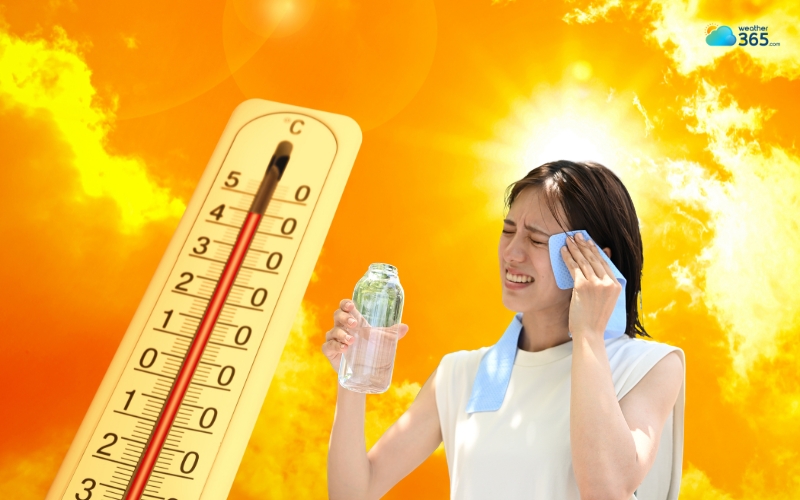
Heat index describe how hot actually feels to your body
To understand this better, you need to look at how your body cools itself.
Normally, your body releases heat through sweating. When sweat evaporates from your skin, it carries heat away, helping you stay cool.
This process is called evaporative cooling, and it’s your body’s natural defense against overheating.
However, when the air is already full of moisture, evaporation slows down. Sweat stays on your skin instead of evaporating, which means your body can’t release heat efficiently.
As a result, your internal temperature rises, and the weather feels much hotter than it actually is.
This is exactly what the heat index captures as it reflects the combined stress of heat and humidity on the human body.
Why The Heat Index Matters?
The heat index matters because it reflects how your body actually experiences heat. And in many cases, that difference can be the line between comfort and real health risk.
When humidity is high, your body struggles to cool itself through sweating. This means heat builds up faster than normal, putting extra strain on your system.
Even temperatures that seem “moderate” can become exhausting or dangerous when the heat index rises.
This is especially important during outdoor activities.
Whether you’re exercising, working, or simply walking outside, a high heat index can lead to dehydration, heat exhaustion, or even heatstroke much sooner than expected.
This makes the index crucial when you check what's the temperature for tomorrow before planning outdoor activities.
Relying solely on the standard forecasted degree often causes people to underestimate how intense the weather will actually feel, leading to unexpected heat stress.
Without it, many people underestimate how intense the weather really is.
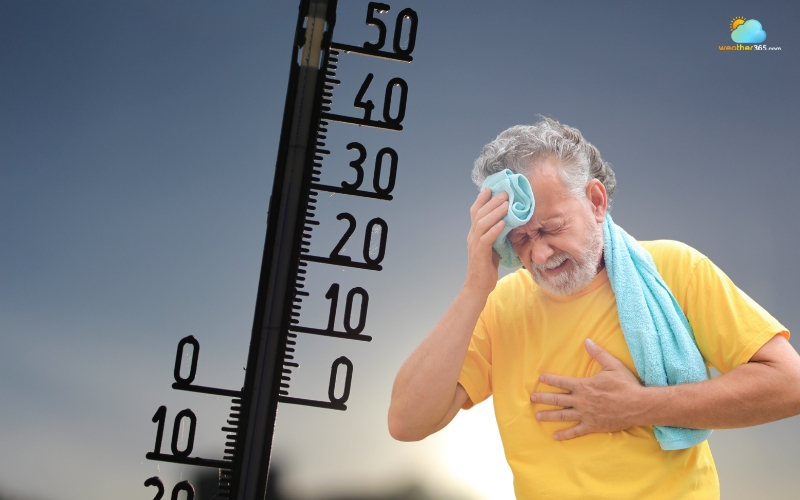
Moderate temperature can become exhausting or dangerous
Heat Index Chart
A heat index chart is a practical tool that shows how hot it feels based on the combination of temperature and humidity.
Instead of guessing, you can look at the chart to understand the real impact of weather on your body.
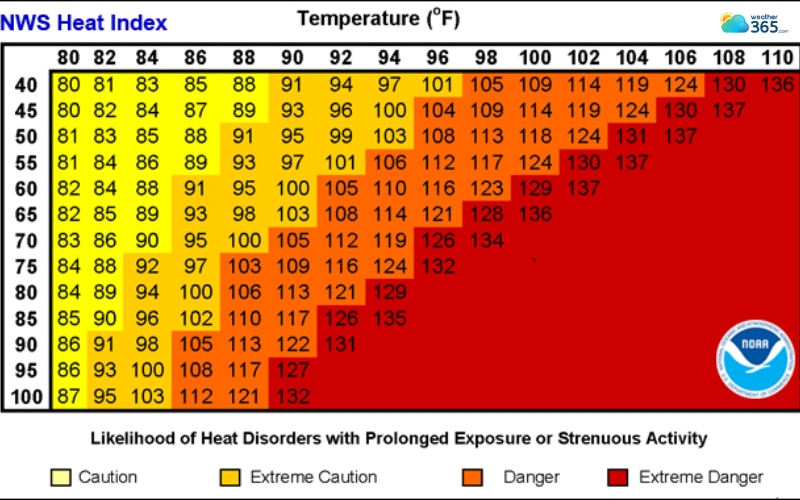
Heat index chart includes temperature and humidity
Source: National Weather Service
Here’s how it works: you find the air temperature on one axis and the relative humidity on the other. Where they intersect, you get the heat index value, often much higher than the actual temperature.
For example, 90°F with 70% humidity can feel like over 100°F, showing how quickly conditions can become dangerous.
Heat Index Risk Categories
Heat index values are grouped into different risk levels to help you quickly understand how dangerous the heat may be.
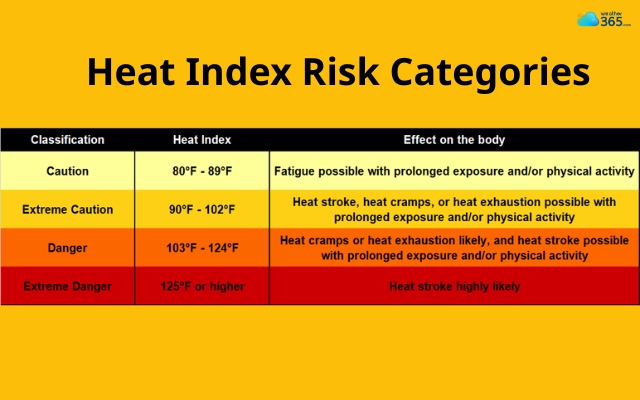
Pay attention to the danger of heat index
Who is most at risk?
In reality, not everyone experiences heat the same way. Some groups are much more vulnerable to high heat index conditions, even at lower levels.
Older adults and young children are especially at risk because their bodies are less efficient at regulating temperature.
People with chronic health conditions may also struggle more, particularly if their condition or medication affects hydration or circulation.
Then there are those exposed to heat for long periods - like athletes or outdoor workers. Their risk increases simply because of duration and intensity of exposure.
Even healthy individuals can develop heat-related illnesses if they push too hard in high heat index conditions.

Some people are more vulnerable to the heat than other
How Is Heat Index Calculated?
The heat index is calculated using a formula that combines air temperature and relative humidity to reflect how hot conditions actually feel to the human body.
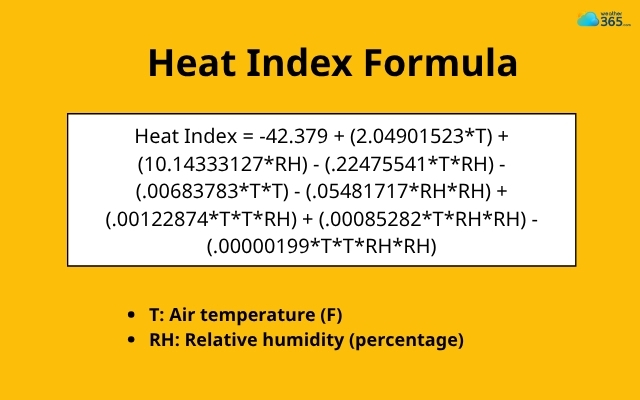
The complicated heat index formula
The idea is: The hotter the air and the higher the humidity, the harder it is for your body to cool itself.
But turning that idea into a precise number requires a more detailed equation developed by meteorologists, particularly the US National Weather Service.
Instead of a basic addition, the formula uses multiple terms to account for how temperature and humidity interact with each other.
In other words, humidity doesn’t just “add” to heat, it amplifies it, especially at higher temperatures.
That’s why the heat index rises much faster once both factors cross certain thresholds.
Let’s say the air temperature is 90°F (32°C) with 70% humidity. Based on the formula, the heat index would be:
Heat Index = -42.379 + (2.04901523*90) + (10.14333127*70) - (.22475541*90*70) - (.00683783*90*90) - (.05481717*70*70) + (.00122874*90*90*70) + (.00085282*90*70*70) - (.00000199*90*90*70*70)
= 105°F (40°C)
Heat Index vs “Feels Like”
The heat index and “feels like” temperature seem identical, and in hot weather, they often are. But there’s a small difference.
Is there difference between heat index and “feels like”?
The heat index is specifically used in warm conditions, combining temperature and humidity to show how hot it feels when your body struggles to cool itself.
Meanwhile, “feels like” temperature is a broader concept. It describes how the weather is perceived overall, taking into account different factors depending on the season:
In hot weather → it’s usually based on the heat index
In cold weather → it includes wind chill, which makes it feel colder
In other words, the heat index is just one part of the bigger “feels like” picture.
If you want a deeper breakdown, check out our full guide on heat index vs feels like to understand exactly how they differ in real-world conditions.
How to Stay Safe During High Heat Index Conditions?
When the heat index rises, your body is no longer dealing with just hot weather, but also real stress.
That’s why staying safe isn’t about one quick fix, but a combination of small, smart habits that help your body cope with heat more effectively.
Keep your body cool
The first priority is keeping your body cool. Spending time in air-conditioned spaces can make a huge difference, even for a few hours.
If that’s not available, staying in the shade, using fans, or taking cool showers can help lower your body temperature and prevent overheating.
Keep hydration
Equally important is hydration. Your body loses a lot of fluids through sweat, especially in humid conditions where cooling is less efficient.
Drinking water regularly, even before you feel thirsty helps maintain your body’s ability to regulate temperature.
Avoid alcohol or sugary drinks, as they can actually worsen dehydration.
Limit outdoor activity
Timing your activities also plays a key role. The heat index is usually highest during midday, so limiting outdoor activity to early morning or evening can significantly reduce risk.
If you must be outside, take frequent breaks and avoid pushing your body too hard.
Choose suitable clothes
Clothing might seem like a small detail, but it matters more than you think. Lightweight, loose-fitting, and light-colored clothes help reflect heat and allow better airflow, making it easier for your body to stay cool.
Pay attention to symptoms
Finally, always pay attention to warning signs from your body. Symptoms like dizziness, nausea, headache, or unusual fatigue can be early signs of heat-related illness.
Ignoring them can quickly lead to more serious conditions like heat exhaustion or heatstroke.

Stay hydrated to regulate temperature
Final Thought
What is heat index, and why should you care about it? Long story short, heat index reflects how heat and humidity truly impact your body. By understanding it, you can better plan your activities, avoid hidden risks, and stay safe during extreme weather conditions.
Frequently Asked Questions (FAQs)
Related post
What's The Temperature For Tomorrow? A Simple Guide to Tomorrow’s Forecast
 566
566
 8
8
 4.7
4.7
 18/08/2026
What Is Air Temperature? Definition, Measurement, and Key Factors
432
8
4.8
18/08/2026
What Is 0 Degrees Celsius In Fahrenheit? An Accurate Answer
250
8
4.7
18/08/2026

8 Comment
Jessica Harrison
I used to think the temperature on the forecast told the whole story. Humidity can really change how hot the air feels.
Hailey Schultz
The heat index is one of those weather numbers that becomes much more useful once you understand what it actually represents.
Giselle Holmes
When is the heat index most useful?
weather365
It’s especially useful during hot and humid weather, when the combination can make outdoor conditions feel significantly hotter than the actual temperature.
Hannah Clark
Is the heat index the same as the actual air temperature?
weather365
No. It’s a measure of how hot conditions may feel when humidity is taken into account.
Gracie Anderson
What does the heat index tell you?
weather365
It estimates how hot conditions feel to the human body by combining air temperature and humidity.
Leave a comment
Your email address will not be published. Required fields are marked *