




Heat Index Vs Feels Like: The Ultimate Guide To How They Differ


What does heat index vs feels like really mean when you check the weather each day? You might see one temperature on the screen, but feel something completely different outside. This guide will help you understand why that happens and how these two terms affect your daily experience. Diving in!
Heat index vs feels like
- What Is The Heat Index?
- What Is The ‘Feels Like’ Temperature?
- How ‘Feels Like’ Temperature Is Calculated?
- Difference Between Temperature and Feels Like Temperature
- Heat Index Vs Feels Like
- How They Relate to Each Other?
- What Happens in Different Seasons
- Why Feels Like Temperature Is Crucial For Outdoor/Wind Sports?
- Reflects Real Physical Stress on Your Body
- Helps You Choose the Right Gear
- Improves Performance and Endurance
- Reduces Health Risks
What Is The Heat Index?
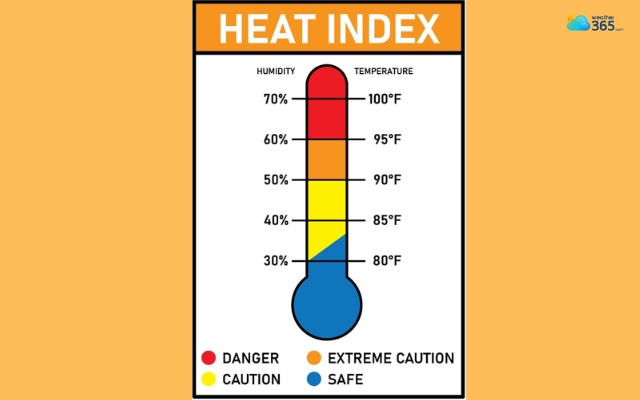
Heat index is a number that adjusts the air temperature based on humidity to show how hot it actually feels to your body.
When the air is humid, sweat doesn’t evaporate efficiently, and that’s a big deal because evaporation is how your body cools itself.
When that process slows down, your body holds onto more heat, making the weather feel much hotter than the actual temperature.
Heat index measures the ‘real’ heat to your body
This is why the heat index matters beyond just numbers on a weather app, it’s closely linked to how comfortable or stressed your body feels outdoors.
For example, a dry 32°C day might feel manageable because your sweat can evaporate and cool you down.
But when humidity rises, that same 32°C can quickly feel like 38°C or even higher.
As a result, your body heats up faster, increasing the chances of dehydration, heat exhaustion, or in more serious situations, heatstroke.
To help people understand this better, meteorologists often use heat index charts.
These charts illustrate how different levels of temperature and humidity combine to create a “feels hotter” effect, giving you a clearer picture of what to expect when you step outside.
Curious about this magic chart? Drop by What is heat index for more!
What Is The ‘Feels Like’ Temperature?
The “feels like” temperature is designed to reflect how the weather actually affects your body, not just what the thermometer shows.
It takes into account factors like humidity, wind, and sunlight to give a more realistic sense of how hot or cold it feels outdoors.
Your body is always exchanging heat with its surroundings. That’s why two days with the same temperature can feel completely different depending on the conditions.
For instance, 30°C with a light breeze and dry air can feel quite comfortable. But if that same 30°C comes with high humidity and still air, it can quickly become exhausting.
The “feels like” temperature exists to capture exactly that difference in real-world experience.
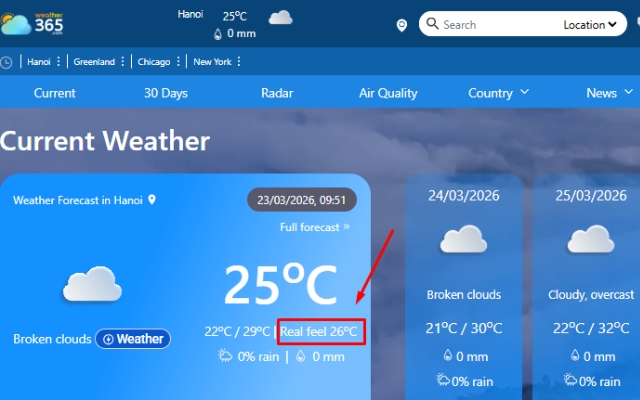
Weather 365 provides the feels-like/real feel temperature
How ‘Feels Like’ Temperature Is Calculated?
There isn’t a single fixed formula behind the “feels like” temperature. Instead, meteorologists use different models depending on the weather conditions to get the most realistic estimate.
In warmer conditions, the calculation is largely based on the heat index, where humidity plays a major role in how hot it feels.
In colder weather, the focus shifts to wind chill, which shows how wind can pull heat away from your body and make the air feel colder than it actually is.
But it doesn’t stop there. A more complete “feels like” value can also factor in elements like wind speed, moisture in the air, sunlight intensity, and even cloud cover.
All of these are used together to better represent how your body gains or loses heat outdoors.
So rather than thinking of it as a single equation, it’s more accurate to see the “feels like” temperature as a combined estimate, one that brings multiple weather factors together to reflect what you’ll truly experience outside.
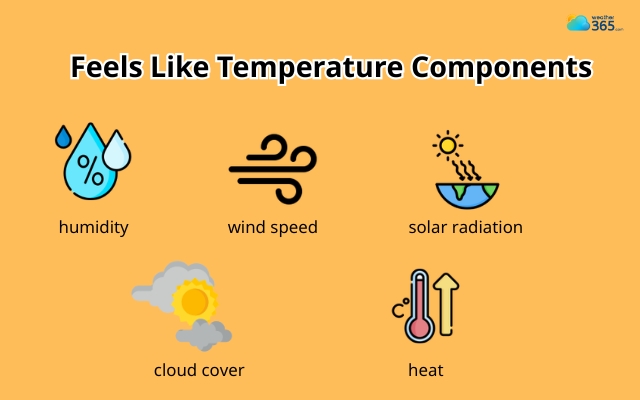
Feels like temperature combines different weather factors
Difference Between Temperature and Feels Like Temperature
The difference between these two is quite simple: one measures the temperature, the other describes how it feels.
You might want to understand what air temperature is before learning the difference between these two types of temperature!
Actual temperature is just a number from a thermometer. It’s measured in controlled conditions, usually in the shade and away from things like wind or direct sunlight.
“Feels like” temperature is different. It tries to show what the weather actually feels like to your body.
Instead of just giving a number, it answers a more useful question: what will it feel like when you step outside?
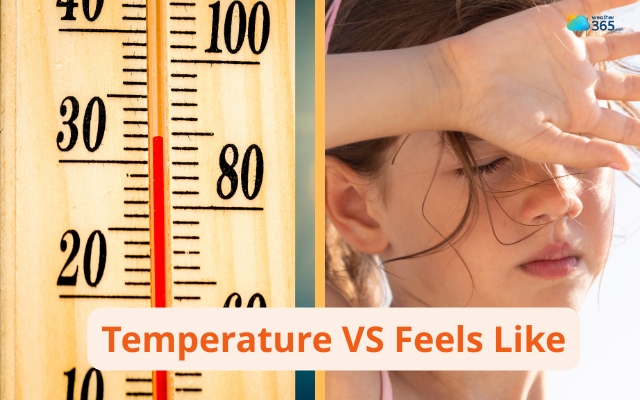
The difference between temperature and feels like temperature
Heat Index Vs Feels Like
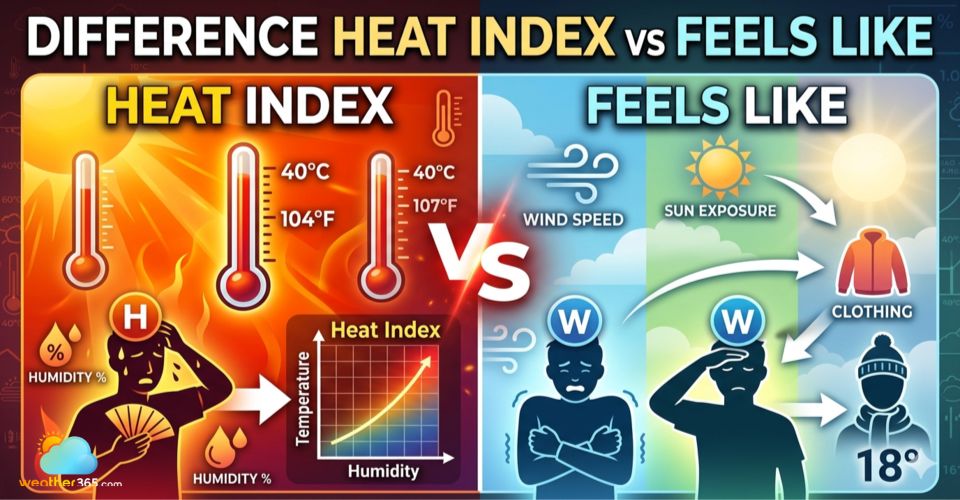
Heat index and feels like temperature may sound the same at first because both describe how the weather feels, not just what the thermometer shows.
But if you look a bit closer, they are actually different and are used in different ways.
How They Relate to Each Other?
The heat index is mainly used in hot weather. It looks at just two things: air temperature and humidity.
When the air becomes more humid, your sweat cannot evaporate easily, so your body has a harder time cooling down.
That’s why the heat index goes up, and the weather feels hotter.
“Feels like” temperature is more general. It may use the heat index in summer, but it also includes other factors like wind and sunlight.
Because of that, it gives a more complete idea of how the weather actually feels to your body.
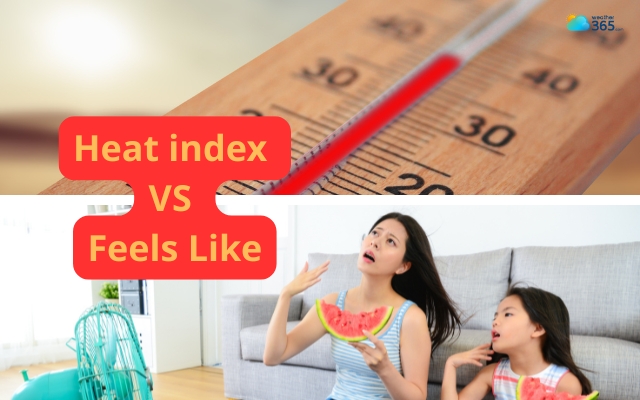
How heat index differs from feels like temperature
What Happens in Different Seasons
The difference between these two becomes easier to see when the seasons change.
In summer, they often move in the same direction.
When humidity is high, both the heat index and the “feels like” temperature go above the actual temperature.
High humidity inflates real-feel values above actual temps on Florida feels like temperature reports.
That’s why a day at 32°C can feel closer to 38°C or even hotter.
But in winter, the heat index is no longer useful. Instead, the “feels like” temperature is affected by wind chill.
When strong winds blow, they take heat away from your body faster, making the air feel much colder than it really is.
If you want to understand wind chill better, you can explore it in more detail here.
To keep it simple, remember this:
Heat index = how hot it feels because of humidity
Feels like = how the weather actually feels, based on many factors
Heat Index | Feels Like temperature | |
Definition | How hot it feels when humidity is added to air temperature | How the weather actually feels to the human body |
Main purpose | Estimate heat stress in hot conditions | Reflect overall human comfort in all weather conditions |
Applies to | Only warm or hot weather | All seasons (summer and winter) |
Key factors included | Air temperature + humidity | Temperature, humidity, wind speed, sun exposure, cloud cover |
Role of humidity | Central factor | One of several contributing factors |
Role of wind | Not included | Very important |
Seasonal behavior | Used mainly in summer | Used year-round |
Winter relevance | Not applicable | Includes wind chill (cold feels colder with wind) |
Complexity | Based on a fixed formula | Uses multiple models depending on conditions |
Accuracy for Human Experience | Limited (only heat-related) | More accurate overall |
Typical use in forecasts | Heat warnings, health alerts | Daily weather apps and general forecasts |
Why Feels Like Temperature Is Crucial For Outdoor/Wind Sports?
If you spend time outdoors, especially doing sports, you quickly realize that the number on the weather app doesn’t always match what your body experiences.
That’s where feels like temperature becomes far more useful than the actual temperature.
When you’re running, cycling, hiking, or out on the water, your body is constantly exchanging heat with the environment.
Wind, humidity, and sun exposure don’t just change comfort, they directly affect your performance, endurance, and even safety.
Reflects Real Physical Stress on Your Body
During outdoor activities, your body generates heat. To stay balanced, it needs to release that heat efficiently.
But environmental conditions can either help or block that process.
On a hot, humid day, sweat doesn’t evaporate well, so your body overheats faster.
Even if the temperature seems manageable, the feels like temperature can reveal a much higher level of stress.
This is why athletes often feel exhausted sooner than expected in humid conditions.

Athletes often feel exhausted sooner than in humid conditions
On the other hand, in windy or cold environments, your body loses heat rapidly.
The air may not look dangerously cold, but strong wind can make it feel much colder, increasing the risk of muscle stiffness or even hypothermia.
Helps You Choose the Right Gear
If you rely only on actual temperature, it’s easy to dress wrong.
For example, 15°C might sound mild. But if it’s windy, it can feel closer to 10°C or lower.
Without proper layers, you may feel uncomfortably cold throughout your activity.

Wind chill makes it colder than the actual temperature
In contrast, a sunny 25°C day with little wind can feel significantly hotter, meaning lighter, breathable clothing becomes essential.
For wind sports like sailing, kitesurfing, or windsurfing, this becomes even more critical.
Wind not only affects performance, but it also dramatically changes how cold or warm you feel on the water.
Improves Performance and Endurance
Your body performs best within a certain temperature range.
When conditions feel too hot or too cold, your energy is diverted from performance to basic survival, cooling down or staying warm.
By checking the feels like temperature, you can better plan when to train, how intense your workout should be, or how long you can safely stay active.

Improving performance by checking feels like temperature
Reduces Health Risks
Ignoring how the weather feels can lead to serious consequences. In hot conditions, a high feels like a signal of increased risk of dehydration, heat exhaustion, and heatstroke.
In cold and windy conditions, it warns about Rapid heat loss, frostbite (in extreme cases), or reduced coordination and injury risk.
Because it combines multiple environmental factors, feels like temperature acts as an early warning system to help you recognize danger before it becomes obvious.

Feels like temperature can help reduce health risks
Final Thought
Heat index vs feels like may seem similar, but they serve different purposes. While the heat index focuses on humidity and heat, feels like temperature gives a more complete picture of how weather truly affects your body. Understanding both helps you stay safe, plan better, and respond more accurately to changing outdoor conditions.
Frequently Asked Questions (FAQs)
Related post
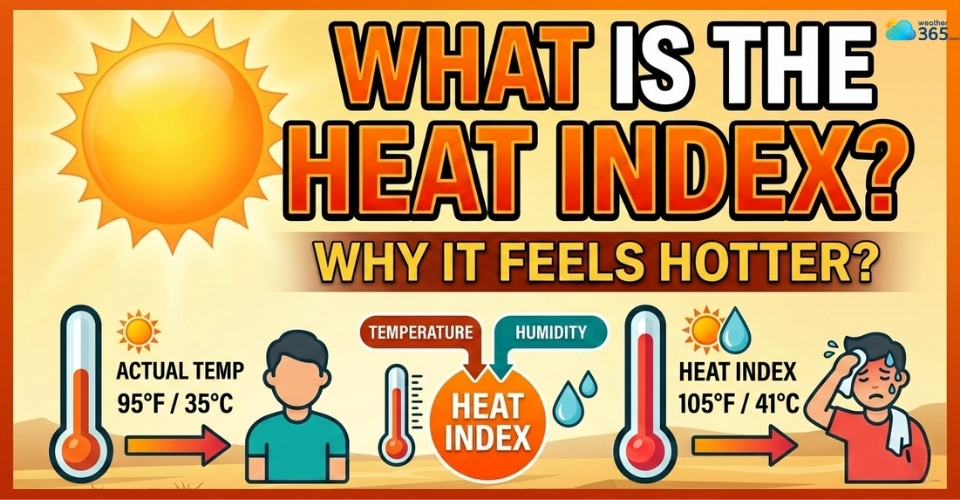
What Is the Heat Index and Why Does Humidity Make Heat Feel Worse?
 1547
1547
 8
8
 4.9
4.9
 18/08/2026
What's The Temperature For Tomorrow? A Simple Guide to Tomorrow’s Forecast
566
8
4.7
18/08/2026

8 Comment
Marcus Smith
This is a useful distinction. “Feels like” sounds simple, but there’s actually more going on behind that number than I realized.
Harrison Webster
I’ve definitely underestimated a hot day because I only looked at the actual temperature. Now I’m going to check the feels-like value too.
Erik Green
Is “feels like” always the same as the heat index?
weather365
Not necessarily. “Feels like” can be a broader term, while heat index specifically describes the combined effect of heat and humidity.
Jack Mills
Should I pay attention to the heat index before spending a long time outdoors?
weather365
Definitely, especially on hot and humid days, because it gives a better idea of how stressful the conditions may feel.
Christian Horton
Is the heat index basically a “feels like” temperature?
weather365
Yes, in hot conditions, the heat index estimates how hot it feels by considering both temperature and humidity.
Leave a comment
Your email address will not be published. Required fields are marked *