




Biggest Hailstorm Ever In US History: Top Record-Breaking Hail Events


Do you know what is the biggest hailstorm ever in US history? It is what happened in Vivian, South Dakota, in 2010, where a record-breaking hailstone was discovered. But that’s only part of the story because the biggest hailstorm is not always about size. Keep reading to explore more interesting information about this.
Want the science behind giant hail? How does hail form

Biggest Hailstorm Ever in the US
- Biggest hailstorm ever in the US
- Key Facts
- Damage from Vivian hailstorm
- Costliest hailstorm in the US
- Unprecedented Damage
- Widespread Destruction
- Largest hailstone accumulation in the US
- Seldon, Kansas - June 3, 1959
- Clayton, New Mexico - August 13, 2004
- US Hailstorm Hotspots
- Hail Alley
- The Great Plains
- The Midwest
Biggest hailstorm ever in the US
When we talk about the biggest hailstorm ever in the US, most people imagine a single, enormous chunk of ice crashing down from the sky.
In many ways, that image is true because one storm in particular left behind exactly such a record: On July 23, 2010, a supercell over Vivian, South Dakota, did not just bring strong winds and heavy rain - it produced the largest hailstone ever officially measured in the United States.
This event has since become the benchmark whenever record-breaking hail is discussed.
Key Facts
Size and Weight: The hailstone from Vivian measured 8.0 inches (~ 20 cm) across, with a circumference of 18.625 inches (~ 47 cm). It tipped the scales at 1.9375 pounds (~ 0.88 kg), making it the heaviest hailstone ever recorded in the US.
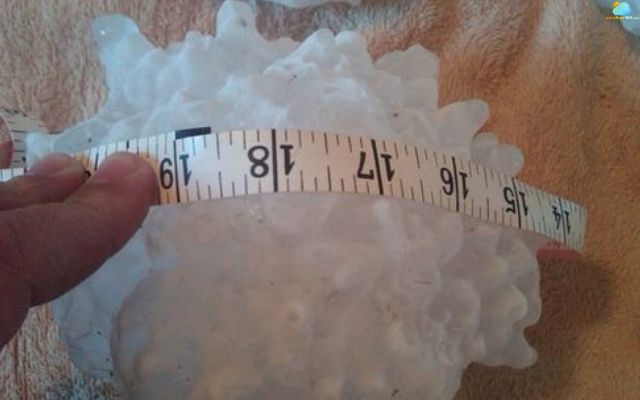
Gigantic hailstone in Vivian, South Dakota
Storm Environment: The hail formed inside a supercell thunderstorm - the type of storm with powerful rotating updrafts strong enough to keep hail suspended as it grows. On that summer evening, the atmospheric setup over central South Dakota created the perfect conditions for giant hail formation.
Multiple Giant Stones: Vivian residents did not just see one monster hailstone: reports confirmed several stones larger than 6 inches in diameter, each capable of smashing roofs, windows, and vehicles.
Impact on the Ground: The most famous stone left a 10-inch-wide divot in the ground where it landed, physical evidence of the massive energy behind its fall.
To confirm the record, the National Climate Extremes Committee (NCEC) reviewed detailed measurements, photos, and handling of the stone.
Their investigation ensured that Vivian hailstone officially replaced the previous US records for both diameter and weight.
Before this, the largest diameter record belonged to a hailstone found in Aurora, Nebraska, on June 22, 2003, measuring 7.0 inches (~18 cm) across.
The heaviest hailstone on record was from Coffeyville, Kansas, on September 3, 1970, weighing 1.67 pounds (~0.76 kg).
Damage from Vivian hailstorm
The Vivian hailstorm on July 23, 2010, was recorded not only for its giant hailstone but also for its lasting impact on the town.
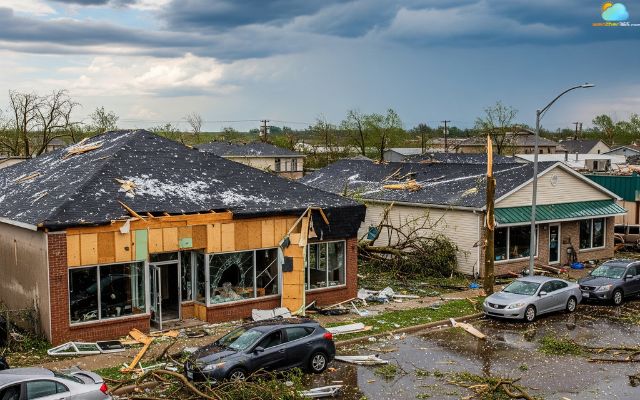
Vivian Hailstorm 2010 heavily affected the local community
Buildings, vehicles, and crops were all heavily affected as the storm swept across central South Dakota. Roofs were dented, windows shattered, and siding was torn from homes and businesses.
Vehicles bore deep indentations, and some were rendered unusable due to the size and force of the hail.
Strong winds accompanying the storm worsened the damage, blowing debris into structures and uprooting trees. In some areas, the hailstorm combined with flash flooding from heavy rain, creating further hazards and complicating cleanup efforts.
Emergency services quickly mobilized to assist residents, assess damage, and coordinate immediate repairs. State and local agencies provided support, and recovery efforts continued for weeks after the storm.
Despite the widespread property damage, there were remarkably few injuries. Residents reported cuts from broken glass and minor bruises from hail impacts, but the community was fortunate compared to the potential risk posed by such massive hail.
Besides the South Dakota 2010 hailstorm, others in different states also report huge hailstones dropped with a diameter range from 3 to almost 8 inches.
Even though these hailstones did not break Vivian’s record, it showed that hailstorms become more and more dangerous over the years.
State | Year | Hail Size |
Alabama | 2018 | 5,38 inches |
Hawaii | 2012 | 4,25 inches |
Illinois | 2015 | 4,75 inches |
Kansas | 2010 | 7,75 inches |
Minnesota | 1968 | 6,0 inches |
Nebraska | 2003 | 7 inches |
Oklahoma | 2011 | 6 inches |
South Dakota | 2010 | 8 inches |
Vermont | 2009 | 3,3 inches |
Wisconsin | 1921 | 5,7 inches |
Official Largest Hailstones Reported by State
If hail hits your area, follow these steps Hail safety tips
Costliest hailstorm in the US
While Vivian, South Dakota, holds the record for the largest hailstone ever, the title of costliest hailstorm goes to a different event.
On April 10, 2001, the Tristate Hailstorm swept across Missouri, Illinois, and Kansas, leaving behind billions in damage.
Unlike Vivian, this storm is recorded for its widespread destruction, massive insurance claims, and lasting economic impact, showing that the “biggest” hailstorm is not always about size alone.

Tristate Hailstorm is the costliest hailstorm in the US
Unprecedented Damage
The storm's impact was severe, with insured losses totaling approximately $1.5 billion. In Missouri alone, there were:
120,000 residential property claims
Roofs were shredded by hailstones, leaving many homes exposed to rain and secondary water damage.
Windows and siding took direct hits, forcing thousands of families to deal with costly repairs and temporary relocations.
For some neighborhoods, nearly every house bore visible scars from the storm.
65,000 automobile claims
Cars became easy targets under the storm’s relentless hail. Many vehicles suffered shattered windshields and deep body dents, while others were declared total losses.
Parking lots at shopping centers and car dealerships looked like scrapyards overnight, illustrating how quickly hail can cripple transportation.
8,000 commercial claims
Businesses weren’t spared either. Warehouses and offices experienced collapsed ceilings from water intrusion after hail punctured roofs.
Retail stores faced broken glass and damaged inventory, forcing some shops to close for weeks. For small businesses, the financial setback proved especially devastating.

The Tristate Hailstorm caused unprecedented damage
Widespread Destruction
The hailstorm produced hailstones up to baseball size, with some areas experiencing hail up to 3 inches in diameter.
The storm's path spanned approximately 245 miles and was up to 22 miles wide, affecting densely populated regions and causing extensive property damage.
Beyond residential and commercial damage, the storm also affected transportation infrastructure.
At Lambert International Airport in St. Louis, 22 jetliners sustained hail damage, and 10 Missouri National Guard aircraft were also affected.
Additionally, numerous vehicles at dealerships and manufacturing plants were destroyed, further escalating the economic toll.

Numerous vehicles were destroyed during the Tristate Hailstorm
Largest hailstone accumulation in the US
While the size of individual hailstones often makes headlines, accumulation can be just as destructive. In some storms, hail falls in such extraordinary volumes that it transforms landscapes, blocks roads, and leaves lasting ice deposits.
Two of the most significant US examples occurred in Seldon, Kansas, and Clayton, New Mexico.
Seldon, Kansas - June 3, 1959
The 1959 Seldon storm remains one of the most dramatic examples of hail piling up on flat ground in US history. Unlike the “biggest hailstone ever” events that are measured by size, this storm is remembered for the sheer volume of ice it unleashed.
Unrelenting storm duration: The hail fell for nearly an hour and a half, a long period by thunderstorm standards. That consistency allowed the ground to accumulate layer upon layer of ice, with little time for melting or drainage.
Depth of ice: By the time the storm ended, level ground in and around Seldon was buried under 18 inches (46 cm) of hail. Imagine nearly knee-deep ice across an entire town.
Widespread coverage: The storm affected roughly 70 square miles, creating a frozen landscape in the middle of June. Fields, roads, and neighborhoods all disappeared under the white sheet of hail.
Weight of hail: A truck scale was used to measure the mass of hail on the ground. In one test, 28,000 pounds were recorded on a platform only 10 feet by 45 feet wide. That translates to more than 60 pounds of ice pressing down on every square foot - heavy enough to crush crops and damage roofs.
Damage and disruption: Trees were stripped of leaves, farm fields were shredded, and buildings with weak or shallow roofs collapsed under the unexpected weight. Roads were blocked by the icy drifts, leaving the town nearly immobilized until cleanup crews could respond.

The 1959 Seldon storm is one of the most dramatic hail accumulation events
Clayton, New Mexico - August 13, 2004
The Clayton event shows another way hail can create astonishing accumulations: through interaction with rain and terrain.
While the stones themselves were not record-sized, the combination of weather and landscape turned the storm into one of the strangest ice events ever observed in the US:
Initial accumulation: Around 12 inches of hail blanketed the area during the thunderstorm itself. Already enough to halt traffic, this would have been memorable on its own.
Flooding interaction: The storm also produced about 5 inches of rain. Water flowing downhill swept the hail into low-lying channels known as draws, concentrating the ice into specific areas.
Massive ice pileup: In one of these draws, a culvert clogged, preventing water and hail from moving further downstream. Behind it, the hail built up into a wall more than 15 feet (4.6 meters) deep.
Longevity: These ice cliffs lasted for nearly a month, despite daytime summer temperatures. The sheer volume insulated the lower layers, slowing the melt. Residents reported seeing “frozen rivers” of hail long after the skies cleared.
Visual impact: Reports described vertical walls of ice several feet thick, mixed with mud and debris. Some piles were 25 feet wide and stretched more than 100 yards long. To locals, it looked like the aftermath of a landslide frozen in time.
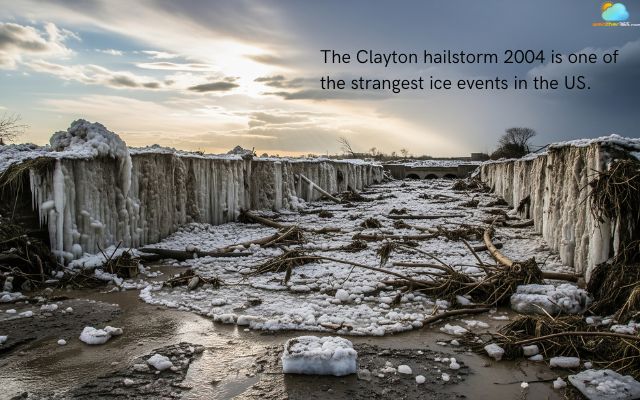
The Clayton Hailstorm left a devastating condition
US Hailstorm Hotspots
Not all parts of the United States face hail with the same intensity.
Meteorologists have identified three major “hotspots” where hailstorms are most frequent and damaging: Hail Alley, the Great Plains, and the Midwest.
These areas not only endure more storms but also experience larger stones and greater property losses compared to other regions.
Hail Alley
Hail Alley, spanning eastern Colorado, western Nebraska, and southeastern Wyoming, is widely regarded as the nation’s hail capital.
The Rocky Mountains play a crucial role, forcing moist air from the Gulf of Mexico upward to meet dry western air, creating the strong updrafts needed for hail formation.
Cities such as Denver and Colorado Springs frequently experience hail events, with some storms producing softball-sized hailstones.
A notable example occurred on May 8, 1990, in Denver, when a storm produced hail up to 2.5 inches in diameter, damaging thousands of vehicles and homes.
The high frequency of storms, combined with urban density, results in regular property damage and significant insurance claims, making Hail Alley a key focus for hail research and forecasting.

Car damaged due to hailstones in Denver
The Great Plains
The Great Plains, covering Texas, Oklahoma, Kansas, and Nebraska, are particularly susceptible to severe hail.
This is most due to the collision of warm, moist Gulf air with cooler, dry air that descends from the Rockies.
Flat terrain allows storms to expand and persist, producing some of the largest hailstones recorded in US history.
For instance, the Tristate Hailstorm of April 10, 2001, which affected eastern Kansas, Missouri, and Illinois, is one of the costliest US hailstorms on record.
In Kansas, the storm produced hailstones up to 2.75 inches in diameter and caused widespread crop and property damage.
Urban areas, including Dallas, Oklahoma City, and Omaha, face repeated damage to homes and vehicles, while the combination of population centers and vast agricultural lands amplifies the economic consequences of each storm.
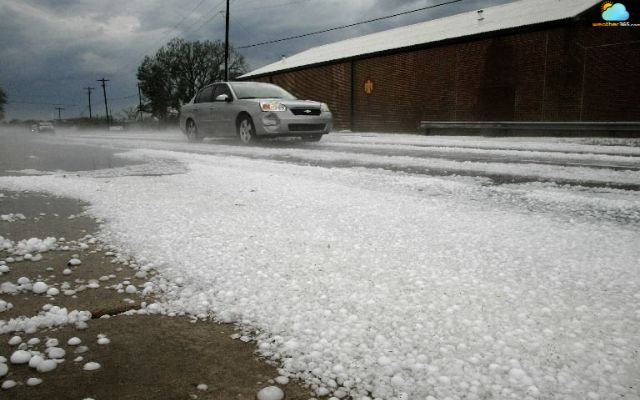
Hailstones in Oklahoma
The Midwest
The Midwest, including Missouri, Iowa, and Illinois, experiences fewer hail events than Hail Alley or the Great Plains, but the region has a history of costly hailstorms.
Thunderstorms originating in the Plains often intensify as they move east, fueled by the region’s heat and humidity, producing large hail.
Major cities such as Chicago, St. Louis, and Des Moines are particularly vulnerable. Population density and concentrated infrastructure amplify the damage potential, as seen during the Tristate Hailstorm of 2001, which caused billions in insured losses.
Residents in this region are often less prepared than those in hail-prone Western areas, making Midwest hailstorms disproportionately costly.

Hailstones damaged car in St.Louis in 2024
Final thought
The biggest hailstorm ever in the US reveals the power and unpredictability of severe weather. From record-breaking stones in Vivian, South Dakota, to massive accumulations in Seldon and Clayton, hail can cause serious damage to property, crops, and communities. Understanding historic events and US hail hotspots helps prepare for future storms and reduce economic and personal losses.
Frequently Asked Questions (FAQs)
Related post
![Largest hail ever recorded in history: location, size, and impacts [TOPLIST]](https://assets.weather365.com/images/1774404364_largest-hail-ever-recorded-1.jpg "Largest hail ever recorded in history: location, size, and impacts [TOPLIST]")
Largest hail ever recorded in history: location, size, and impacts [TOPLIST]
 1484
1484
 0
0
 4.7
4.7
 06/05/2026

How Does Hail Form? Unveil the Mysterious Process of Ice Creation
1317
0
4.9
06/05/2026

Hail Safety Tips Before, During, and After Hailstorms You Should Know
1294
0
4.9
06/05/2026

0 Comment
Leave a comment
Your email address will not be published. Required fields are marked *