




How Does Hail Form? Unveil the Mysterious Process of Ice Creation


Have you ever wondered how does hail form and what makes it so dangerous? In this post, you’ll learn how hail develops, how big it can get, where it happens most, and why this knowledge helps you stay prepared. Let’s dive in!
Browse more Storm guides and Severe Weather hub

How Does Hail Form?
- What is Hail?
- How Does Hail Form
- Thunderstorm updrafts
- Freezing level
- Ice embryo
- Growth Cycle
- Growth and Fall
- How Hail Falls to the Ground
- How Fast Does Hail Fall?
- Hail Size and Classification
- Where Does the Most Hail Occur?
- Global patterns
- Regions with the largest hail
- When Does Hailstorm Season Peak
- Spring and Early Summer
- Late Summer and Fall
- Temperature contrast
What is Hail?
Hail is a form of precipitation made of solid ice.
Unlike snow, which forms from tiny ice crystals, hailstones are compact balls or irregular lumps of ice that fall from strong thunderstorms.
Key characteristics of hail include:
Composition: Hailstones are mainly frozen water. Many contain alternating layers of ice, created as they cycle through freezing and melting zones within the cloud.
Size: Their diameter ranges widely, from tiny pellets as small as a pea to massive stones larger than a baseball.
Shape: While some hailstones are nearly spherical, many are irregular, with jagged edges caused by repeated collisions with supercooled water droplets.
Texture: They often have a layered structure, similar to an onion, revealing multiple growth stages inside the cloud.
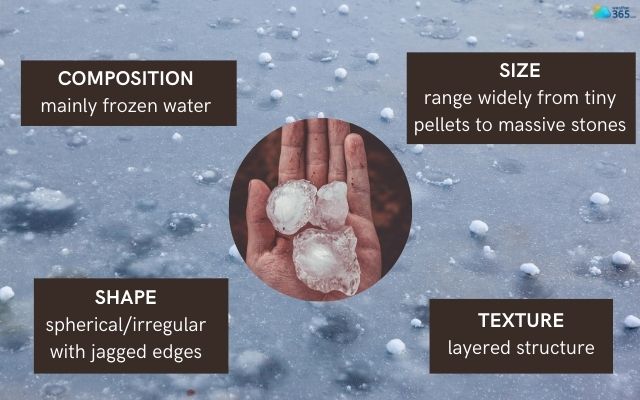
Characteristics of hail
How Does Hail Form
Hail forms through a complex process inside powerful thunderstorms.
It begins with rising air currents, continues as water droplets freeze, and develops through multiple growth cycles before falling to the ground.
Each step of this process explains why hail can range from tiny pellets to massive, destructive stones.
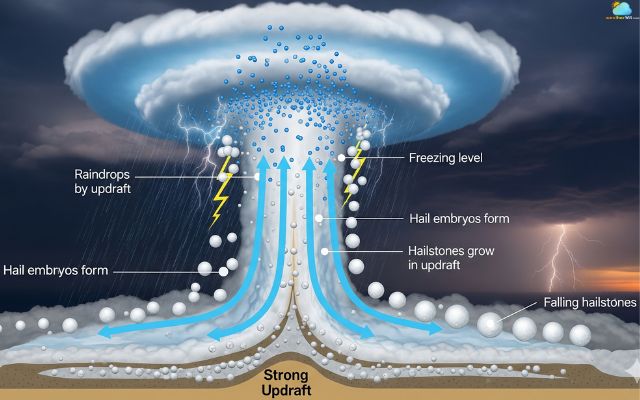
How does a hail form
Thunderstorm updrafts
The formation of hail starts with strong updrafts - columns of rising air inside thunderclouds.
These updrafts lift raindrops high into colder regions of the atmosphere. The stronger the updraft, the longer the droplets remain suspended, allowing them to grow larger as they are repeatedly pushed upward.
Without these updrafts, hailstones would not have time to develop beyond small frozen droplets.
Freezing level
As the water droplets are carried upward, they reach the freezing level of the cloud, where temperatures fall below 0°C (32°F).
In this zone, liquid water rapidly turns into ice. The altitude of the freezing level determines how often droplets can be lifted back up and refrozen, directly influencing the size of the hailstone.
Ice embryo
The initial frozen particle, called an ice embryo, acts as the seed of a hailstone.
It may begin as a tiny ice crystal, a frozen raindrop, or even a speck of dust. This embryo provides a surface for supercooled water droplets to attach to.
Once formed, it becomes the core that future ice layers will build upon.
Growth Cycle
Hailstones grow as they cycle repeatedly through the storm cloud. Updrafts lift them into supercooled regions where liquid droplets freeze on contact, adding new layers of ice.
When the hailstone becomes too heavy, it briefly falls, only to be carried up again by another updraft.
Each trip through these layers adds thickness, creating the familiar onion-like structure of hailstones.
Growth and Fall
Eventually, the hailstone reaches a point where its weight exceeds the strength of the updraft.
At this stage, gravity takes over and the hailstone falls to the ground. Larger hailstones indicate that they spent more time cycling through the storm, supported by exceptionally strong updrafts.
When they finally descend, they can strike the surface with tremendous force, posing risks to people, property, and agriculture.
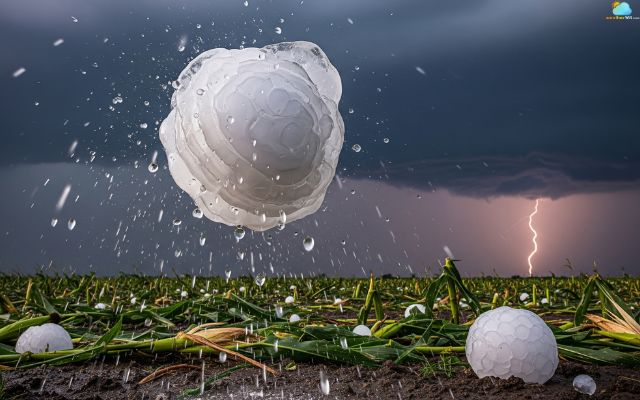
Hailstones fall to the ground
See more: Hail safety tips
How Hail Falls to the Ground
The moment hailstones begin their descent marks the final stage of their journey inside a thunderstorm.
A hailstone will only fall when its weight becomes too heavy for the updraft to support. Until then, strong rising air currents keep it suspended, allowing time for additional layers of ice to form.
Once gravity overpowers the updraft, the hailstone starts to drop rapidly toward the ground. Hail’s fall is influenced by several factors such as size, weight, air resistance, and wind patterns.
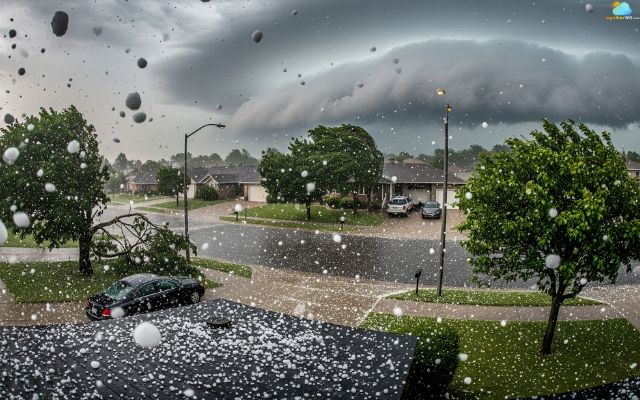
How hail galls to the ground
When hail finally hits the ground, the impact can be powerful. Even medium-sized stones create loud, rattling noises on roofs, vehicles, and windows.
Larger hailstones, especially those exceeding one inch in diameter, are capable of denting cars, breaking glass, damaging crops, and injuring people caught outdoors.
Related: Largest hail ever recorded
How Fast Does Hail Fall?
The speed of hail as it falls depends mainly on its size, weight, and the air resistance it encounters.
Small hailstones, about the size of a pea (roughly 0.25 inches in diameter), usually fall at around 20-25 mph (32-40 km/h).
As hailstones grow larger, their speed increases dramatically.
Golf ball-sized hail (about 1.75 inches) can fall at 40-50 mph (64-80 km/h), while baseball-sized hailstones may reach 70 mph (113 km/h).
In extreme cases, giant hailstones over 4 inches across have been recorded falling at more than 100 mph (160 km/h).
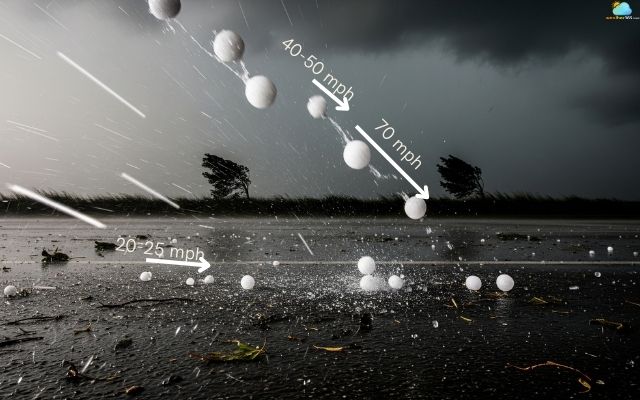
How fast does hail fall
Air density and wind patterns also affect the final speed. For instance, strong updrafts inside thunderstorms can temporarily hold hailstones aloft, allowing them to grow larger before gravity pulls them down.
Once the updraft weakens, these heavy chunks of ice drop rapidly, striking the ground with dangerous force.
To put this into perspective, hail falling at 70 mph hits with enough energy to shatter glass, dent vehicles, and cause serious injuries.
This is why even short hailstorms can create widespread property damage and safety risks.
Hail Size and Classification
Hailstones are not measured by weight but by their diameter, and meteorologists classify them using size comparisons that are easy for the public to understand.
The most common system is the NOAA hail size chart, which links hailstones to familiar objects like coins, balls, or everyday items.
Non-severe hail includes the smallest sizes:
BB-size (~⅛ inch): tiny pellets, usually harmless except for sensitive plants.
Pea-size (~¼ inch): about the size of green peas; may sting when falling but rarely causes structural damage.
Marble-size (~½ inch): slightly larger, capable of minor garden or car paint damage.
Dime, Pickle, or Penny (~¾ inch): the upper range of non-severe hail; can stress crops and chip soft materials.
Severe hail begins when stones reach at least 1 inch in diameter:
Quarter (~1 inch): the official threshold for severe hail; can crack windows and dent vehicles.
Half-dollar (~1¼ inch): more destructive, often damaging shingles and outdoor siding.
Walnut (~1½ inch): capable of breaking glass and harming livestock.
Golf ball (~1¾ inch): one of the most reported severe sizes, strong enough to punch holes in roofs.
Significant severe hail refers to the largest and most destructive stones:
Hen egg (~2 inches): can shatter windshields and injure anyone caught outside.
Tennis ball (~2½ inches): heavy enough to cause widespread roof and car damage.
Baseball (~2¾ inches): extremely dangerous, often leading to total roof replacement.
Grapefruit (~4 inches): rare but devastating, destroying siding, vehicles, and windows.
Softball (~4½ inches): among the largest ever reported, capable of life-threatening injuries and catastrophic property damage.
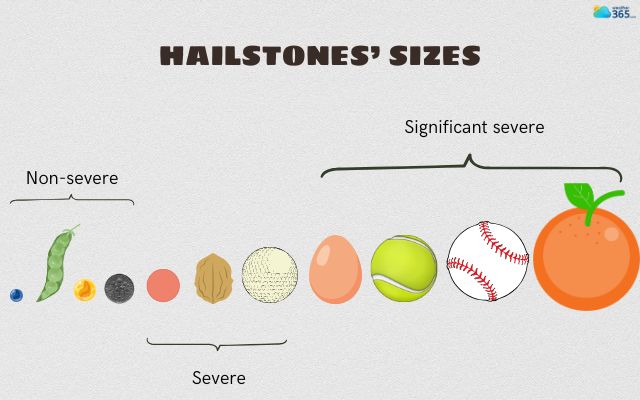
Hailstones’ size range widely
Where Does the Most Hail Occur?
Hail may seem like a rare event, but some regions experience it far more often than others.
From the plains of North America to storm-prone areas in Asia and Europe, hail frequency is shaped by geography, climate, and storm dynamics.
Global patterns
Hail is most frequent in mid-latitude regions, where warm, moist air collides with colder air higher in the atmosphere.
These conditions fuel the towering thunderstorms that produce hail. Areas with strong updrafts - vertical winds that lift raindrops high enough to freeze see the most activity.
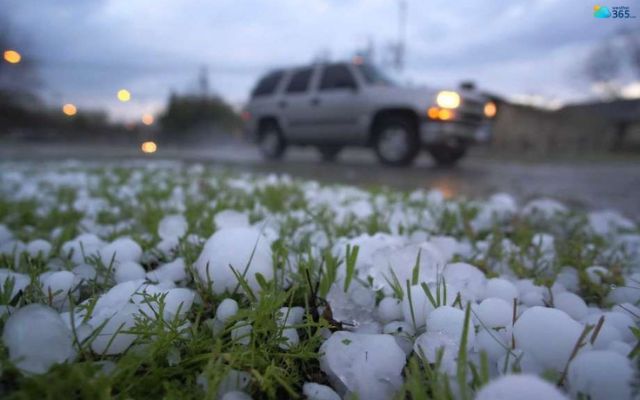
Hail is most frequent in mid-latitude regions
The United States, China, northern India, and parts of Europe consistently rank among the most hail-prone regions.
In contrast, tropical zones near the equator rarely see large hail because storms there, while powerful, lack the cold upper layers of air needed for hailstone growth.
Regions with the largest hail
While many countries experience hail, a few regions stand out for producing the largest and most damaging hailstones.
In the United States, the central plains, especially Texas, Oklahoma, Kansas, Nebraska, and Colorado are known as “Hail Alley.” Here, spring and summer storms often generate hailstones larger than golf balls.
In northern India and Bangladesh, intense pre-monsoon storms regularly create hail that causes severe crop loss and widespread property damage.
Parts of China, especially around the Tibetan Plateau, see frequent hailstorms linked to its high elevation and strong convective storms.
Europe also experiences destructive hail, particularly in countries like France, Germany, and Italy, where summer supercell storms can produce stones the size of tennis balls.
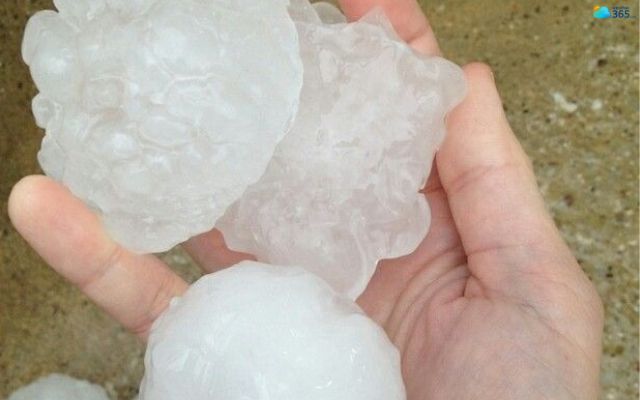
Which regions have largest hails?
When Does Hailstorm Season Peak
Hailstorms tend to peak during specific seasons and under particular weather conditions.
By looking at seasonal patterns and storm dynamics, we can better understand when hail is most likely to strike.
Spring and Early Summer
In many parts of the world, spring and early summer mark the peak hail season.
This is when the atmosphere has the perfect mix of warm, moist surface air and lingering cold air aloft.
The sharp temperature contrast fuels powerful thunderstorms, especially across regions like the US Great Plains and parts of Europe.
Most severe hail reports occur between April and June, making this the most active window for damaging storms.
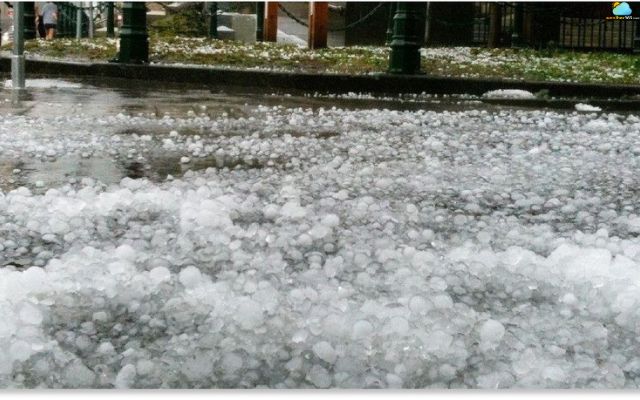
Spring and early summer mark the peak hail season
Late Summer and Fall
Hail does not completely vanish after June. In some regions, late summer and fall bring additional outbreaks, though they are usually less frequent.
These storms often connect to lingering heat waves or the transition into cooler autumn air.
For example, parts of Asia and southern Europe still experience damaging hail events into August and September.
While less common than spring events, they can still produce large hailstones capable of serious damage.
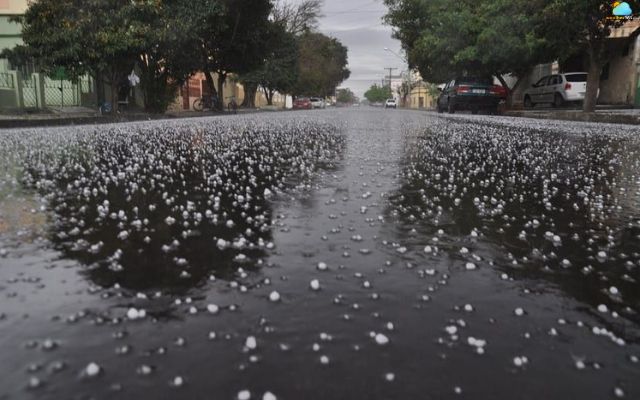
Hails also happen during late summer and fall
Temperature contrast
When warm, humid ground air rises into layers of cold air high in the atmosphere, hailstones can form and grow.
This sharp contrast is strongest in spring, which explains why hail is most frequent then.
Without a strong temperature gradient, thunderstorms may still form, but hailstones remain small or melt before hitting the ground.
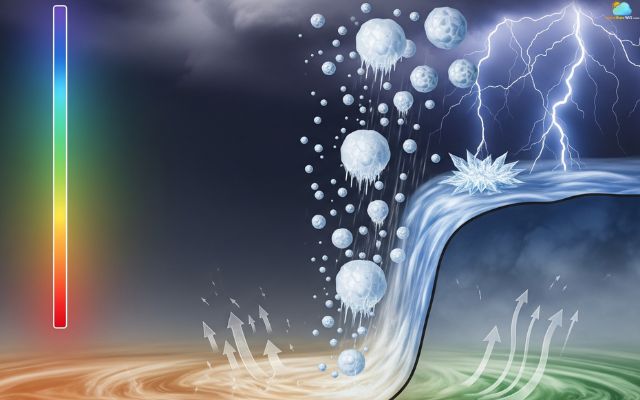
Hailstorm form and grow in strong temperature gradient
Conclusion
Now that you know how does hail form, you can better understand why some storms bring only tiny pellets while others unleash destructive ice. This knowledge not only satisfies curiosity but also gives you tools to stay alert, protect your home, and prepare for hail season.
Related post: Biggest hailstorm ever in US history
Frequently Asked Questions (FAQs)
Related post

What Is A Dust Storm? Understanding Its Origins, Health Risks, and Survival Tips
 1294
1294
 0
0
 4.7
4.7
 06/05/2026

What is A Haboob? Exploring the Science, Dangers, and Safety Measures
1282
0
4.9
06/05/2026

What Is Derecho? Discover Definition, Causes, and Safety Tips
1276
0
4.7
06/05/2026

0 Comment
Leave a comment
Your email address will not be published. Required fields are marked *