




What Is Air Pressure? Understanding Atmospheric Pressure


What is air pressure, and why can it totally shape everything from daily weather to how your body feels before a storm? Though invisible, this force plays a crucial role in our environment. In this guide, you’ll uncover how it works, why it changes, and why it matters. Scrolling down now!

What is air pressure?
- What is air pressure?
- Air pressure vs atmospheric pressure vs barometric pressure
- Units of measurement
- Who discovered air pressure?
- How does air pressure affect weather?
- High pressure
- Low pressure
- How does the weather affect atmospheric pressure?
- Temperature
- Humidity
- How is air pressure measured?
- Mercurial barometer
- Aneroid barometer
- Digital/Capacitive sensors
What is air pressure?
Air pressure is the force that air exerts as it presses down on the Earth’s surface and everything on it.
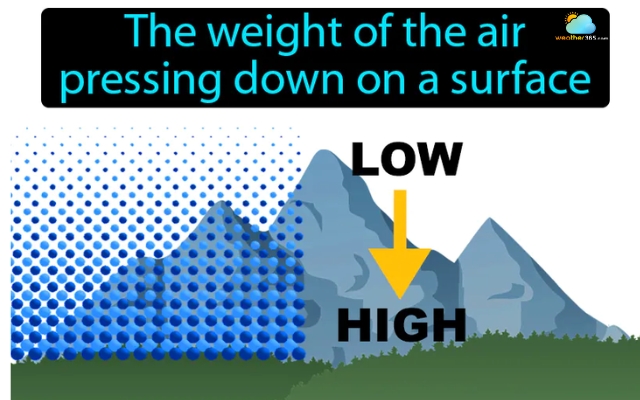
Air pressure presses down on the Earth’s surface
Think of the atmosphere like a thick blanket of gases wrapped around the planet.
Even though each layer is light, together they create a noticeable force.
The closer you are to sea level, the more air is stacked above you, which means higher pressure.
As you go higher, like climbing a mountain, there’s less air above, so the pressure drops.
Air pressure vs atmospheric pressure vs barometric pressure
You’ll often see these three terms used almost interchangeably, which can be confusing at first.
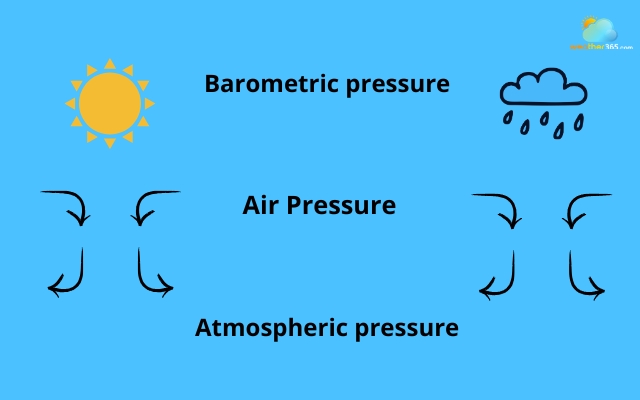
The difference among air pressure, barometric pressure, and atmospheric pressure
The difference mainly comes down to context rather than meaning.
Air pressure is the most general term. It can refer to the pressure of air in any setting: outdoors, indoors, or even inside a tire.
Atmospheric pressure is more specific. It refers to the pressure created by the Earth’s atmosphere as a whole.
When people talk about weather, this is usually what they mean.
Barometric pressure is simply atmospheric pressure measured using a device called a barometer.
So technically, it’s not a different type of pressure, it’s just how we measure it.
Units of measurement
Measurement units of air pressure include: Hectopascals (hPa), Inches of mercury (inHg), Atmospheres (atm).
Hectopascals (hPa)
In weather reports, the most common unit is hectopascals (hPa) or millibars (mb), and the two are actually equal.
Standard pressure at sea level is around 1013 hPa, which serves as a useful reference point.
Inches of mercury (inHg)
In the United States, you’ll often see inches of mercury (inHg). This unit comes from early barometers that used mercury columns to measure pressure.
Atmospheres (atm)
In scientific contexts, atmospheres (atm) are used. One atmosphere represents the average pressure at sea level.
Even though the numbers look different across these units, they’re just different ways of describing the same thing: how strongly the air is pressing down.
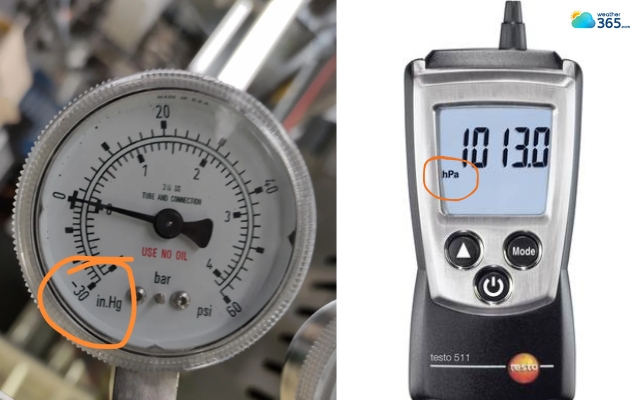
Air pressure is measured in different units
Who discovered air pressure?
The discovery of air pressure is credited to Evangelista Torricelli, an Italian physicist in the 17th century.
Around 1643, he conducted a simple but groundbreaking experiment using a tube filled with mercury.
When he inverted the tube, some mercury stayed inside instead of flowing out completely.
Torricelli realized this happened because the weight of the air outside was pushing on the mercury, proving that air has mass and exerts pressure.
This experiment led to the invention of the barometer and completely changed how scientists understood the atmosphere.
Later, Blaise Pascal built on this idea by showing that air pressure decreases with altitude - something we still rely on in weather science today.
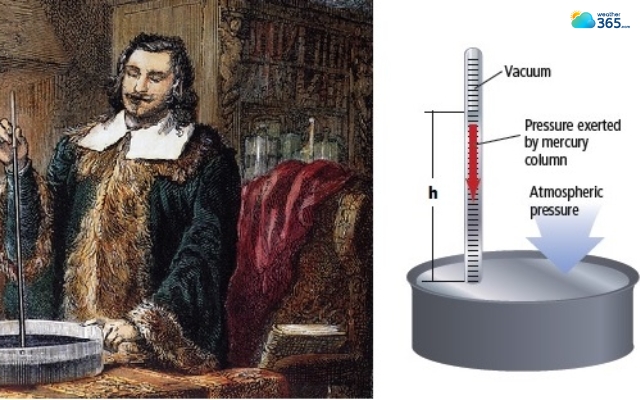
Air pressure was discovered in the 17th century by Evangelista Torricelli
How does air pressure affect weather?
Air pressure is one of the key drivers behind weather changes, especially when it comes to clouds, rain, and storms.
Air is always moving from areas of high pressure to low pressure.
Atmospheric weight drives this wind movement, influencing daily changes on Illinois pressure and weather.
More importantly, it affects whether air rises or sinks, and that’s what shapes the weather you experience.
High pressure
When air pressure is high, the air tends to sink toward the ground. As it sinks, it becomes more stable and less likely to form clouds.
That’s why high-pressure systems are usually linked to clear skies, dry air, and calm weather.
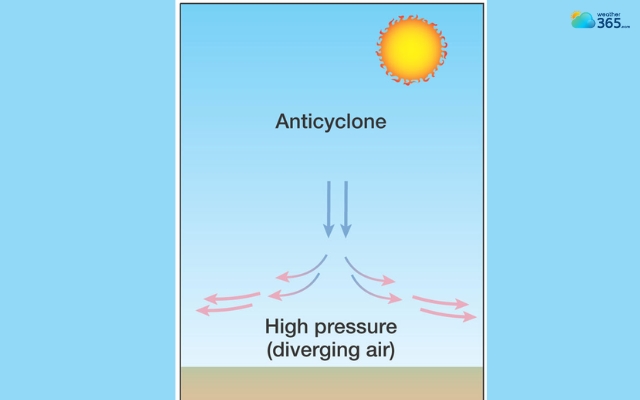
High pressure usually means calm weather
Low pressure
On the other hand, when air pressure is low, the air starts to rise. As it rises, it cools down, and that cooling causes water vapor in the air to condense into clouds.
If the process continues, those clouds can grow thicker and eventually lead to rain, storms, or even severe weather.
That’s why a drop in pressure often signals that bad weather is on the way.
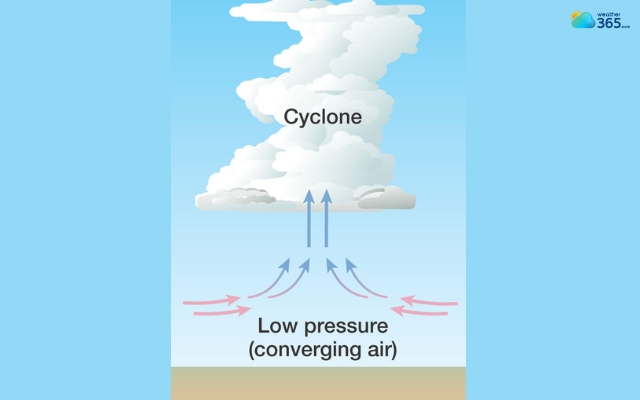
Low pressure causes water vapor to condense into clouds
What makes this even more interesting is how quickly these changes can happen.
A steady drop in pressure over a short time usually means a weather system, like a storm, is approaching.
That’s also the moment when some people start to feel it physically, like headaches or pressure in their ears.
So, while air pressure itself is invisible, its effects are everywhere.
How does the weather affect atmospheric pressure?
Weather conditions like heat, cold, and moisture are constantly changing the structure of the air, which in turn affects atmospheric pressure.
Instead of staying fixed, pressure is always shifting depending on what’s happening in the atmosphere.
Two of the biggest factors behind these changes are temperature and humidity.
Temperature
Temperature has a direct impact on how air behaves, and that naturally affects pressure.
When the air gets warmer, its molecules move faster and spread farther apart. This makes the air less dense and lighter, causing it to rise.
As air rises, it reduces the amount of air pressing down on the surface below, which leads to lower atmospheric pressure.
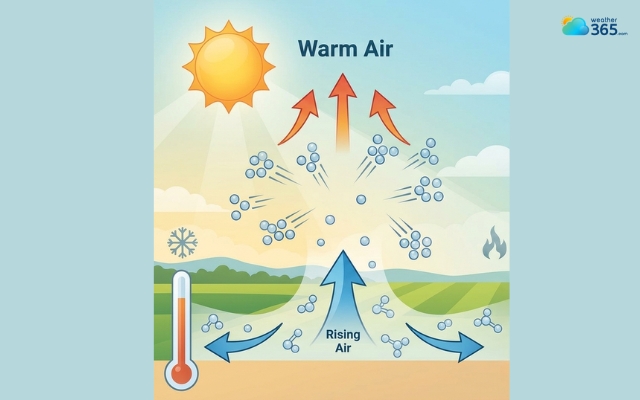
Warmer air moves faster and spreads farther apart
On the flip side, when air cools down, the molecules slow down and move closer together. The air becomes denser and heavier, so it sinks.
This increases the weight of air above a given area, resulting in higher pressure.
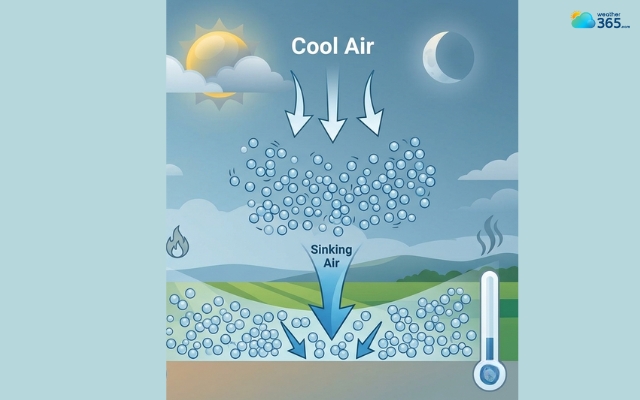
Cool air slows down and moves closer
This is why hot days, especially in the afternoon, often see falling pressure, while cooler conditions tend to stabilize or increase it.
Over larger areas, these temperature differences are what help create pressure systems that drive weather patterns.
Humidity
Humidity, or the amount of water vapor in the air, also plays a subtle but important role in pressure changes.
It might sound counterintuitive, but moist air is actually lighter than dry air.
That’s because water vapor molecules weigh less than the nitrogen and oxygen molecules they replace.
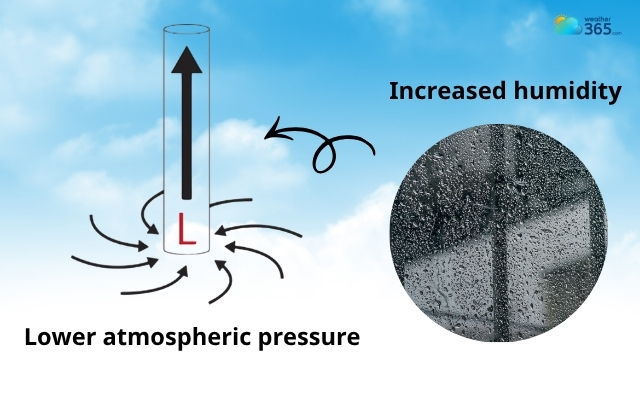
High humidity makes the air become less dense
So when humidity increases, the overall air becomes slightly less dense.
As a result, areas with high humidity often experience lower atmospheric pressure, especially when combined with warm temperatures.
This is one reason why humid, sticky days can feel heavy and uncomfortable; there’s rising air and often unstable conditions in the atmosphere.
On the other hand, dry air is denser and tends to support higher pressure, which is why dry climates are often associated with clearer and more stable weather.
What about altitude, movement, and storm systems? Do they affect air pressure, and how? Drop by How does weather affect air pressure to learn the details!
How is air pressure measured?
Air pressure is measured using an instrument called a barometer.
There are several types of barometers, such as a mercurial barometer, an aneroid barometer, and digital (capacitive) sensors.
Mercurial barometer
The mercury barometer is the oldest way people used to measure air pressure.
It works with a glass tube filled with mercury, placed upside down in a container of the same liquid.
When this happens, air pressure pushes on the mercury in the container and forces some of it up into the tube.
If the air pressure is high, the mercury rises higher. If the pressure drops, the mercury level goes down.
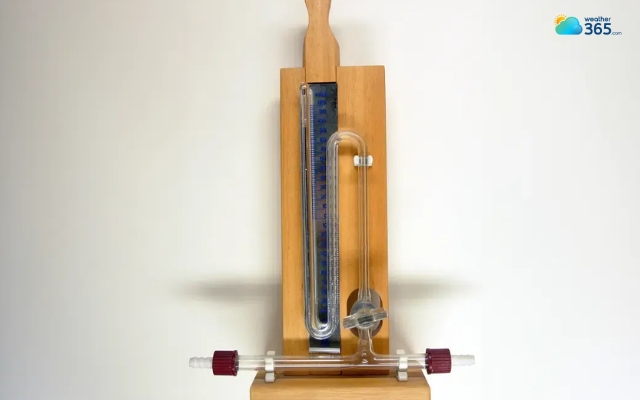
The mercury barometer is the most traditional tool
By looking at how high the mercury stands in the tube, scientists can figure out the air pressure.
That’s also why you see units like mmHg or inHg - they come from measuring the height of mercury.
Even though it’s very accurate, this type of barometer isn’t used as much today because it’s fragile, and mercury can be dangerous.
Aneroid barometer
To make things safer and more practical, scientists created the aneroid barometer.
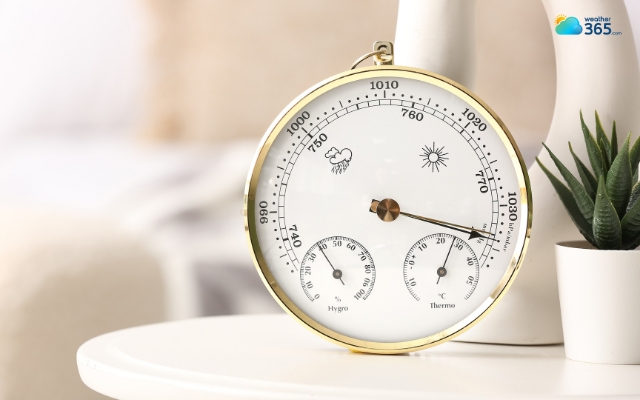
The aneroid barometer is commonly used in everyday items
Instead of using liquid, this device has a small metal box with most of the air removed.
When outside air pressure changes, this box slightly expands or shrinks.
These tiny movements are passed through small mechanical parts to a needle on a dial, which shows the pressure reading.
Because it’s compact and easy to carry, aneroid barometers are commonly used in everyday items like wall barometers, watches, and even aircraft instruments.
Digital/Capacitive sensors
Today, air pressure is often measured using digital sensors.
These sensors use very small, flexible components that react to pressure changes and turn them into electrical signals. The data is then shown instantly on a screen.
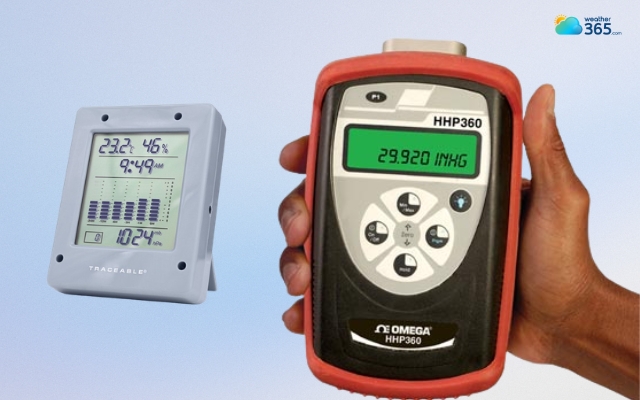
Digital barometer is the most used tool today
You can find these in weather stations, smartphones, and GPS devices.
One big advantage is that they can track changes over time, which helps scientists and weather apps make more accurate forecasts.
If you want to go a step further and actually interpret those numbers, you can check out this guide on how to read a barometer.
Wrap up
What is Air Pressure, and why should you care? Because it explains so much of what you see and feel every day, from sunshine to sudden rain. With a basic understanding, you’re not just checking the weather anymore; you’re actually understanding it.
Frequently Asked Questions (FAQs)
◉ Headaches
◉ Joint pain
◉ Ear pressure changes
These usually happen when the pressure drops before storms.
Related post

What Is Barometric Pressure? Simple Explanation for Beginners
 1001
1001
 8
8
 5.0
5.0
 30/09/2026

How to Read a Barometer? Simple Step-by-Step Guide for Beginners
964
8
4.8
30/09/2026
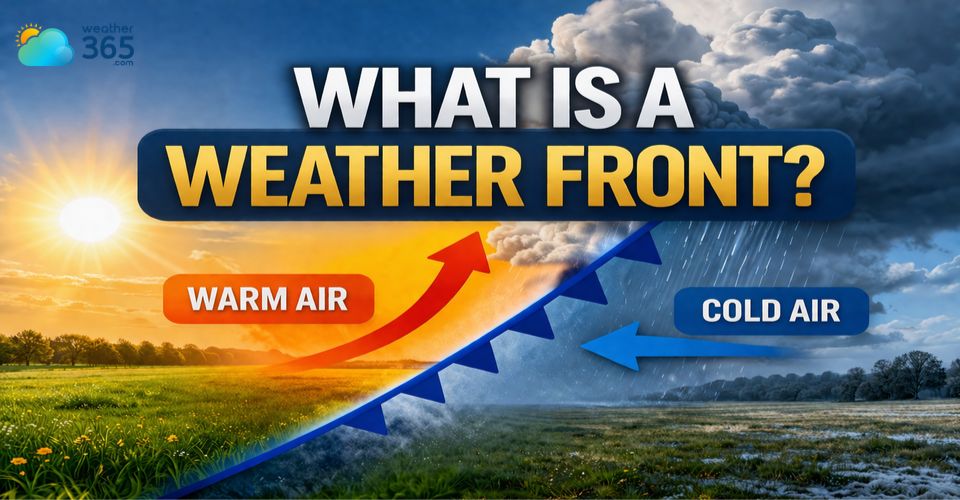
What Is a Weather Front? Types, Examples & Weather Impact
200
8
4.9
18/08/2026

15 Comment
Carson Thomas
Learning the basics of air pressure makes weather maps look much less like a collection of mysterious numbers and symbols.
Kenneth Barnes
The more I learn about atmospheric pressure, the more it feels like the hidden framework behind everyday weather. Pretty fascinating for something we can’t even see.
Emilio Martin
Why are pressure differences important for wind?
weather365
Air tends to move from areas of higher pressure toward areas of lower pressure, creating wind as the atmosphere works to balance those differences.
Cayden Kelly
How does temperature influence air pressure?
weather365
Heating air can make it expand and become less dense, while cooling generally makes it denser, which can contribute to pressure differences.
Patrick Wright
Why don’t we normally feel the atmosphere pressing down on us?
weather365
Our bodies have internal pressure that balances the surrounding atmospheric pressure, so we generally don’t notice the force.
Emilio Martin
The atmosphere is basically a giant layer of air sitting on Earth, and somehow I had never stopped to think about what that means physically.
Cayden Kelly
Why are pressure differences important for wind?
weather365
Air tends to move from areas of higher pressure toward areas of lower pressure, creating wind as the atmosphere works to balance those differences.
Patrick Wright
How does temperature influence air pressure?
weather365
Heating air can make it expand and become less dense, while cooling generally makes it denser, which can contribute to pressure differences.
Cody Mccarty
Why don’t we normally feel the atmosphere pressing down on us?
weather365
Our bodies have internal pressure that balances the surrounding atmospheric pressure, so we generally don’t notice the force.
Leave a comment
Your email address will not be published. Required fields are marked *