



Difference Between High and Low Pressure Systems: Easy Explanation


What exactly is the difference between high and low pressure systems, and why does it matter for your daily weather? If you’ve ever wondered why some days are clear while others bring sudden storms, you’re not alone. Let’s break the difference down in the simplest way!
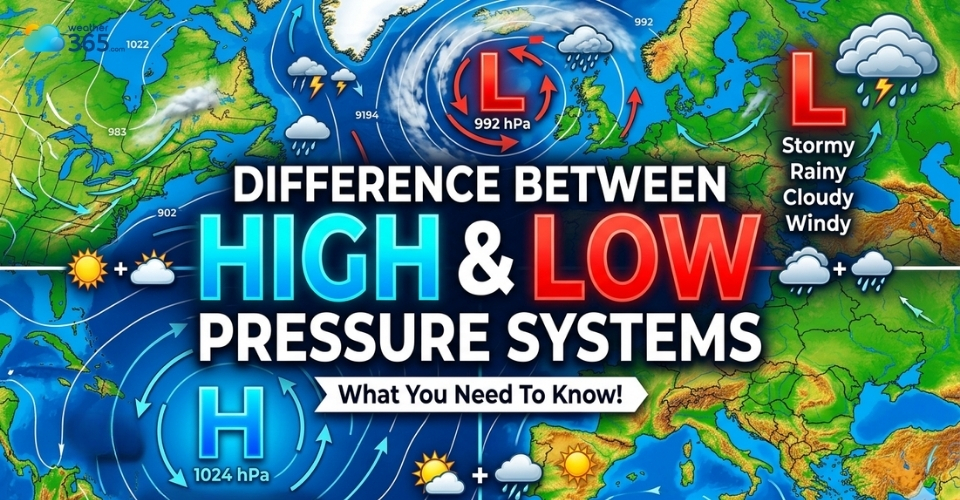
Difference between high and low-pressure systems
- Understanding the air pressure
- What is a high-pressure system?
- Type of weather is associated with high-pressure systems
- Common high-pressure centers
- What is a low-pressure system?
- Type of weather is associated with low-pressure systems
- Common low-pressure centers
- Difference between high and low pressure systems
- Air Movement
- Pressure Level
- Weather
- Wind Flow
- Cloud Formation
- When high and low-pressure systems interact
- Normal interaction between high and low pressure systems
- Blocking patterns
- Cut-off lows
Understanding the air pressure
Air pressure is the force created by the weight of air pressing down on the Earth’s surface.
Even though we don’t feel it, the air around us is constantly pushing in all directions.
This pressure is not fixed; it changes all the time depending on temperature, altitude, and how air moves in the atmosphere.
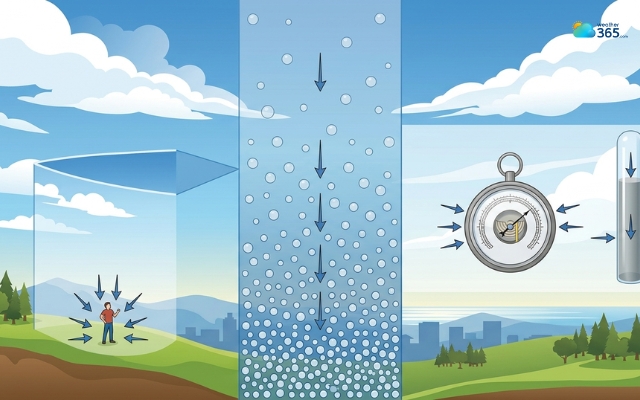
Air pressure is the force pressing down on the Earth’s surface
A helpful way to picture this is to imagine the atmosphere as a thick blanket of air surrounding the planet.
At lower altitudes (like sea level), there’s more air stacked above you, so the pressure is higher.
As you go higher, like up a mountain, there’s less air above, so the pressure drops. That’s why your ears sometimes “pop” when you travel to higher elevations.
Temperature also plays a big role.
When air gets warm, its molecules spread out, making it lighter. This lighter air rises upward, which reduces the pressure near the ground.
On the other hand, cold air becomes denser and heavier, so it sinks and increases pressure at the surface. This constant cycle of rising and sinking air is what drives changes in pressure.
So, temperature can significantly affect air pressure, but what about vice versa? Can air pressure affect the temperature? Uncover what is air pressure here!
What is a high-pressure system?
A high-pressure system is an area where the air pressure at the surface is higher than in the surrounding regions.
In simple terms, it means there is more air “stacked” above a location, pressing down with greater force.
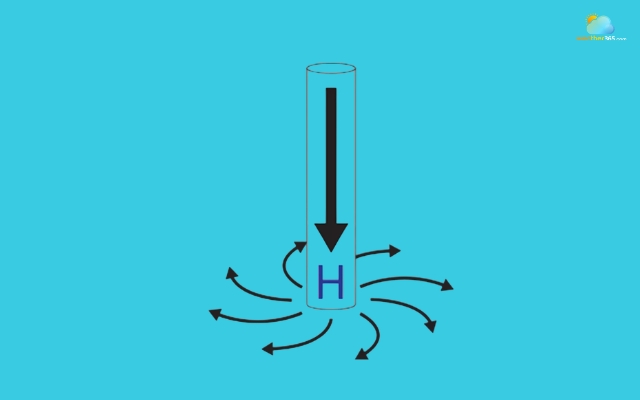
More air is “stacked” above a location
You might wonder, what is the difference between a high pressure area and a high pressure system?
While a “high pressure area” simply refers to the geographic location where the pressure is high, a “high pressure system” includes the actual movement and dynamics of the air.
That is why the key idea is that high-pressure is the movement of air.
In a high-pressure system, air from higher in the atmosphere slowly sinks toward the ground. Meteorologists call this process subsidence.
As this air sinks, it becomes more compressed, which increases the pressure near the surface.
You’ll often see a big “H” on weather maps marking these areas. They are sometimes called anticyclones, and they tend to dominate large regions for days at a time.
Type of weather is associated with high-pressure systems
Because the air is sinking, it actually prevents clouds from forming. Why? Cloud formation needs rising air that cools and condenses.
In a high-pressure system, the opposite is happening: air is moving downward, warming up, and drying out.
That’s why high pressure is usually linked to:
Clear skies and lots of sunshine
Dry air with low chances of rain
Calm or light winds
Stable, predictable weather
Think of those bright, cloudless days when everything feels still - that’s classic high-pressure weather.
However, “good weather” doesn’t always mean perfect.
When high pressure sticks around too long, it can lead to heatwaves in summer or trap pollution and fog near the ground in cities.
The same stability that keeps storms away can also keep unwanted air in place.
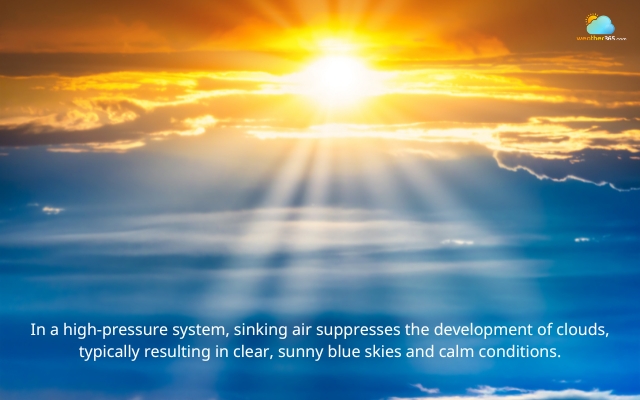
High-pressure conditions lead to a clear sky
Common high-pressure centers
High-pressure systems tend to form in certain regions and follow global patterns.
One of the most well-known examples is the subtropical high-pressure belt, which sits roughly around 30° latitude in both hemispheres.
These systems are responsible for many of the world’s deserts because they consistently bring dry, sinking air.
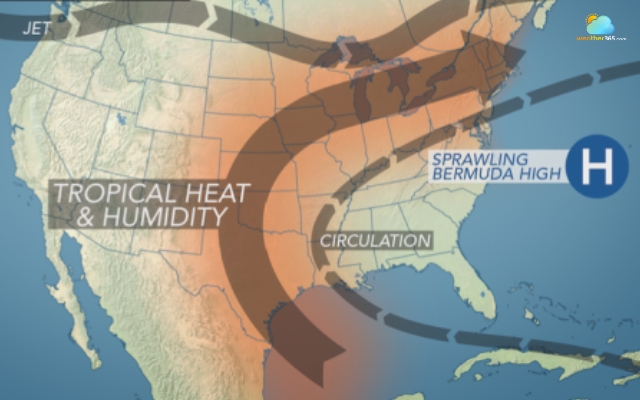
Subtropical high-pressure belt
You might also hear about specific high-pressure centers like:
The Bermuda High in the Atlantic, which often influences summer weather
Continental high-pressure systems that form over land during winter, bringing cold and dry conditions
Another interesting role of high-pressure systems is that they can act like a “block” in the atmosphere.
They can slow down or even redirect storms, forcing bad weather to move around them instead of through them.
What is a low-pressure system?
A low-pressure system is an area where the atmospheric pressure is lower than that of the surrounding regions.

Atmospheric pressure is lower than that of the surrounding regions
In these systems, air near the surface moves inward and then rises upward into the atmosphere.
As this air rises, it expands and cools because pressure decreases with height.
You can think of a low-pressure system like a “vacuum effect” in the atmosphere.
Air is constantly being pulled in and lifted up.
On weather maps, these systems are marked with a big “L” and are often called cyclones or depressions.
Type of weather is associated with low-pressure systems
If high pressure is linked to calm, clear days, then low pressure is where things get more active, and sometimes messy.
Because the air is rising, it cools down as it goes higher.
Cooler air can’t hold as much moisture, so the water vapor inside it condenses into tiny droplets.
That’s how clouds form. And when enough moisture builds up, it falls as rain or snow.
This is why low-pressure systems are typically associated with:
Cloudy or overcast skies
Rain, snow, or other forms of precipitation
Stronger winds due to air rushing inward
Unstable and changing weather conditions
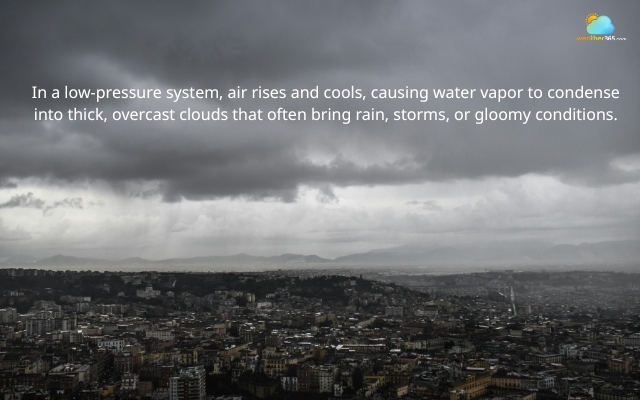
Water vapor condenses into tiny droplets and forms clouds
In reality, most of the “interesting” weather you experience - storms, heavy rain, even thunderstorms comes from low-pressure systems.
The deeper the pressure drops, the more intense the weather can become.
That’s also why weather forecasts pay so much attention to them.
When a low-pressure system is approaching, it’s often a sign that conditions are about to change.
Common low-pressure centers
Low-pressure systems appear in many forms, ranging from everyday rainmakers to large-scale storms that can disrupt entire regions.
Some of the most common examples include
Tropical cyclones (like hurricanes or typhoons), which form over warm oceans
Mid-latitude cyclones are responsible for everyday rain and seasonal storms
Nor’easters, powerful winter storms in North America
If you’ve never heard of this type of storm, you can get a clearer picture through this detailed guide on what a nor’easter is: What is a Nor’easter?
What makes things more interesting is that not all low-pressure storms behave the same way.
For example, Nor’easters are often confused with hurricanes, even though they form differently and occur in different conditions.
If you’re curious about how they compare, find out the key difference between a Nor'easter and a hurricane!
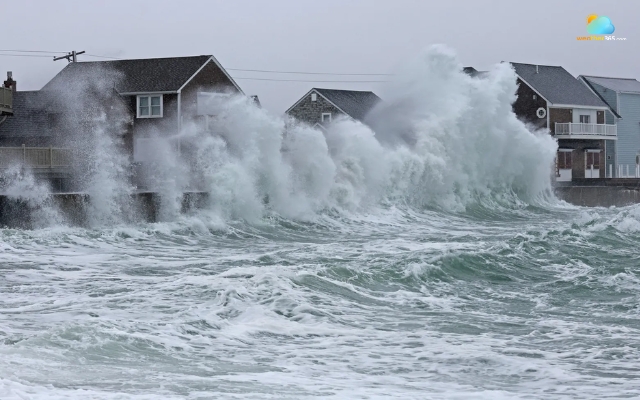
A Nor'easter results from low-pressure condition
As low-pressure systems pull in air from different regions, they often force warm and cold air masses to collide.
Learn how these boundaries form and shape our daily conditions in our full guide on what a weather front is.
Difference between high and low pressure systems
Key differences between high and low pressure lie in how air moves, how clouds form, and ultimately how weather behaves around you.
Air Movement
The core difference starts with how air moves in the atmosphere. In a high-pressure system, air slowly sinks from higher altitudes down toward the surface.
This downward movement creates a stable environment where the air isn’t rising or mixing much.
In contrast, a low-pressure system works oppositely.
Air near the ground rises upward into the atmosphere, creating a constant upward flow.
As air rises, it leaves behind a slight “gap” near the surface, which pulls in more air from surrounding areas.
This continuous cycle makes low-pressure systems much more active and dynamic.
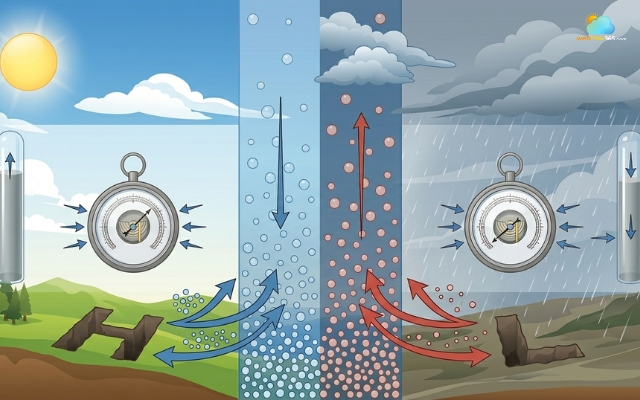
Air movement in high and low-pressure systems
Pressure Level
The pressure itself also behaves differently between the two systems.
In a high-pressure area, the pressure at the surface is higher than in nearby regions because sinking air adds more weight pressing downward.
Meanwhile, a low-pressure system has less force pressing on the surface. Since air is rising and spreading out above, the overall pressure in that area drops compared to its surroundings.
This difference in pressure is what drives air to move from high to low, setting winds in motion.
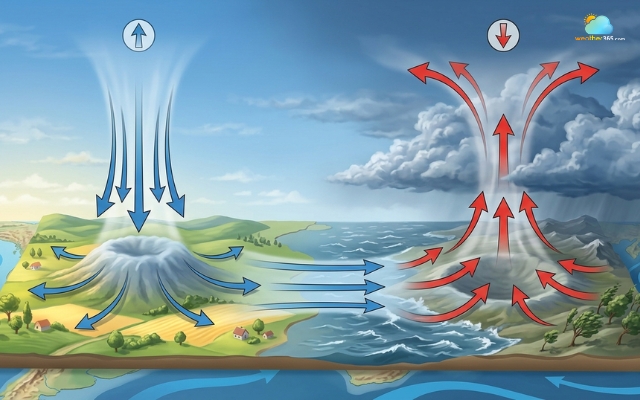
The difference in pressure drives air to move from high to low
Weather
If you’ve ever wondered why the weather feels so different from one day to another, this is where the answer becomes clear.
High-pressure systems are usually linked to calm, steady weather. The sinking air limits cloud formation, so skies tend to stay clear, and conditions remain dry.
These are the days when the weather feels predictable and doesn’t change much.
Low-pressure systems, on the other hand, are responsible for most of the “active” weather.
Because air is rising, clouds can easily form and grow. This often leads to rain, snow, or even storms.
The weather tends to feel more unsettled, and changes can happen more quickly.
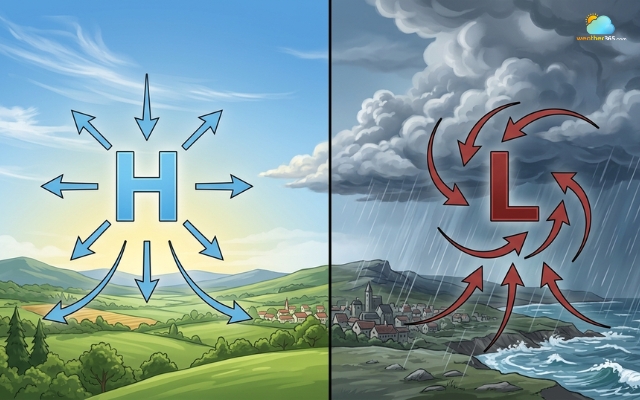
Weather difference between high and low pressure systems
Wind Flow
Wind patterns also reveal a clear contrast between the two systems.
In high-pressure areas, air flows outward from the center.
This outward movement is generally gentle, which is why winds are often light under high pressure.
In low-pressure systems, air flows inward toward the center before rising.
This inward movement can create stronger winds, especially when the pressure difference between regions is large.
That’s why windy conditions are often linked to approaching low-pressure systems.
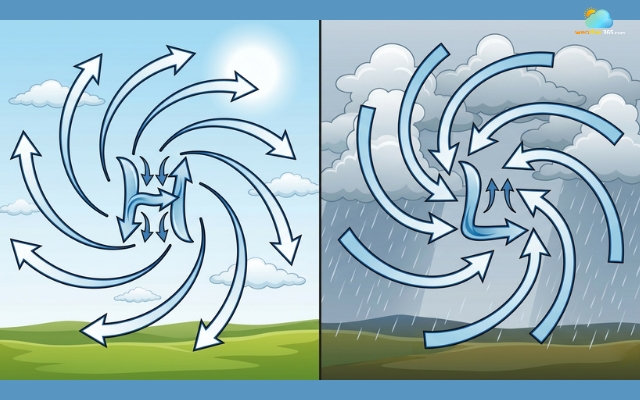
Wind flows differently in high and low-pressure conditions
Cloud Formation
One of the easiest ways to visually spot the difference is by looking at the sky.
In a high-pressure system, cloud formation is limited. The sinking air warms up slightly, which makes it harder for moisture to condense into clouds.
As a result, skies are often clear or only lightly clouded.
In a low-pressure system, the opposite happens. Rising air cools as it moves upward, allowing moisture to condense and form clouds.
Over time, these clouds can thicken and lead to precipitation, which is why gray skies and rain are so common in low-pressure conditions.
Feature | High-pressure system | Low-pressure system |
Air movement | Sinking (descending) air | Rising (ascending) air |
Pressure level | Higher than the surrounding areas | Lower than the surrounding areas |
Weather | Clear, dry, stable | Cloudy, wet, unstable |
Wind flow | Outward (diverging) | Inward (converging) |
Cloud formation | Suppressed | Enhanced |
When high and low-pressure systems interact
High and low pressure systems usually move steadily with the jet stream, creating the day-to-day changes in weather we experience.
However, some interactions can slow or even stop this movement, leading to weather that lasts much longer than usual.
The most common examples include typical pressure system interactions, blocking patterns, and cut-off lows, each affecting weather in a different way.
Normal interaction between high and low pressure systems
Under normal conditions, high- and low-pressure systems move steadily across the atmosphere, guided by the jet stream.
Air flows from high pressure toward low pressure, creating wind, while alternating pressure systems bring changing conditions.
In everyday life, high pressure brings clear skies while low pressure brings rain, controlling Kansas weather today and creating day-to-day shifts between sunshine and storms.
A high-pressure system is often followed by a low-pressure system, keeping the atmosphere dynamic.
Blocking patterns
Sometimes, the jet stream becomes distorted, causing pressure systems to slow down or remain nearly stationary.
Meteorologists call these blocking patterns because they block the normal west-to-east movement of weather systems.
As a result, the same weather, such as sunshine, heat, rain, or storms, can persist for several days or even weeks.
Omega High (Omega Block)
An Omega block forms when a high-pressure system sits between two low-pressure systems, creating a pattern that resembles the Greek letter Ω. The high acts as a barrier, forcing weather systems to move around it.
This often brings prolonged dry weather under the high pressure, while the surrounding low-pressure systems produce extended periods of rain or storms.
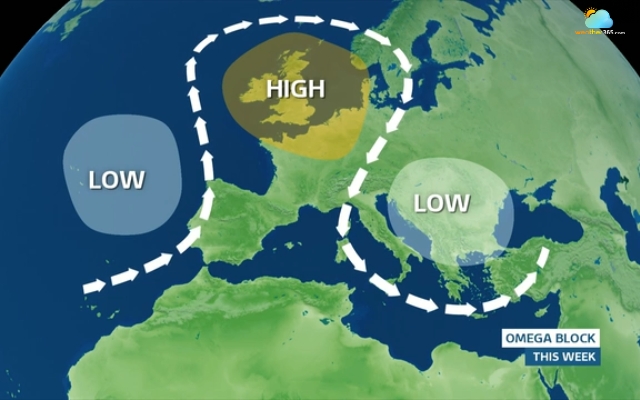
An Omega block on a weather map
Rex Blocks
A Rex block forms when a high-pressure system develops directly north of a low-pressure system. This arrangement disrupts the jet stream, causing both systems to remain nearly stationary.
Areas under the high pressure usually stay dry and stable, while regions beneath the low pressure often experience several days of clouds, rain, and cooler weather.
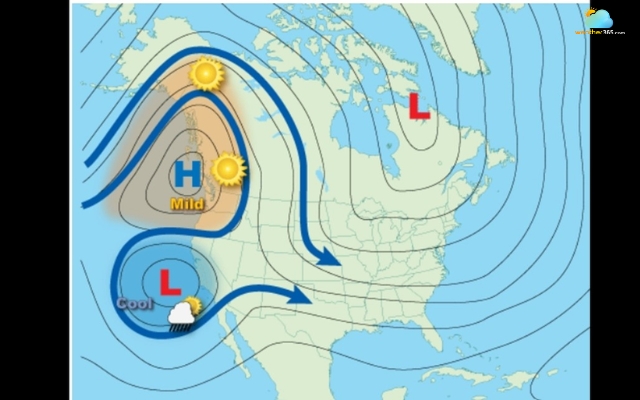
A Rex block is a type of blocking pattern
Cut-off lows
A cut-off low is an upper-level low-pressure system that becomes separated from the jet stream.
Without the jet stream to steer it, the system moves very slowly, often bringing several days of clouds, rain, thunderstorms, and cooler temperatures.
Although it is not a blocking pattern, a cut-off low can also lead to prolonged weather conditions.
Conclusion
Understanding the difference between high and low pressure systems can change how you look at the weather. Instead of guessing, you’ll know why skies stay clear or suddenly turn stormy, and that makes everyday forecasts much easier to follow.
Frequently Asked Questions (FAQs)
Related post

What Is Barometric Pressure? Simple Explanation for Beginners
 1004
1004
 8
8
 5.0
5.0
 30/09/2026
How Does Weather Affect Air Pressure? A Comprehensive Guide
325
8
4.6
18/08/2026

What Is Air Pressure? Understanding Atmospheric Pressure
291
15
5.0
18/08/2026

8 Comment
Giselle Perez
I never realized how useful the simple H and L symbols could be. They’re basically shortcuts for understanding what the atmosphere is doing.
Violet Hill
I’m starting to look at weather maps differently now. Instead of just seeing H and L, I see two different atmospheric personalities competing for space. 😄
Gwendolyn Jackson
Can a high-pressure system ever bring unpleasant weather?
weather365
Yes. High pressure does not automatically mean perfect weather; it can also contribute to heat, cold, fog, or poor air quality depending on the season and local conditions.
Avery Green
Why can low-pressure systems be associated with clouds and precipitation?
weather365
Air tends to rise around areas of low pressure, and rising air can cool and condense moisture, helping clouds and precipitation develop.
Bowen Perkins
Why do high-pressure systems often bring calmer weather?
weather365
Air in a high-pressure system generally sinks, which tends to suppress cloud formation and can lead to more stable conditions.
Leave a comment
Your email address will not be published. Required fields are marked *