




What's the difference between a nor'easter and a hurricane? Full explained


What's the difference between a nor'easter and a hurricane? While both storms can bring powerful winds and heavy precipitation, they are fundamentally different weather systems. Read on to learn how these two storms apart and what dangers each one brings.
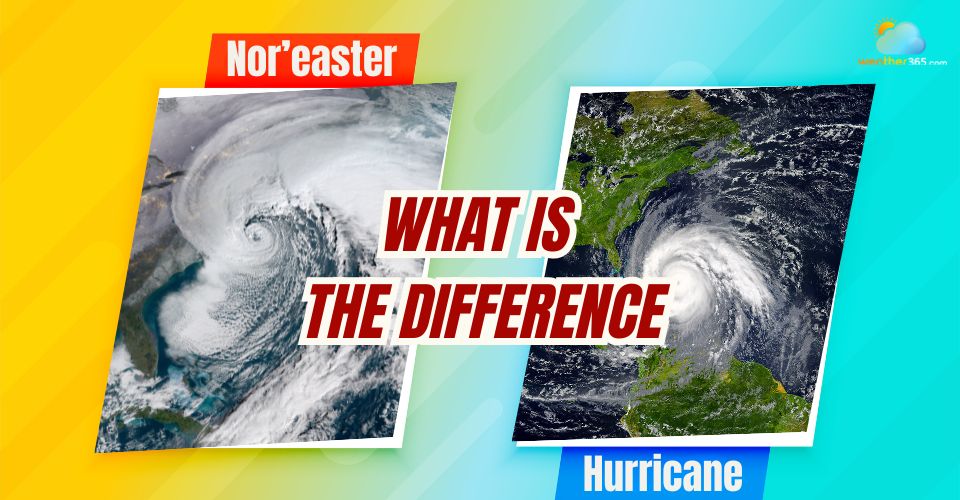
Difference between a Nor’easter and a Hurricane
What is a Nor’easter?
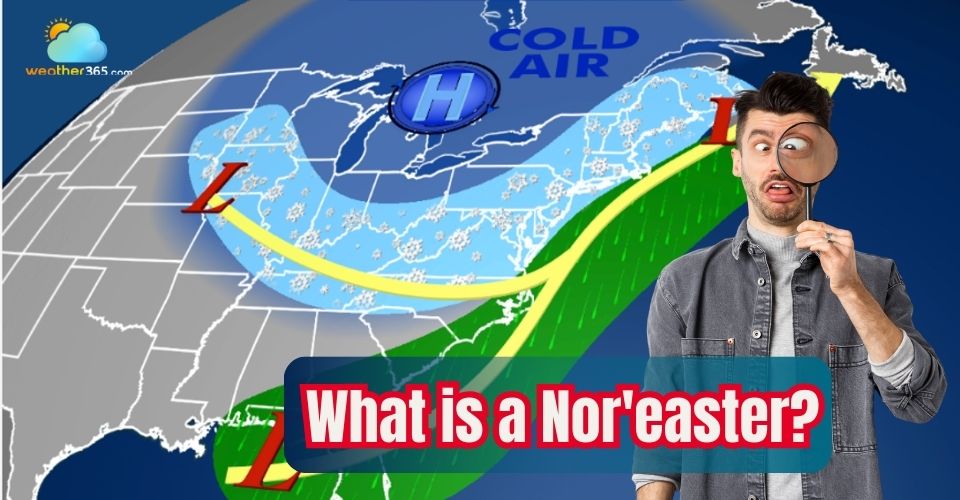
A nor’easter is a powerful low-pressure storm system that develops along the East Coast of the United States. The storm gets its name from the strong northeast winds that blow in from the Atlantic Ocean.
Nor'easters often impact states from Georgia to New Jersey and beyond.
While many associate nor’easters with heavy snowfall, they can also bring flooding rains, strong winds, and coastal storm surges, making them dangerous and disruptive weather events across the region.

Definition of a Nor’easter
What is a hurricane?
A hurricane is a powerful low-pressure weather system that develops over warm tropical ocean waters and produces sustained winds of at least 74 mph.
These storms can unleash destructive winds, torrential rainfall, and life-threatening storm surges that cause widespread flooding along coastal areas.
In the United States, hurricanes typically make landfall along the Atlantic and Gulf coasts.
Most hurricanes form during the Atlantic hurricane season, which runs from June 1 to November 30, with September historically being the most active month.

Definition of a hurricane
What’s the similarity between nor’easters and hurricanes?
Nor’easters and hurricanes have several similarities despite forming in different ways and at different times of the year.
Both are powerful low-pressure systems capable of producing strong winds, heavy rain or snow, and significant coastal flooding.
They both form over the ocean, where they gather moisture and energy before moving inland, often causing severe damage to coastal communities.
Also, they look similar on a satellite image, as well. Both nor’easters and hurricanes are seen as a tightly wound spiral of clouds spinning counterclockwise around a center.
Additionally, both storm types can lead to dangerous travel conditions, power outages, and property damage, depending on their strength and path.
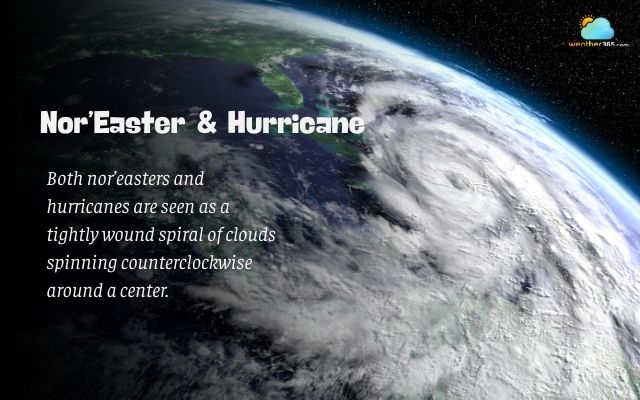
Similarity between a Nor’easter and a hurricane
What's the difference between a nor'easter and a hurricane?
While both Nor'easters and hurricanes are powerful cyclones, they are fundamentally different in their core.
Origin and Formation
A nor’easter is a powerful cold-season storm that usually develops along the East Coast of the U.S. It forms when cold, dry air from the Arctic or Canada clashes with warm, moist air from the Atlantic Ocean.
This temperature contrast, combined with low-pressure systems along the coast, fuels the storm’s intensity.
In contrast, a hurricane is a warm-season tropical cyclone that develops over warm ocean waters, typically in the Atlantic Ocean or Gulf of Mexico.
These storms draw their energy from warm, moist air and require sea surface temperatures of at least 80°F to form.
Season
Nor’easters typically occur between late fall and early spring, with most storms developing from October through April when cold Arctic air masses frequently interact with warmer coastal air.
Hurricanes, however, form mainly during the Atlantic hurricane season, running from June 1 to November 30.
The peak hurricane activity in September, when ocean temperatures are at their highest, creating ideal conditions for storm development.
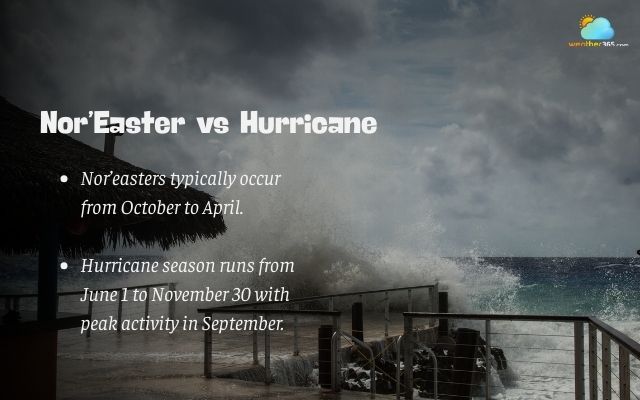
Nor’easter and hurricane season
Wind direction and speed
Nor'easter winds primarily come from the northeast, which is how the storm gets its name. Wind speeds can be strong and damaging, often reaching 50–70 mph in severe storms, but they are usually less intense than hurricane winds.
Whilst hurricane winds rotate counterclockwise around the storm’s eye due to the Coriolis effect, with the strongest winds near the eyewall. Sustained winds of at least 74 mph are classified as hurricanes.
The most powerful ones (Category 5) can exceed 157 mph, causing catastrophic damage.
Weather effects
Nor’easters typically occur in colder months and often deliver heavy snow, sleet, freezing rain, strong winds, and coastal flooding, especially across the Northeast and Mid-Atlantic regions.
To understand these cold-season hazards in a broader context, see our Winter storm overview.
When combined with powerful winds, these conditions can lead to blizzard-like weather, dangerous travel, and widespread power outages.
Hurricanes, on the other hand, form in warm tropical waters and produce torrential rainfall, destructive winds, severe storm surges, and inland flooding.
Their intense wind speeds can devastate coastal communities, destroy infrastructure, and leave long-lasting damage in their path.
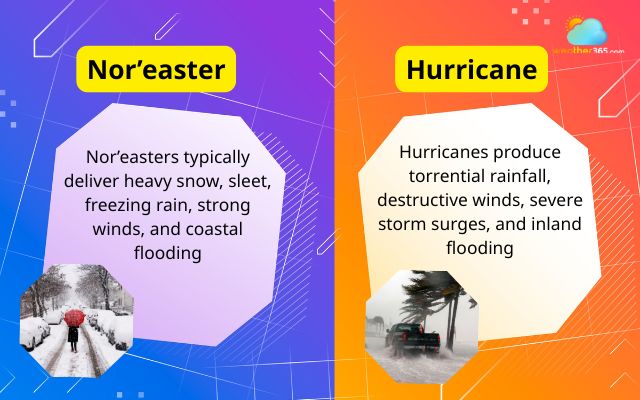
The Nor’easter and hurricane cause different weather effects
Classification
Nor’easters do not have an official classification scale; instead, meteorologists often describe them based on their impacts, including snowfall totals, wind speeds, and coastal flooding risks.
In some cases, the Northeast Snowfall Impact Scale (NESIS) is used, ranking storms from Category 1 (Notable) to Category 5 (Extreme) based on snowfall amounts and the population affected.
If you want a clearer definition of what officially counts as a blizzard (and how it differs from a regular snowstorm), read Difference between snowstorm and blizzard.
Hurricanes, on the other hand, are classified using the Saffir-Simpson Hurricane Wind Scale. Storms are categorized from Category 1 to Category 5 according to sustained wind speeds.
Category 1 hurricanes have winds of 74–95 mph, while Category 5 hurricanes bring catastrophic winds exceeding 157 mph.
Here’s a clear comparison table showing the differences between a Nor’easter and a Hurricane. Have a look.
Feature | Nor’easter | Hurricane |
Formation | Forms along the U.S. East Coast when cold Arctic air collides with warm, moist Atlantic air. | Forms over warm ocean waters in tropical regions, mainly in the Atlantic or Gulf of Mexico. |
Season | Occurs between late fall and early spring (October–April). | Develops during hurricane season, June 1–November 30, peaking in September. |
Wind Direction | Winds blow primarily from the northeast, giving the storm its name. | Winds rotate counterclockwise around a central eye due to the Coriolis effect. |
Wind Speed | Can reach 50–70 mph in severe storms, sometimes stronger during blizzards. | Must have sustained winds of 74 mph or higher; strongest storms exceed 157 mph. |
Weather Effects | Brings heavy snow, sleet, freezing rain, strong winds, and coastal flooding. | Produces torrential rainfall, storm surges, powerful winds, and inland flooding. |
Classification | No official scale; sometimes measured by Northeast Snowfall Impact Scale (NESIS) based on snow and impact. | Uses the Saffir-Simpson Hurricane Wind Scale (Category 1–5) based on wind speed. |
Primary Threats | Blizzard-like conditions, transportation shutdowns, and power outages in the Northeast. | Coastal destruction, flooding, and catastrophic wind damage in tropical and coastal regions. |
Conclusion
Through the article, hope you found the answer to the question "what’s the difference between a Nor'easter and a hurricane?". Nor’easters strike mainly in colder months with heavy snow, rain, and strong winds along the East Coast, while hurricanes form over warm ocean waters during hurricane season, bringing intense winds, storm surge, and flooding. Knowing these differences ensures better preparation and safety during extreme weather events.
Frequently Asked Questions (FAQs)
Related post
What Is A Nor'easter? Definitions, Weather Effects And Safety Tips
 2337
2337
 8
8
 5.0
5.0
 01/04/2026

8 Comment
Gracelyn Douglas
Can a hurricane actually turn into a Nor’easter?
weather365
Rarely, yes. Superstorm Sandy is a well-known example of a hurricane that transitioned into a storm with Nor’easter-like characteristics.
Eleanor Howard
I didn’t know Nor’easters don’t have an official category scale like hurricanes do.
Axel Morales
Why do Nor’easters happen mostly from October to April?
weather365
That’s when cold Arctic air is more likely to collide with warm, moist air along the East Coast, helping these storms strengthen.
Keith Davidson
The 74 mph threshold for hurricanes makes the comparison much clearer.
Walter Allen
Can a Nor’easter really be as destructive as a hurricane?
weather365
Yes. Strong Nor’easters can cause major flooding, power outages, transportation problems, and billions of dollars in damage.
Leave a comment
Your email address will not be published. Required fields are marked *