




What Causes An Atmospheric River? A Full Explanation


What causes an atmospheric river? These massive moisture bands can transport more water vapor than the Mississippi River and trigger dangerous floods, landslides, and heavy snowfall worldwide. In this guide, Weather365 explains the science behind atmospheric rivers, their impacts, and how to stay prepared. Keep reading to fully understand this powerful weather phenomenon.
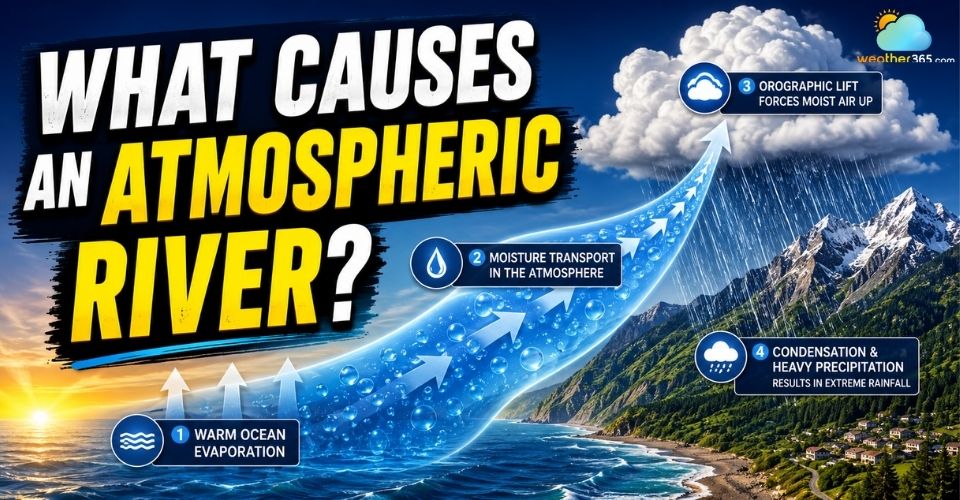
What causes an atmospheric river
- What is an atmospheric river?
- “Atmospheric river”
- Key characteristics of atmospheric rivers
- What are the atmospheric river categories
- Category 1: Weak
- Category 2: Moderate
- Category 3: Strong
- Category 4: Extreme
- Category 5: Exceptional
- What causes an atmospheric river?
- Tropical moisture and evaporation
- The jet stream acts like a highway
- Cold fronts and cyclones organize the moisture
- Orographic lift triggers heavy rain and snow
- How does atmospheric river impact?
- Positive impacts
- Negative impacts
- How to prepare for atmospheric rivers
What is an atmospheric river?
An atmospheric river, often shortened to AR, is a long, narrow band of concentrated moisture in the atmosphere that transports enormous amounts of water vapor across the sky.
These weather systems usually form over tropical oceans and move with strong winds toward land, where they can release intense rain or snow.
Atmospheric rivers are sometimes described as “rivers in the sky” because they carry huge quantities of moisture over thousands of miles.
In fact, a single atmospheric river can transport more water than the Mississippi River, and in some extreme cases, even rival the Amazon River.
“Atmospheric river”
The term “atmospheric river” was first introduced in the 1990s by scientists Yong Zhu and Reginald E. Newell from the Massachusetts Institute of Technology (MIT).
Since then, the concept has become essential in modern meteorology and climate science.
One of the most famous examples is the Pineapple Express, an atmospheric river that carries warm, moist air from near Hawaii to the west coast of North America.
This system is known for bringing heavy rainfall, flooding, and mountain snow to parts of California and the Pacific Northwest.
If you live along the West Coast, stay ahead of approaching storm systems by taking a moment to check Seattle WA weather conditions before heading out.

The atmospheric river was first introduced in the 1990s
Key characteristics of atmospheric rivers
Massive moisture transport: Atmospheric rivers move enormous volumes of water vapor through the atmosphere.
Tropical origins: Most atmospheric rivers begin over warm tropical oceans where evaporation is strongest.
Long-distance movement: Powerful winds and jet streams can carry them across entire oceans.
Major weather impacts: They contribute significantly to annual rainfall and snowfall in regions such as the US West Coast, Europe, and New Zealand.
Narrow but powerful: Although they are typically only 250–375 miles wide, they can stretch for thousands of miles in length.
Atmospheric rivers are not always dangerous. In some dry regions, they provide much-needed rainfall and help refill reservoirs.
However, when they become too intense or remain stationary for too long, they can trigger severe flooding, landslides, and infrastructure damage.
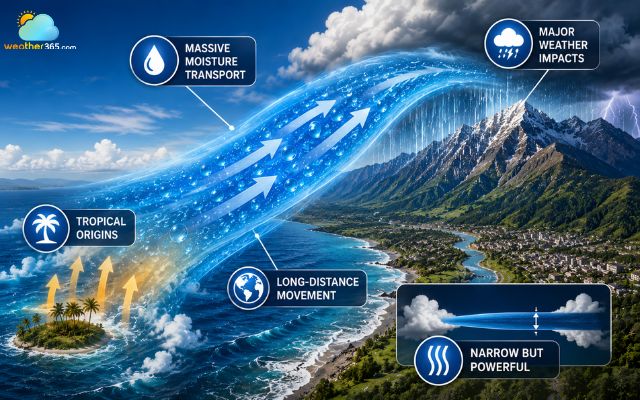
Features of an atmospheric river
What are the atmospheric river categories
Meteorologists classify atmospheric rivers using a ranking system that measures both intensity and duration.
The scale ranges from Category 1 to Category 5, similar to hurricane classifications.
Category 1: Weak
Category 1 atmospheric rivers are considered mostly beneficial. They usually bring light to moderate rainfall or snowfall that helps replenish reservoirs, rivers, and groundwater supplies.
These weaker storms are especially important in drought-prone regions because they deliver much-needed moisture without causing major damage.
Mountain areas may receive healthy snowfall that supports water supplies later in the year.
Although minor travel disruptions can still occur, Category 1 events rarely cause serious flooding or destruction.
Category 2: Moderate
Category 2 atmospheric rivers are still primarily beneficial, but they carry a slightly higher risk of localized impacts.
These storms can produce heavier rainfall over longer periods, which may lead to small floods in low-lying or poorly drained areas.
Some roads may experience temporary closures due to water accumulation or minor landslides.
At the same time, Category 2 events often play a critical role in improving reservoir levels and building mountain snowpack.
In many western coastal regions, these storms are considered an important source of annual precipitation.
Category 3: Strong
Category 3 atmospheric rivers represent a balance between beneficial and hazardous effects.
At this level, rainfall becomes significantly heavier and more persistent. Urban flooding becomes more likely, especially in cities with overwhelmed drainage systems.
Rivers and streams may begin rising rapidly, and mountain areas can experience heavy snowfall.
Additional impacts may include:
Road closures
Mudslides and minor landslides
Fallen trees
Power outages
Travel disruptions
While these storms still contribute valuable water resources, they also begin posing serious risks to infrastructure and public safety.
Category 4: Extreme
Category 4 atmospheric rivers are mostly hazardous and can cause widespread damage.
These powerful systems deliver intense and prolonged precipitation that often overwhelms rivers, storm drains, and flood-control systems.
Flooding may become severe in both urban and rural areas.
Common impacts include:
Major river flooding
Significant landslides
Infrastructure damage
Highway closures
Damaged homes and businesses
Emergency evacuations
Mountain regions may receive extreme snowfall, increasing avalanche risks and making travel extremely dangerous.
Category 5: Exceptional
Category 5 atmospheric rivers are the most dangerous and destructive events on the scale.
These storms are capable of producing catastrophic flooding, widespread landslides, and long-lasting infrastructure damage.
Entire communities may face evacuation orders as rivers overflow and hillsides collapse under saturated soil conditions.
Category 5 atmospheric rivers can cause:
Historic flood events
Large-scale transportation shutdowns
Massive property damage
Extended power outages
Billions of dollars in economic losses
Serious threats to human life
Because of their extreme intensity, these events are often remembered for years after they occur.
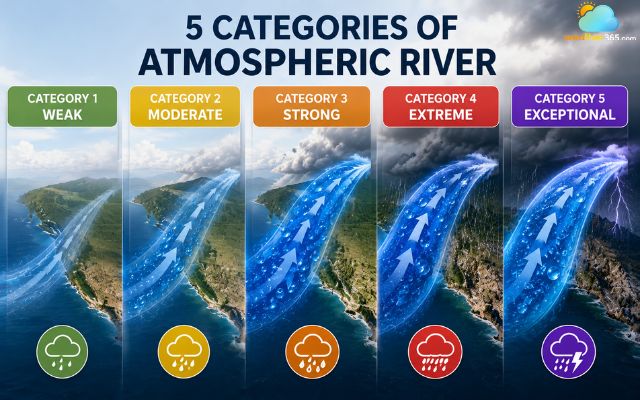
5 categories of an atmospheric river
What causes an atmospheric river?
Understanding what causes an atmospheric river requires looking at several connected weather processes that work together to transport moisture across the atmosphere.
Tropical moisture and evaporation
The first major factor behind atmospheric rivers is intense evaporation over warm tropical oceans.
Solar heat warms ocean surfaces in tropical and subtropical regions, causing large amounts of water to evaporate into the atmosphere.
This creates huge reservoirs of water vapor suspended in the air.
Warm air can hold more moisture than cold air, which is why tropical regions are ideal sources for atmospheric rivers.
As evaporation continues, moisture accumulates and becomes available for transport by large-scale wind systems.
Without this constant supply of evaporated ocean water, atmospheric rivers would not form.
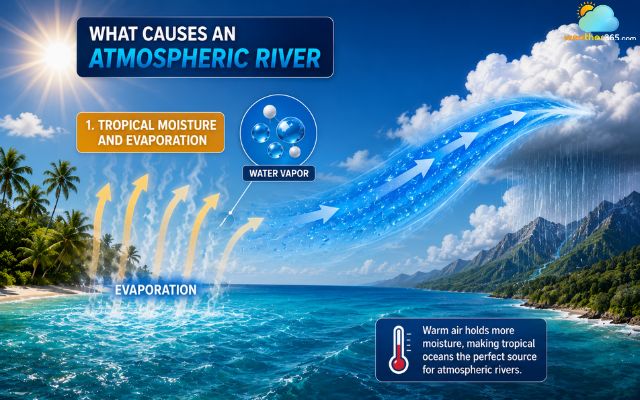
Evaporation over warm tropical oceans causes an atmospheric river
The jet stream acts like a highway
Another key answer to the question what causes an atmospheric river is the role of the jet stream.
The jet stream is a fast-moving current of air high in the atmosphere. It acts like a highway that guides moisture across long distances.
Strong winds associated with extratropical cyclones help steer these moisture-rich air masses thousands of miles away from their tropical origins.
As the jet stream shifts position, atmospheric rivers can move toward different regions around the world.
This explains why places such as California, Western Europe, and New Zealand frequently experience these events.
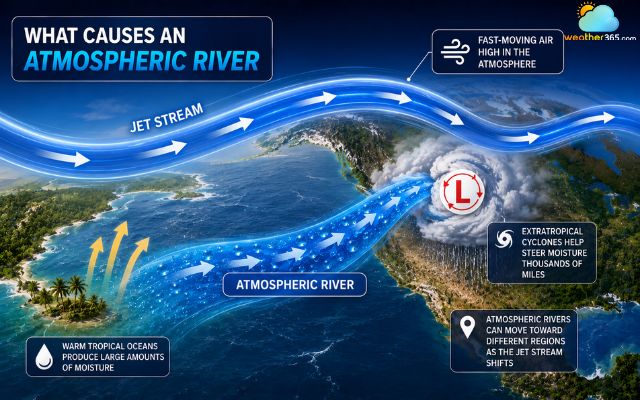
The role of the jet stream
Cold fronts and cyclones organize the moisture
Atmospheric rivers become more concentrated when cold fronts and low-pressure cyclones organize the moisture into narrow bands.
These weather systems pull warm, moist air into a focused plume ahead of a cold front.
The moisture becomes compressed into a corridor that is often only a few hundred miles wide but extremely long.
In a similar way to how a turbidity current forms a highly concentrated, fast-moving flow of sediment under the ocean, the atmosphere creates these powerful narrow channels of water vapor.
This concentrated transport system allows atmospheric rivers to deliver enormous amounts of precipitation once they reach land.
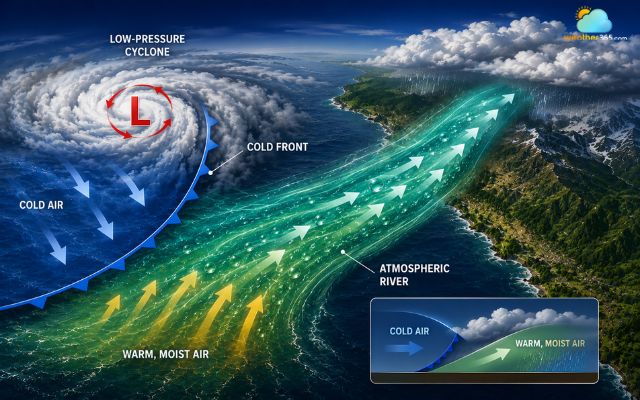
Cold fronts organize the moisture into narrow bands
Orographic lift triggers heavy rain and snow
One of the final and most important stages in atmospheric river formation is called orographic lift.
When moisture-filled air reaches coastal mountains, it is forced upward along the slopes.
As the air rises, it cools rapidly. Cooler air cannot hold as much moisture, so the water vapor condenses into clouds and precipitation.
This process can produce:
Torrential rainfall
Intense snowfall in mountain regions
Landslides
River overflow
Mountain ranges along coastlines greatly amplify the impacts of atmospheric rivers.
This is why areas near mountains often experience the heaviest rainfall during these events.
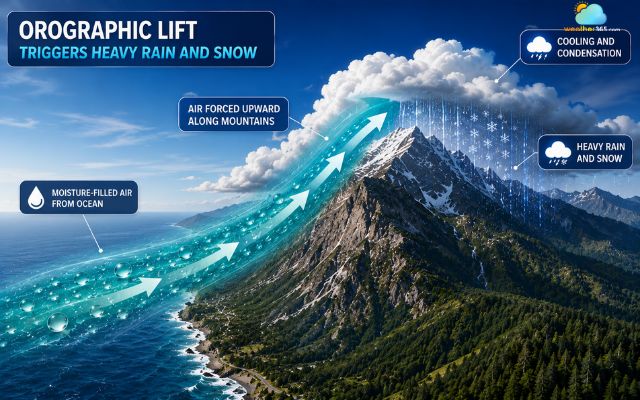
Moisture-filled air forces upward along the slopes
How does atmospheric river impact?
Atmospheric rivers can bring both benefits and serious dangers depending on their strength, duration, and location.
Positive impacts
In many regions, atmospheric rivers are essential sources of freshwater.
Benefits include:
Refilling reservoirs
Restoring snowpack in mountains
Reducing drought conditions
Supporting agriculture
Replenishing groundwater supplies
For example, atmospheric rivers contribute a large portion of annual precipitation along the US West Coast.
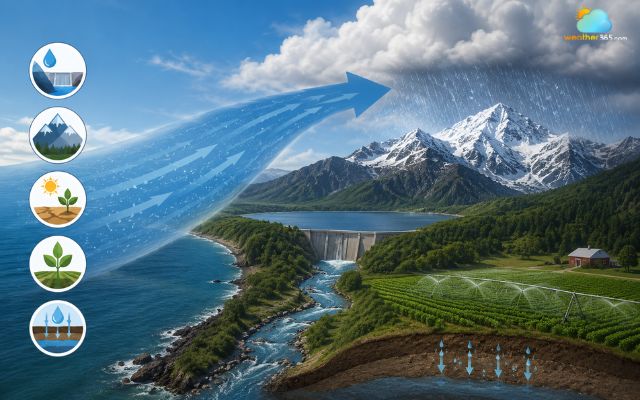
Positive sides of an atmospheric river
Negative impacts
Flooding and infrastructure damage
Strong atmospheric rivers can also become highly destructive.
Heavy rainfall over short periods can overwhelm drainage systems and rivers, leading to:
Flash floods
Urban flooding
Damaged roads and bridges
Power outages ( Read more: Power outage safety tips )
Transportation disruptions
Some atmospheric river events in California have caused billions of dollars in damage and forced large-scale evacuations.
To track incoming storms in real time, residents should always view the latest Los Angeles CA weather forecast before planning outdoor travel.
Landslides and erosion
When soil becomes oversaturated, hillsides may collapse, triggering landslides and mudslides.
These events can destroy homes, block highways, damage pipelines, or even threaten human safety
Coastal erosion may also worsen during prolonged storms.
Extreme snowfall
In colder mountain regions, atmospheric rivers can produce massive snowfall instead of rain.
Heavy snow may help water supplies long term, but it can also create:
Avalanche risks
Dangerous travel conditions
Structural damage from snow loads
Climate change and stronger atmospheric rivers
Scientists believe climate change may intensify atmospheric rivers in the future.
Warmer air can hold more moisture, meaning future atmospheric rivers could transport larger amounts of water vapor and produce heavier precipitation.
Some regions may experience more severe flooding events as global temperatures continue rising.
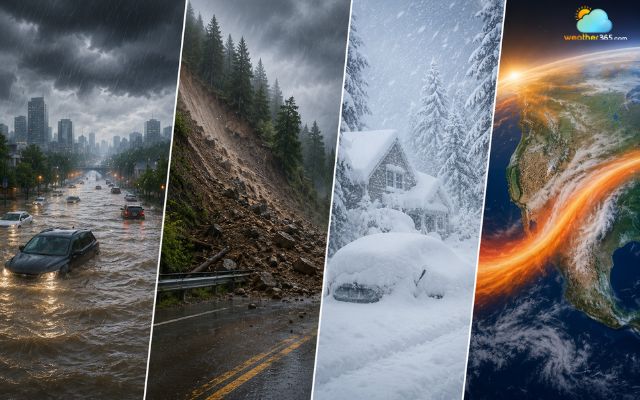
An atmospheric river may pose several dangers
How to prepare for atmospheric rivers
Although atmospheric rivers cannot be prevented, people can reduce risks and improve safety through preparation.
Stay informed
Monitor weather forecasts regularly
Follow emergency alerts from local authorities
Prepare for evacuation orders if necessary
Protect your home
Clear gutters and drainage systems
Use sandbags in flood-prone areas
Inspect roofs and windows for leaks
Prepare emergency supplies
Keep an emergency kit that includes:
Drinking water
Non-perishable food
Flashlights
Batteries
Medications
Portable chargers
Avoid floodwaters
Never drive or walk through flooded roads.
Fast-moving water can be much deeper and stronger than it appears.
Plan for power outages
Atmospheric rivers can knock down trees and power lines. Charge devices early and keep backup batteries ready.
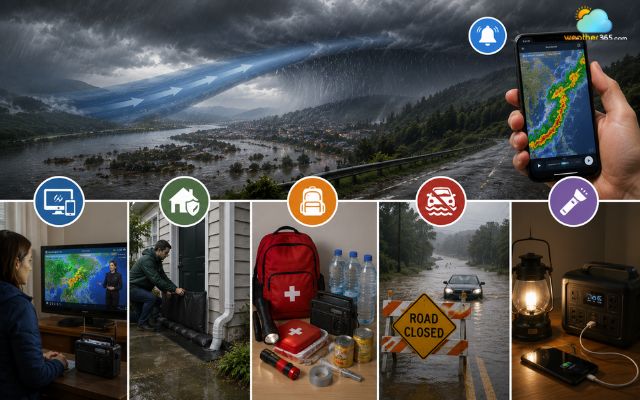
Stay safe before an atmospheric river
Closing thoughts
Now that you understand what causes an atmospheric river, it becomes easier to see why these weather systems are both essential and dangerous. They deliver critical water supplies to many regions but can also trigger destructive floods and landslides. As climate patterns continue changing, understanding atmospheric rivers and staying prepared will become increasingly important.
Frequently Asked Questions (FAQs)
Related post
What is a turbidity current? Understanding Causes, Effects, and Solutions
 180
180
 0
0
 4.6
4.6
 03/09/2026

What is the largest whirlpool in the world? Safety tips for visiting
180
0
4.7
03/09/2026
What causes a whirlpool in the ocean? Causes, Dangers and Survival Tips
161
0
4.6
03/09/2026

0 Comment
Leave a comment
Your email address will not be published. Required fields are marked *