




What is the pineapple express? Distinguish pineapple express vs atmospheric river


What is the pineapple express, and why can it trigger massive flooding, landslides, and heavy mountain snow across the U.S. West Coast? This powerful weather pattern is responsible for some of the region’s most extreme winter storms. Read on to discover how it forms, why it matters, and how it differs from a typical atmospheric river.
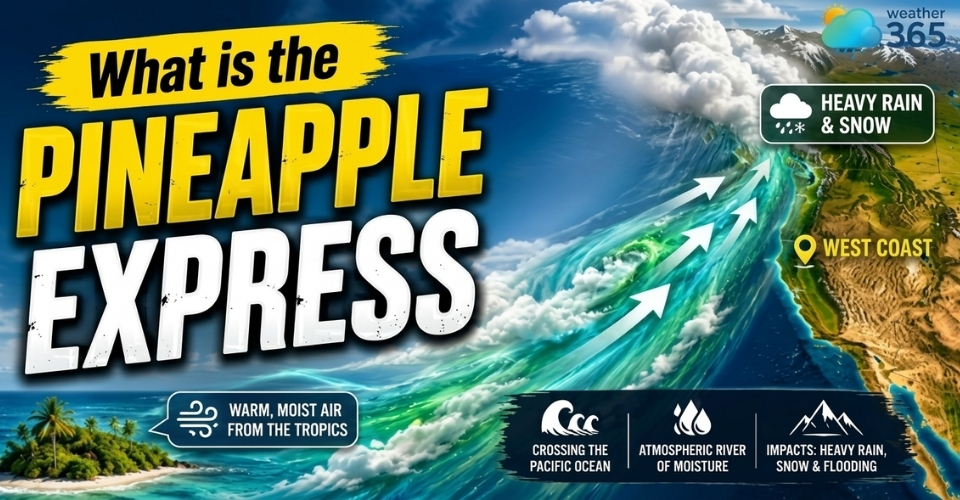
What is the Pineapple Express
- What is the pineapple express?
- Why is it called the Pineapple Express?
- Key characteristics of the Pineapple Express
- Why does the Pineapple Express bring heavy rain, flooding, and snow?
- Pineapple Express vs. Atmospheric River: Key Difference
- How does the pineapple express form?
- Impacts of the pineapple express
What is the pineapple express?
The Pineapple Express is a specific type of atmospheric river that carries warm, moisture-rich air from the tropical Pacific near Hawaii to the western coast of North America.
It is famous for producing intense rain, flooding, powerful storms, and heavy mountain snow, especially in California, Oregon, Washington, and parts of British Columbia.
Before heading out during storm season, track live storm conditions in San Francisco, CA to see if an atmospheric river is headed your way.
Although the name sounds unusual, it simply refers to the storm’s origin near Hawaii, historically associated with pineapples.
As this long corridor of tropical moisture stretches northeast across the Pacific Ocean toward the U.S. West Coast, meteorologists began calling it the “Pineapple Express.”
Pineapple Express transports enormous amounts of water vapor through the atmosphere.
When this moisture reaches land and collides with mountain ranges, it condenses into heavy precipitation.
Why is it called the Pineapple Express?
The term comes from two ideas:
“Pineapple” refers to Hawaii, where the moisture often originates.
“Express” describes the fast-moving flow of tropical moisture traveling across the Pacific Ocean.
Because these systems draw moisture from warm subtropical waters near Hawaii, they are usually warmer and wetter than normal winter storms.
(Read more: What causes an atmospheric river?)
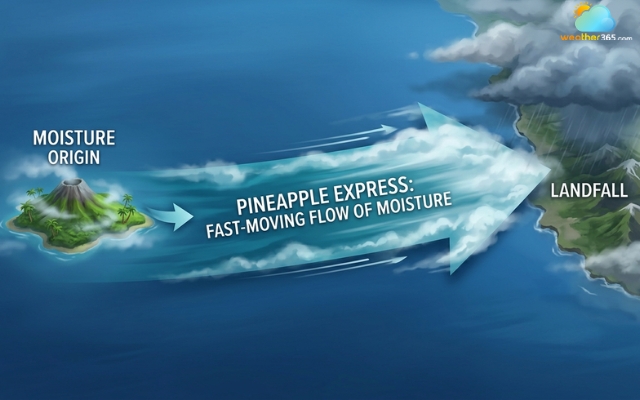
Why “Pineapple”?
Key characteristics of the Pineapple Express
Origin: Near Hawaii
The Pineapple Express typically develops near the Hawaiian Islands, where warm ocean temperatures allow large amounts of moisture to evaporate into the atmosphere.
Path: Northeast toward the U.S. West Coast
The moisture plume stretches thousands of miles across the Pacific Ocean before reaching the West Coast of North America.
Type: A concentrated atmospheric river
It is essentially a narrow corridor of highly concentrated water vapor in the atmosphere.
Season: Most common in winter
These events are most frequent during winter when the jet stream shifts southward and helps steer tropical moisture toward North America.
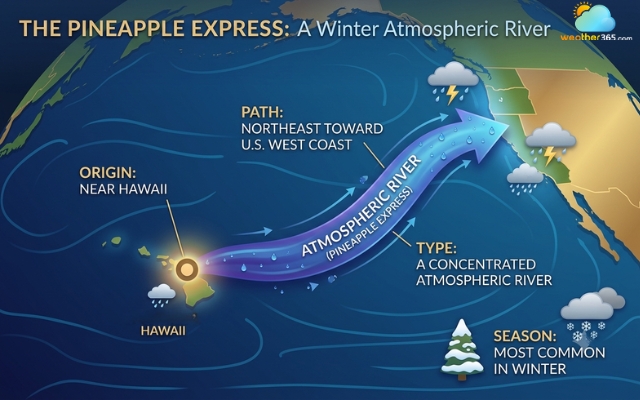
Facts about Pineapple Express
Why does the Pineapple Express bring heavy rain, flooding, and snow?
The Pineapple Express can produce dangerous weather because it combines tropical moisture, strong winds, and mountainous terrain.
Tropical moisture source
Warm waters near Hawaii continuously feed the system with enormous amounts of water vapor. This creates a nearly endless supply of moisture for storms.
“Rivers in the sky”
Atmospheric rivers are narrow but extremely powerful. Some stretch thousands of miles long and transport more water vapor than many of Earth’s largest rivers.
Mountain uplift intensifies precipitation
When moist air reaches the Sierra Nevada and Cascade Range, it is forced upward. As the air rises, it cools and condenses into intense rainfall or snowfall.
This process can generate:
10–20 inches of rainfall in some regions
Several feet of snow in higher elevations
Warm storms increase flooding risk
Unlike colder winter storms, Pineapple Express systems often carry relatively warm air from the tropics. Rain may fall on existing snowpacks, rapidly melting snow and dramatically increasing flood risks.
Extreme intensity
Some studies estimate that atmospheric rivers, including Pineapple Express events, contribute up to 65% of extreme rainfall and snow events on the West Coast. These storms can trigger:
Flash flooding
Mudslides
Road washouts
Infrastructure damage
Power outages
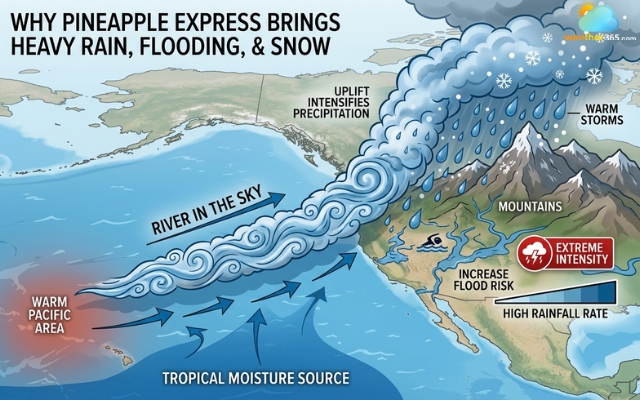
The Pineapple Express can bring dangerous weather phenomena
Pineapple Express vs. Atmospheric River: Key Difference
The Pineapple Express is a specific type of atmospheric river, but not every atmospheric river is a Pineapple Express.
Many people confuse the two terms because they are closely connected.
However, there is an important difference in where the moisture comes from and how the storm behaves.
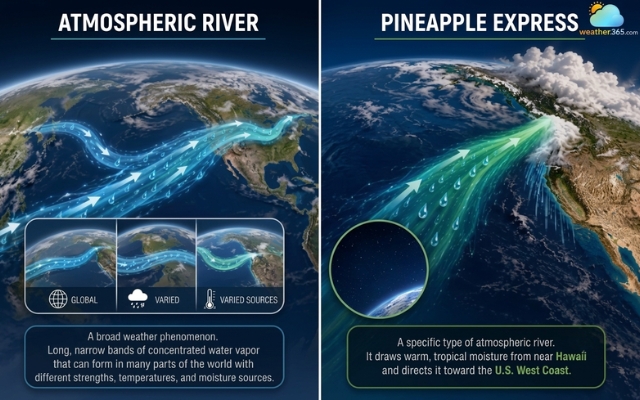
Difference between a pineapple express and an atmospheric river
An atmospheric river is a broad weather phenomenon.
It refers to a long, narrow band of concentrated water vapor moving through the atmosphere.
These systems can form in many parts of the world and vary in strength, temperature, and moisture source.
The Pineapple Express, on the other hand, is a well-known atmospheric river that specifically pulls warm tropical moisture from near Hawaii and directs it toward the U.S. West Coast.
In short,
Atmospheric river = the general category
Pineapple Express = a famous subtype within that category
Another key difference is Temperature.
Because the Pineapple Express originates in the subtropics, it usually carries warmer air than many other atmospheric rivers.
This warm moisture often turns winter snow into heavy rain at lower elevations, increasing the risk of flooding and rapid snowmelt.
Regular atmospheric rivers may not always be this warm or intense. Some can be weaker, colder, or form in entirely different ocean regions.
Here’s a quick comparison:
Pineapple Express | Atmospheric River |
A specific type of atmospheric river | A general weather phenomenon |
Moisture comes from near Hawaii | Moisture can originate from many regions |
Primarily affects the U.S. West Coast | Occurs worldwide |
Usually warmer and wetter | Can be warm or cold |
Often linked to flooding in California | Includes storms of varying intensity |
How does the pineapple express form?
The Pineapple Express typically forms during the winter months when changes in the jet stream allow tropical moisture to move farther north across the Pacific Ocean.
The process begins when strong winds over the Pacific pull warm, moisture-rich air from near Hawaii.
This creates a long, narrow band of concentrated water vapor in the atmosphere.
As the system approaches the U.S. West Coast, several things happen:
Warm tropical waters add moisture to the atmosphere
The formation begins near Hawaii, where ocean temperatures are relatively warm year-round.
As intense sunlight heats the upper layers of the Pacific Ocean, large amounts of water evaporate into the air.
This sunlight is strongest at the surface, which is why the ocean gets darker as you dive deeper into zones where solar rays cannot penetrate
This creates a humid air mass packed with water vapor. The warmer the ocean surface becomes, the more moisture the atmosphere can hold.
The jet stream creates a moisture pathway
Next, the jet stream plays a major role. The jet stream is a fast-moving band of winds high in the atmosphere that helps steer storms across the Pacific.
During certain winter weather patterns, the jet stream dips south and forms a direct channel between Hawaii and the West Coast.
This allows tropical moisture to move quickly across thousands of miles of ocean.
Without the jet stream acting like a conveyor belt, the Pineapple Express would not develop in the same organized way.
Moist air reaches the West Coast
As the moisture plume approaches California, Oregon, or Washington, it encounters cooler air and mountainous terrain.
When the warm air is forced upward over mountain ranges such as the Sierra Nevada or Cascades, it cools rapidly.
Cooler air cannot hold as much moisture, so the water vapor condenses into thick clouds and heavy precipitation.
This is why Pineapple Express storms often produce long-lasting rain at lower elevations and heavy snow in the mountains.
Prolonged storms increase impacts
Unlike short thunderstorms, Pineapple Express systems can remain in place for several days. Because the atmospheric moisture flow continues nonstop, rainfall totals can rise very quickly.
In stronger events, this can lead to:
River flooding
Landslides
Snowpack buildup in mountains
Rapid snowmelt at lower elevations
Travel and infrastructure disruptions
The combination of tropical moisture, strong winds, and mountain uplift is what makes the Pineapple Express one of the most powerful winter weather patterns on the West Coast.
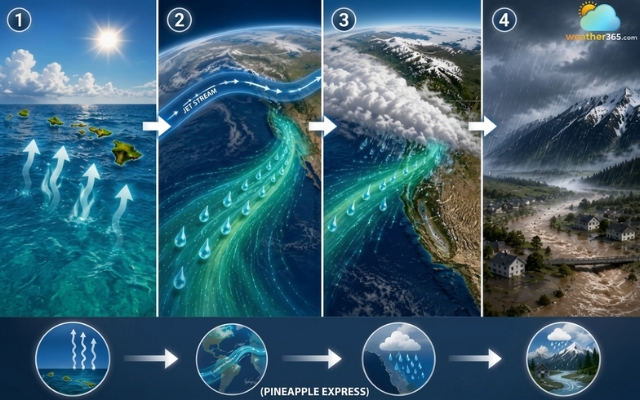
The Pineapple Express usually forms during winter months
Impacts of the pineapple express
The Pineapple Express can bring both major benefits and serious hazards, supplying much-needed water to the West Coast while also causing flooding, landslides, and damaging winter storms.
Intense rainfall and flooding
One of the biggest dangers is extreme rainfall.
Strong Pineapple Express events can dump more than 5 inches of rain in a single day across parts of California.
When rain falls faster than the ground can absorb it, flooding develops quickly, especially in urban areas where concrete limits drainage.
These storms can also trigger flash floods, landslides, mudslides, and river overflow.
Areas recently affected by wildfires are particularly vulnerable because damaged soil absorbs less water.
Water supply and drought relief
Despite the risks, the Pineapple Express is essential for the western U.S. water supply.
Atmospheric rivers provide a significant portion of annual rainfall and snowfall in California and the Pacific Northwest, sometimes contributing 25% to 50% of yearly precipitation totals.
This moisture helps refill reservoirs, support agriculture, build mountain snowpack, and reduce drought conditions across the region.
Mountain snow and rapid snowmelt
At higher elevations, the Pineapple Express often brings heavy snowfall.
However, because these systems carry warm tropical air, they can also melt existing snowpacks quickly.
This rapid snowmelt increases runoff and raises flood risks in nearby rivers and valleys.
Transportation and infrastructure disruptions
Heavy rain, flooding, and strong winds frequently disrupt transportation and infrastructure along the West Coast.
Roads may close due to flooding or mudslides, while airports often experience delays and cancellations during major storms.
Power outages, fallen trees, and damage to roads, bridges, and buildings are also common during stronger events.
Environmental effects
The Pineapple Express can negatively affect ecosystems and water quality.
Heavy runoff may erode soil, remove nutrients from farmland, and carry pollutants into rivers, lakes, and coastal waters.
Coastal hazards
In coastal regions, especially in the Pacific Northwest, these storms can generate large waves, strong winds, and coastal flooding.
Beach erosion and shoreline damage become more severe when storms arrive during high tides.
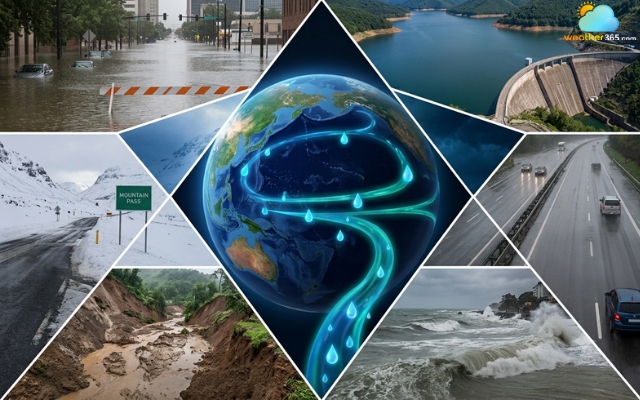
Potential impacts of the pineapple express
What can people do to reduce the impacts of Pineapple express?
While the Pineapple Express cannot be prevented, communities can reduce damage through preparation and smarter infrastructure planning.
Some important solutions include:
Improving flood control systems and storm drainage
Restoring wetlands that naturally absorb water
Strengthening levees and reservoirs
Expanding early warning systems
Avoiding construction in high-risk flood zones
Preparing emergency evacuation plans
Stay safe by checking localized forecasts regularly - you can get real-time weather alerts for Portland, OR to prepare before heavy rain hits.
For individuals, staying informed during major storm events is one of the best ways to stay safe.
Monitoring forecasts, avoiding flooded roads, and preparing emergency supplies can significantly reduce risks during a powerful Pineapple Express event.
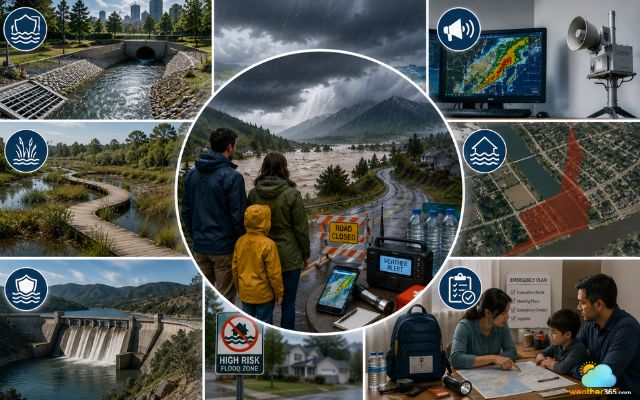
Methods to reduce the Pineapple Express’s impacts
The bottom line
What is the Pineapple Express? It is a powerful atmospheric river that transports warm tropical moisture from near Hawaii to the U.S. West Coast, bringing both valuable rainfall and dangerous flooding. Understanding how the Pineapple Express forms and impacts communities can help people better prepare for extreme winter weather and changing climate patterns.
Frequently Asked Questions (FAQs)
Related post

What is the largest whirlpool in the world? Safety tips for visiting
 190
190
 0
0
 4.7
4.7
 03/09/2026
What is a turbidity current? Understanding Causes, Effects, and Solutions
180
0
4.6
03/09/2026
What causes a whirlpool in the ocean? Causes, Dangers and Survival Tips
161
0
4.6
03/09/2026

0 Comment
Leave a comment
Your email address will not be published. Required fields are marked *