



What is Dew Point? A Complete Science & Weather Guide


What is dew point, and why do meteorologists often rely on it more than humidity? This simple measurement can reveal how comfortable, sticky, or dry the air actually feels. In this guide, you'll learn how dew point works, how it is calculated, and why it matters for weather forecasts, health, and everyday comfort. Diving in!
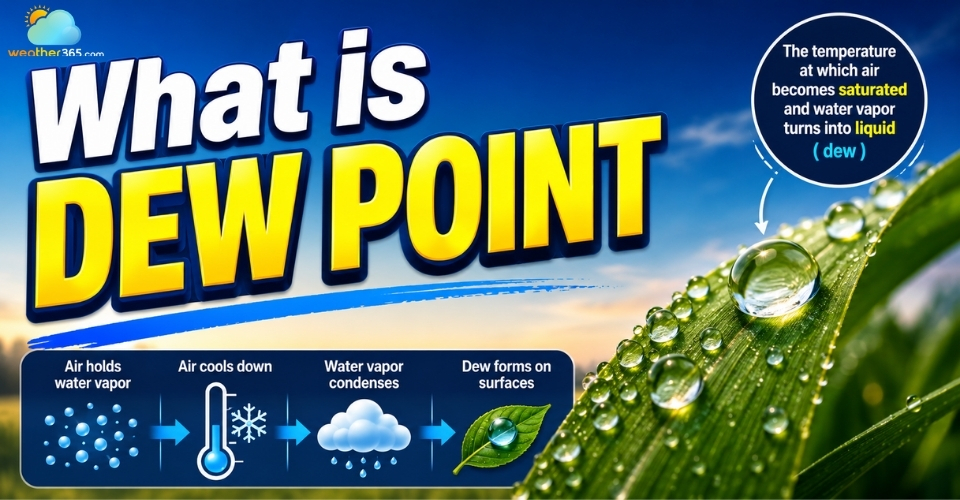
What is dew point
What is Dew Point?
Dew point is the temperature at which air becomes fully saturated with moisture and water begins to condense into liquid droplets.
When the air cools down to its dew point temperature, it can no longer hold all of its moisture, causing condensation to form as dew, fog, or even frost in colder conditions.
Meteorologists often use it to describe how humid the air truly feels.
Why Does Dew Point Matter?
Dew point matters because it affects both weather conditions and human comfort.
A higher dew point means there is more moisture in the air.
As moisture levels increase, sweat evaporates more slowly from your skin, making hot weather feel even more uncomfortable.
This is why a summer day with a high dew point often feels sticky or muggy, even if the temperature itself is not extreme.
Dew point is also important for forecasting weather events.
It helps meteorologists predict fog formation, cloud development, rainfall potential, and overnight dew accumulation.
For instance, when the ambient temperature drops to equal the dew point, fog forms as shown on Chicago Illinois hourly dew point charts.
Farmers, pilots, and outdoor workers often pay close attention to dew point values because they can influence visibility and working conditions.

Dew point affects weather conditions and human comfort
Dew Point Example
Imagine two days with the same air temperature of 85°F (29°C).
In a desert climate like Nevada, the current dew point in Las Vegas might sit around 40°F (4°C).
The air feels incredibly dry and refreshing because sweat evaporates instantly.
Meanwhile, on the coast of Florida, the real-time dew point in Miami could easily reach 75°F (24°C) at the same temperature.
The air here feels thick, heavy, and exhausting because the high moisture levels trap heat against your skin.
This example shows why dew point is often a better indicator of comfort than humidity percentages alone.
When the dew point rises, the air usually feels noticeably more humid regardless of the actual temperature.

The 50°F dew point feels comfortable
Dew Point vs Relative Humidity
Dew point measures the actual moisture in the air, while relative humidity measures how close the air is to saturation.
Although both describe atmospheric moisture, they are not the same.
Relative humidity is expressed as a percentage and changes whenever air temperature changes.
Dew point, on the other hand, remains much more stable because it reflects the actual amount of water vapor in the air.
For example, a summer morning may have 90% relative humidity, while the afternoon drops to 50%.
Even though the percentage changes significantly, the amount of moisture in the air may remain nearly the same.
In this situation, the dew point would change very little and provide a more accurate picture of humidity.
As a general rule:
Low dew point = dry and comfortable air
High dew point = humid and sticky air
High relative humidity = air is close to saturation
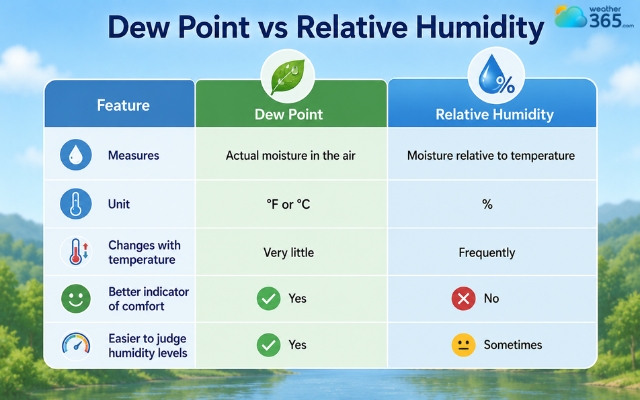
Dew point vs relative humidity difference
How Is Dew Point Calculated
Dew point is calculated by measuring the air temperature and relative humidity, then calculating the result with the Magnus-Tetens formula or a quick mental rule.
Specifically, the basic dew point is: 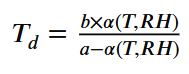
Where:
Td = Dew point temperature
T = Air temperature
RH = Relative humidity (%)
a = 17.27
b = 237.7°C
And:
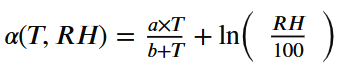
Although the formula looks complex, modern weather stations, weather apps, and forecasting systems perform these calculations instantly.
If this formula seems too complicated, there is a quick mental rule only using the temperature and relative humidity to make the calculation simpler:
Dew point ≈ Air Temperature − (100 - Relative humidity)/5
Suppose:
Air temperature = 30°C
Relative humidity = 70%
Step 1: Calculate
 = (17.27×30)/(237.7+30) + ln(0.70)
≈ 1.579
Step 2: Calculate the dew point.
Td = (237.7x1.579)/(17.27-1.579)
Td ≈ 23.9°C
→ The dew point is approximately 24°C (75°F). If the air cools to this temperature, condensation will begin to form.
For everyday weather estimates, you can use this simple rule:
Dew point ≈ Air Temperature − (100 - Relative humidity)/5
≈ 30 - 100 - 705
≈ 30 - 6
≈ 24 °C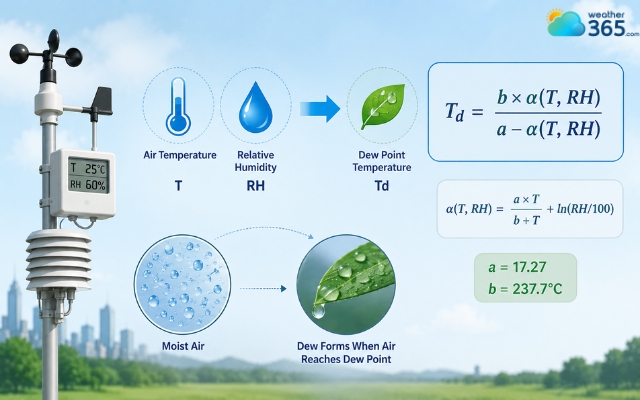
Dew point is calculated by combining air temperature and moisture
The Dew Point Comfort Scale
The dew point comfort scale shows how humid the air actually feels.
In general, higher dew points make the air feel more humid, sticky, and uncomfortable because sweat evaporates less efficiently from your skin.
Unlike relative humidity, which changes with temperature, the dew point provides a more consistent measure of atmospheric moisture.
This is why meteorologists often use it to describe how comfortable or uncomfortable the weather will feel.
Low Dew Points Feel Dry and Comfortable
When the dew point is below 55°F (13°C), most people consider the air pleasant and refreshing. Moisture levels are relatively low, making outdoor activities more comfortable.
In very dry conditions, however, some people may notice dry skin, chapped lips, or irritated eyes.
Moderate Dew Points Feel Slightly Humid
As the dew point climbs into the 60°F to 64°F (16°C to 18°C) range, the air starts to feel more humid.
Most people can still remain comfortable, but the difference becomes noticeable during exercise or extended time outdoors.
High Dew Points Feel Sticky and Muggy
Once the dew point reaches 65°F (19°C) or higher, many people begin to describe the air as sticky or muggy.
At these levels, the body's natural cooling process becomes less effective because sweat does not evaporate as quickly.
This is often the point where summer weather starts to feel uncomfortable, even if temperatures are not exceptionally high.
Very High Dew Points Can Be Oppressive
When dew points exceed 70°F (21°C), the atmosphere feels noticeably heavy and humid. Outdoor activities can become exhausting, and heat-related stress becomes more likely.
At 75°F (24°C) or above, conditions may feel oppressive or even dangerous, particularly when combined with high temperatures.
This is why weather forecasts often pay close attention to both heat and dew point during heat waves.
Learn more about what is considered high humidity!
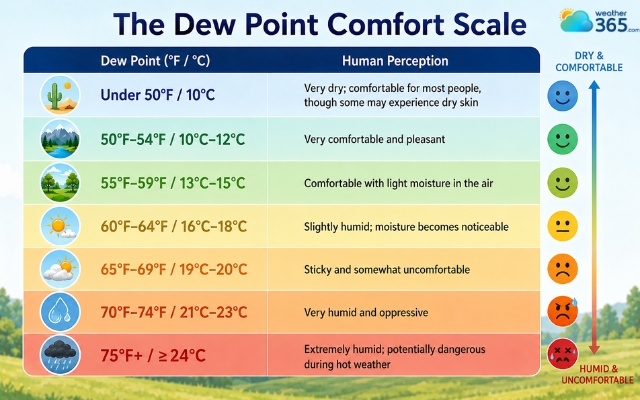
The dew point scale chart
Quick Check Dew Point on Weather365
Wanna check the dew point in your place? Drop by Weather365!
To find the dew point for your location:
Visit Weather365.
Search for your city or location.
Open the local weather forecast page.
Look for the Dew Point value in the weather details section.
Checking the dew point alongside temperature helps you better understand how humid the air will actually feel. As a quick guide:
Below 60°F (16°C): Comfortable
60–69°F (16–20°C): Moderately humid
70°F (21°C) and above: Very humid and muggy
By monitoring dew point on Weather365, you can quickly gauge outdoor comfort levels and plan your day more effectively.
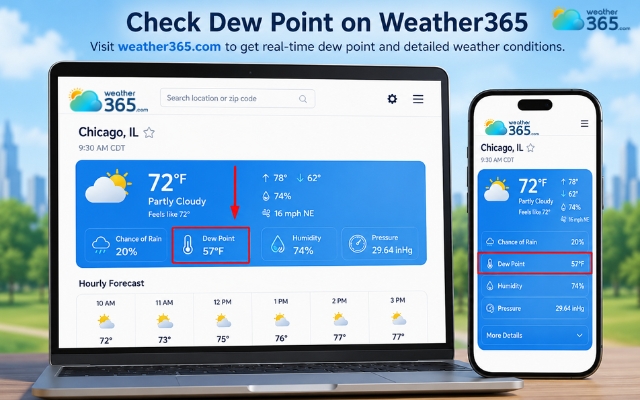
Easily check the dew point on Weather365
Final Words
What is dew point? It is the temperature at which air becomes saturated and condensation begins to form. More importantly, it is one of the best indicators of how humid the air actually feels. By understanding dew point and its relationship to comfort, weather, and moisture, you can make better decisions about outdoor activities and interpret weather forecasts more accurately.
Frequently Asked Questions (FAQs)
Related post
Most humid states in the US: Which States Feel the Muggiest?
 331
331
 1
1
 4.9
4.9
 22/08/2026
What Is Considered High Humidity? Steps To Manage Ideal Humidity Level
85
0
4.9
22/08/2026
What is 100% humidity? Meaning, Misconceptions, and Science
51
0
4.8
21/08/2026

0 Comment
Leave a comment
Your email address will not be published. Required fields are marked *