




Types Of Wind: Understanding Different Wind Classifications


Types of wind shape the weather, climate, and even daily conditions around us. But why do some winds blow steadily across oceans while others change direction every day? In this guide, we will explore the main types of wind, what causes them, and how they influence our planet. Diving in!
Discover different types of wind
What Causes Wind?
Wind is mainly caused by the uneven heating of the Earth's surface.
Besides, differences in air pressure, Earth's rotation, and surface friction also contribute to the development of wind.
Uneven Heating From the Sun
The primary driver of wind is the uneven heating of the Earth by the Sun. The amount of solar energy reaching the Earth varies from one region to another. For example:
The equator gets stronger and more concentrated sunlight than the polar regions.
Land heats up faster than oceans
Mountains, forests, and deserts absorb heat differently
Because of these differences, some areas of the atmosphere become warmer than others. Warm air expands and rises, while cooler air becomes denser and sinks.
This creates temperature contrasts across the planet that start the wind-forming process.
For instance, during the day, land heats faster than the ocean. Warm air rises over land, and cooler air from the sea moves in to replace it, creating a sea breeze - one of the simplest examples of wind formation.
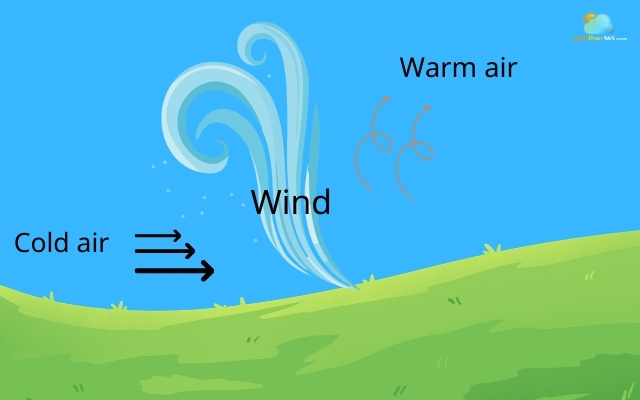
Wind results from the air temperature differences
Differences in Air Pressure
Temperature differences naturally lead to air pressure differences.
When warm air rises, it leaves behind an area of low pressure, while cooler sinking air creates high-pressure zones.
Nature always tries to balance these differences. As a result, air moves from areas of high pressure to areas of low pressure, and this moving air is what we feel as wind.
The stronger the pressure difference - called the pressure gradient, the stronger the wind becomes.
This is why storms and weather systems with large pressure differences can produce very strong winds.
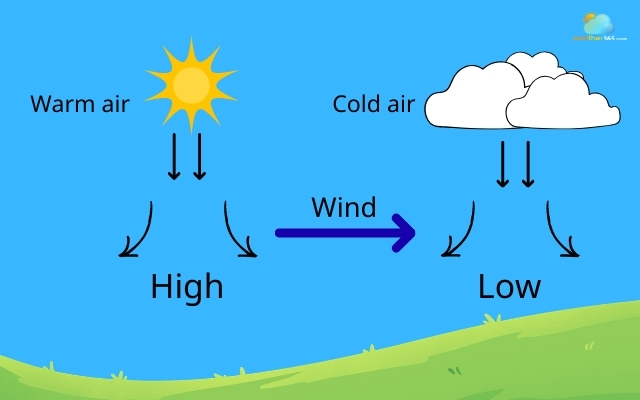
Differences in air pressure create winds
Earth’s Rotation (Coriolis Effect)
If Earth did not rotate, wind would travel directly from high-pressure areas to low-pressure areas.
However, the planet’s rotation changes the path of moving air.
This effect is known as the Coriolis Effect. It causes winds to curve instead of moving in straight lines:
In the Northern Hemisphere, winds are deflected toward the right
In the Southern Hemisphere, winds bend toward the left.
Because of this deflection, large-scale wind patterns such as trade winds and westerlies form across the globe.
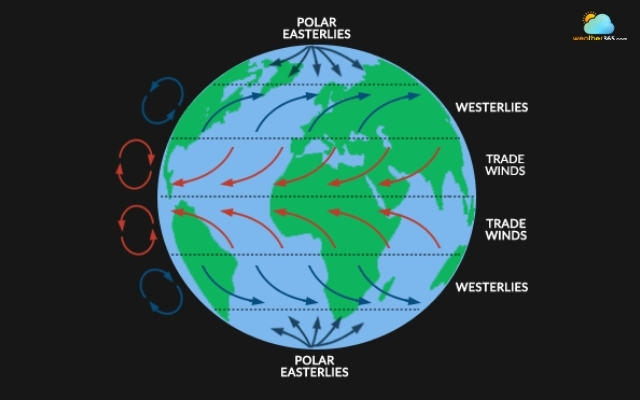
The Coriolis Effect is the reason for differences in winds’ moving path
Surface Friction and Terrain
Closer to the ground, wind is also influenced by surface friction. Mountains, forests, buildings, and uneven terrain slow down and redirect moving air.
For example, mountains can block or redirect wind flow, and valleys can channel winds into stronger streams,...
Friction generally reduces wind speed near the surface but can also cause winds to spiral around pressure systems.
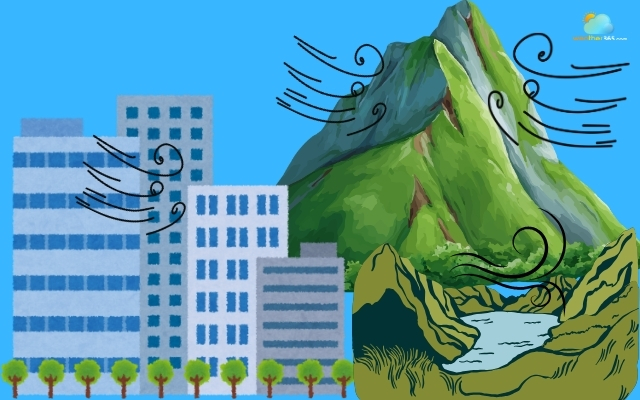
The wind is influenced by surface friction
Different Types Of Wind
Different types of wind include: planetary (prevailing) winds, periodic winds, and local winds.
Let’s discover how many winds you have witnessed!
Planetary/Prevailing winds
Planetary winds, also called prevailing winds, are large-scale wind systems that blow continuously over vast areas of the Earth.
These winds are part of the planet’s global atmospheric circulation and generally maintain the same direction throughout the year.
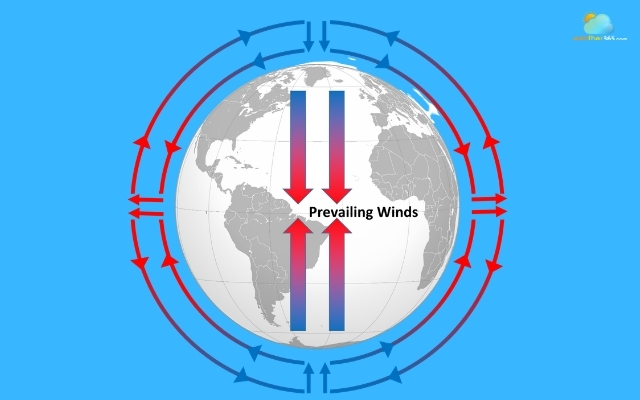
Prevailing winds form due to global pressure belts
They form mainly because of several factors, like global pressure belts between the equator and the poles, and the uneven heating of the Earth by the Sun.
Planetary winds play a major role in distributing heat and moisture across the globe, helping regulate the planet’s climate.
The three main planetary winds include:
Trade Winds
These winds blow from the subtropical high-pressure zones toward the equator.
In the Northern Hemisphere, they flow from the northeast, and in the Southern Hemisphere from the southeast.
Trade winds are known for their stability and were historically used by sailors to cross oceans.
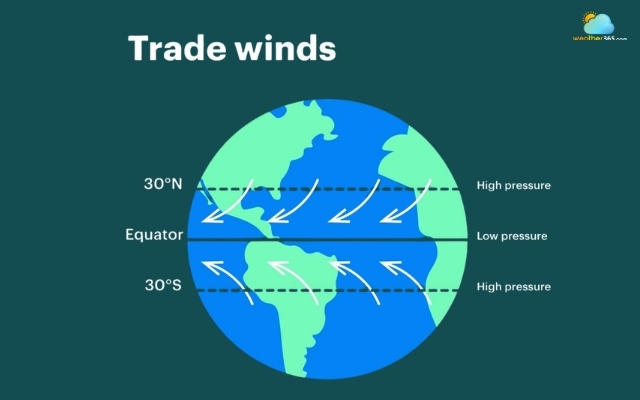
Trade winds are the permanent east-to-west prevailing winds
Source: Windy.app
Westerlies
Westerlies occur in the middle latitudes between about 30° and 60°.
They generally blow from west to east and help move weather systems across continents, especially in North America and Europe.
Polar Easterlies
Polar Easterlies wind occurs near the poles and blows from east to west.
They are usually cold and dry because they originate from polar high-pressure regions.
Together, these global wind belts form the foundation of Earth’s atmospheric circulation and strongly influence long-term weather patterns.
Periodic winds
Unlike planetary winds, periodic winds change direction at regular intervals. These intervals can be seasonal or daily, depending on temperature differences between land, water, and terrain.
Periodic winds are especially important in regions where seasonal weather patterns strongly affect agriculture and ecosystems.
Some common examples include:
Monsoons
Monsoon winds are large seasonal wind systems that reverse direction during the year.
In summer, warm land draws moist ocean air inland, bringing heavy rainfall.
In winter or spring, cooler land causes winds to flow outward toward the ocean, often producing dry conditions.
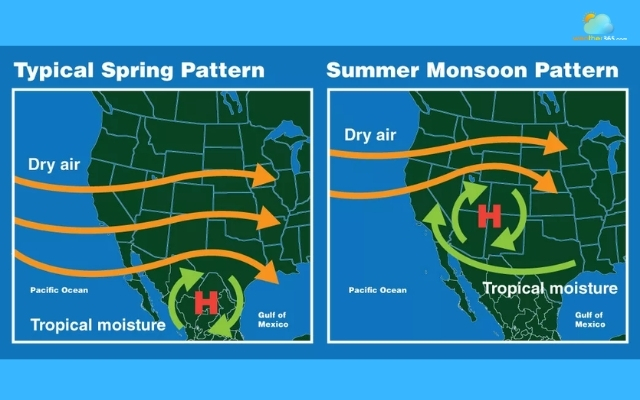
Monsoon pattern in spring and summer
Image source: National Environmental Satellite, Data, and Information Service
Land and sea breezes
Land and sea breezes are classic examples of periodic winds that occur in coastal regions.
These winds change direction between day and night because land and water heat and cool at different rates.
Sea breeze: During the daytime, land warms up more quickly than the ocean, so cooler air from the sea moves toward the land.
Land breeze: At night, land cools faster than the sea, and air flows from land toward the water.
Land breezes are usually weaker than sea breezes but can still influence nighttime weather near coastlines.
Together, land and sea breezes help regulate temperatures in coastal areas, preventing extreme heat during the day and reducing temperature drops at night.
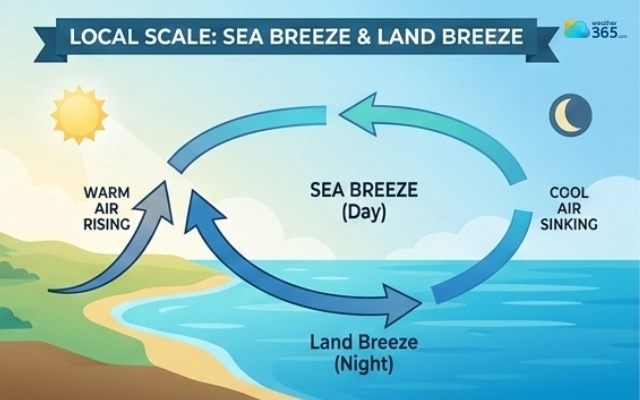
Sea and land breezes change direction across day and night
Mountain and Valley Breezes
Mountain regions also experience regular wind patterns caused by daily heating and cooling cycles.
These are known as mountain and valley breezes, and they occur because mountain slopes warm and cool faster than the air above valleys.
Valley breeze: During the day, warm air rises along mountain slopes.
Mountain breeze: At night, cooler, dense air flows downhill into valleys.
Overall, mountain and valley breezes play an important role in local mountain climates, affecting temperature patterns, fog formation, and even pollution distribution in valleys.
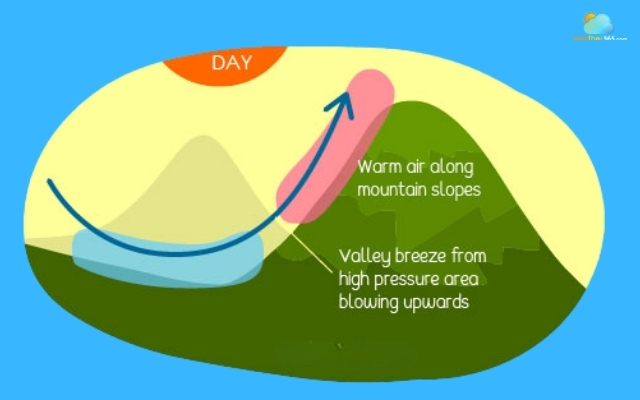
The pattern of the valley breeze
Local winds
Local winds occur over relatively small geographic areas and usually last for shorter periods.
They form due to localized differences in temperature, pressure, and terrain, such as mountains, valleys, deserts, or coastlines.
Unlike planetary winds, local winds vary greatly from region to region and often have specific regional names.
Trade winds, jet streams, and local downslope gusts like California Santa Ana winds shape local weather.
Examples include:
Chinook: a warm, dry wind descending the eastern slopes of the Rocky Mountains
Mistral: a strong, cold wind that blows from northern France toward the Mediterranean
Bora: a cold, gusty wind flowing from mountainous regions toward the Adriatic Sea
Local winds can significantly influence regional climates.
For example, warm downslope winds like Chinook can quickly raise temperatures and melt snow, while cold winds such as Bora can cause sudden temperature drops.
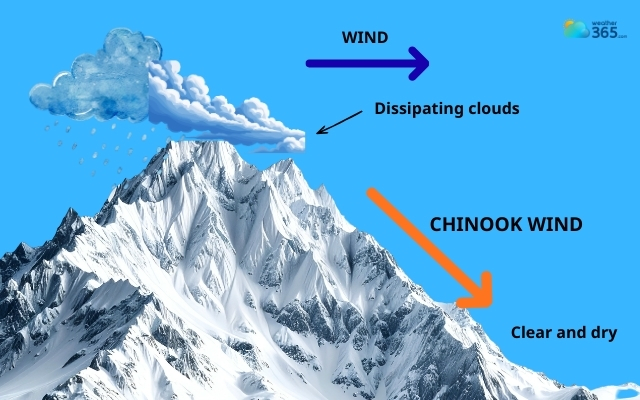
Chinook wind descends the eastern slopes of the Rocky Mountains
Other types of wind
Other types of wind include wind gusts and the jet stream. Let’s discover these two special phenomena!
Wind gusts
A wind gust is a sudden, brief increase in wind speed that lasts for only a few seconds.
Unlike steady winds that blow at a relatively constant speed, gusts happen when airflow becomes unstable or turbulent.
Wind gusts often occur when storm systems or cold fronts pass through an area, or when thunderstorms create strong downdrafts.
For example, during a storm, the average wind speed might be moderate, but occasional gusts can be much stronger.
This is why weather forecasts often mention “wind gusts up to…” in addition to the sustained wind speed.
Although gusts are short-lived, they can have significant effects.
Specifically, Strong gusts can make driving more difficult, cause branches or debris to fall, and create dangerous conditions for sailing,....
Because of these risks, meteorologists carefully monitor gusts when issuing severe weather warnings, high wind alerts.
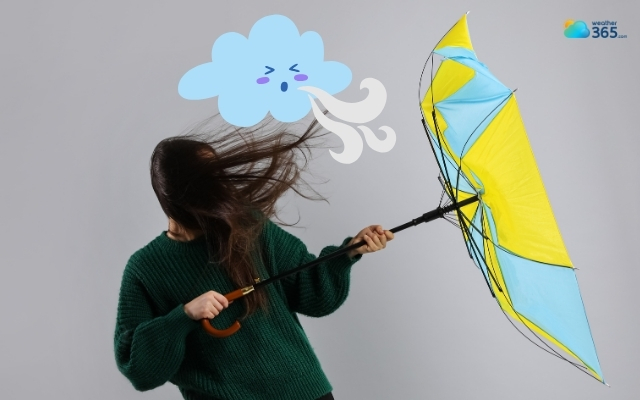
Wind gusts can pose risks to outsiders
Jet stream
While wind gusts occur close to the ground, some of the most powerful winds on Earth exist high above the surface in narrow bands called the jet stream.
The jet stream is a fast-moving current of air located in the upper levels of the atmosphere, typically about 9 to 16 kilometers above the Earth’s surface.
These air currents can reach speeds of 160-400 km/h (100-250 mph) or even higher.
Jet streams form mainly because of large temperature differences between warm and cold air masses.
When these temperature contrasts combine with Earth’s rotation, powerful high-altitude winds develop.
Even though jet streams occur high in the atmosphere, they strongly influence weather at the surface.
They help steer storm systems, guide the movement of high- and low-pressure areas, and affect temperature patterns across continents.
Moreover, jet streams are also important in aviation.
Airplanes often take advantage of these strong winds to reduce travel time and fuel consumption when flying in the same direction as the jet stream.
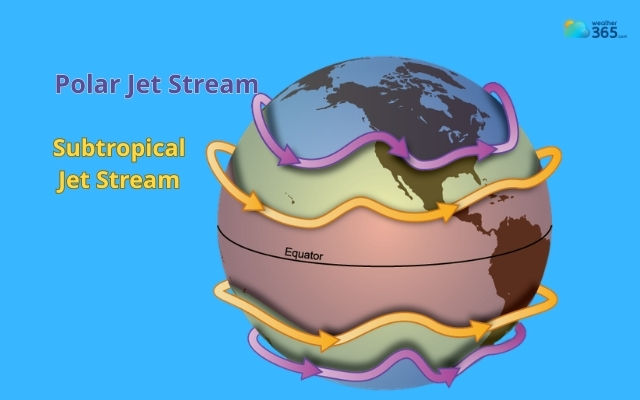
Two dominant jet streams
How Is Wind Speed Measured?
Wind speed is measured by using an anemometer. It is one of the simplest and most accurate ways.
The basic process only takes a few steps:
Place the anemometer in an open area: Make sure it is away from buildings, trees, or obstacles that could block the wind.
Hold or mount the device facing the wind: This allows the cups or sensors to catch the airflow properly.
Let the device spin and stabilize: The rotating cups measure how fast the wind isblowing.
Read the wind speed on the display: The result usually appears in mph, km/h, or m/s.
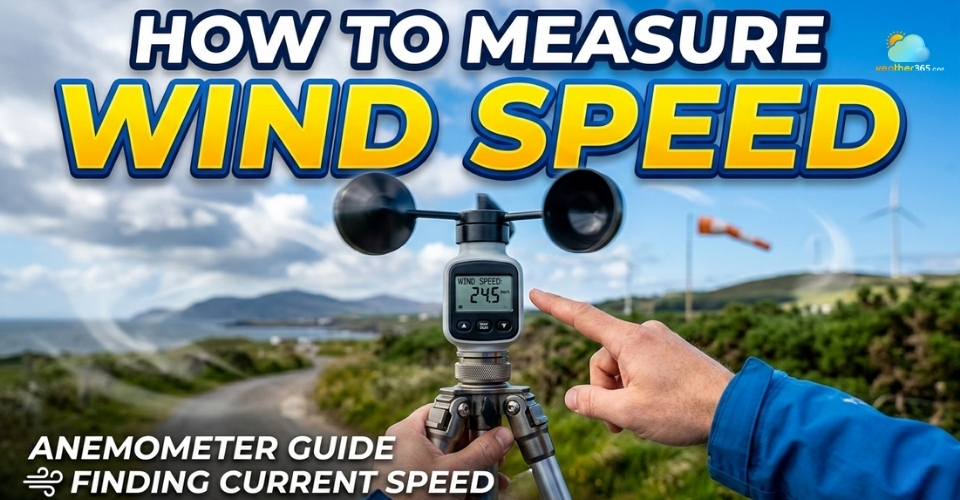
If you want to learn other ways to measure wind, including tools used in meteorology and field observations, read our full guide on how to measure wind speed.
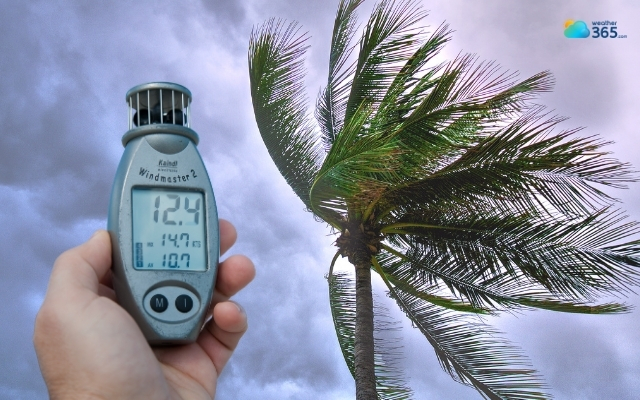
Anemometer is one of the simplest tools to measure wind speed
Final Thought
Types of wind help explain why air moves differently in every part of the world. From large global wind belts to small local breezes, these wind patterns shape weather systems and climate. Learning about them gives you a clearer picture of how the atmosphere works and why wind behaves the way it does.
Frequently Asked Questions (FAQs)
Related post
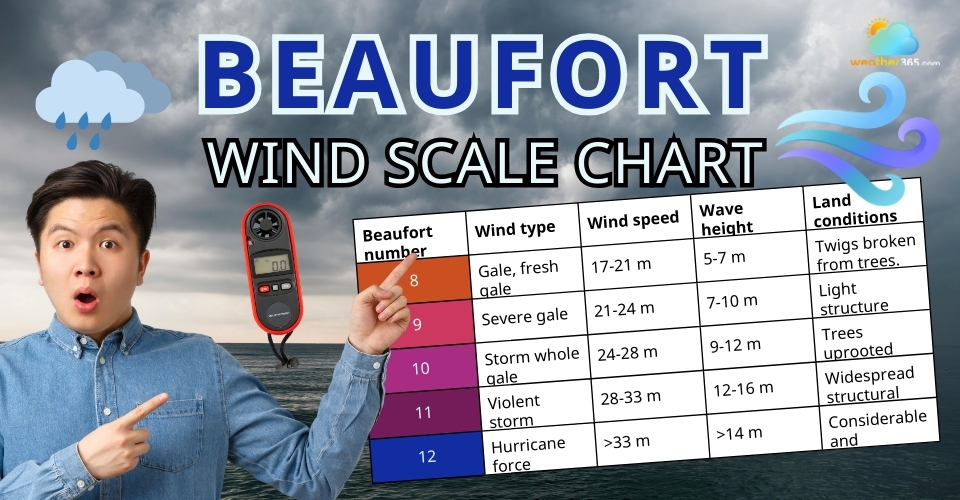
Beaufort Wind Scale Chart: Discover Wind Speed Levels and How To Read Them
 2028
2028
 8
8
 4.9
4.9
 18/08/2026
What Does Wind Chill Mean? Complete Guide to Wind Chill Explained
1534
8
4.9
18/08/2026
How To Measure Wind Speed: Step-by-Step Guide for Accurate Measurement
1501
8
4.7
18/08/2026

8 Comment
Wesley Mills
This is a nice introduction to wind types without making the topic feel too technical.
Theo Smith
I didn’t realize there were so many different types of wind. The examples made the differences much easier to understand.
Marshall Brown
Do mountains and coastlines affect local winds?
weather365
Definitely. Mountains, valleys, and nearby oceans can strongly influence how wind moves and where it develops.
Jonathan Douglas
Are monsoons considered a type of wind?
weather365
Yes. Monsoon winds are seasonal wind patterns that change direction as the seasons change.
Victoria Ruiz
What determines the type of wind in a particular area?
weather365
Things like air pressure, temperature differences, geography, and Earth’s rotation all play a role.
Leave a comment
Your email address will not be published. Required fields are marked *