




Where Does Lightning Strike The Most in The US? Top Risky Regions


Where does lightning strike the most in the US? Each year, millions of bolts hit the ground, but Florida, Texas, and the Gulf Coast stand out as the nation’s lightning hotspots. In this guide, we will explore where lightning strikes the most, why these regions are hotspots, and what you can do to stay safe.
Where Does Lightning Strike The Most in The US?
Lightning Statistics in the US
Lightning statistics reveal how often strikes occur across the US, and who is most at risk.
These figures not only highlight the scale of the hazard but also underline the real dangers of lightning that communities face every year.
General lightning data
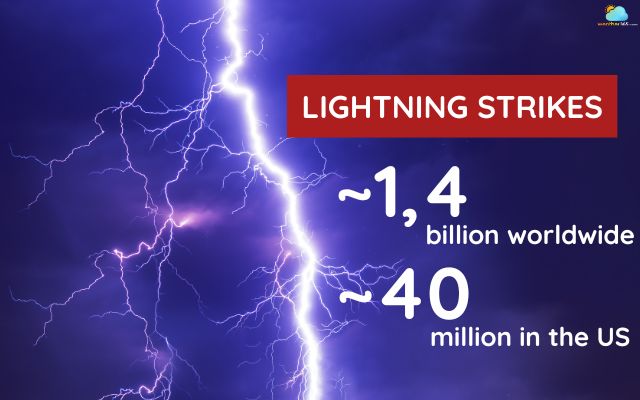
Each year, the world records around 1.4 billion lightning flashes, with roughly 40 million striking the ground in the United States.
The chance of an individual being struck in a single year is less than one in a million.
While most people (about 90%) struck by lightning survive, many experience lasting health effects.
Where Does Lightning Strike The Most in The US?
Lightning-Related Fatality
Data from 2006 to 2024 reflect how age, gender, daily habits, and even the season can affect the risk of lightning fatality.
Now look at these trends to see why some groups face greater danger than others.
Lightning data
Source: National Lightning Safety Council
By Age
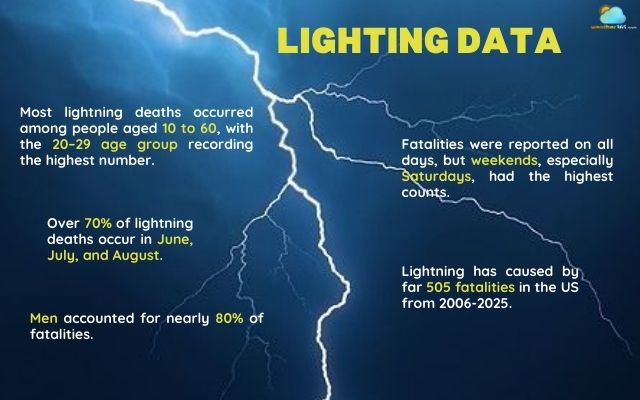
Most lightning deaths occur among people between 10 and 60 years old, with the 20-29 age group standing out as the most vulnerable.
This trend is linked to lifestyle factors: young adults spend more time outdoors for sports, travel, or work.
They are also less cautious, often continuing activities despite approaching storms, which reduces the chance of reaching safe shelter in time.
(Note: The average age of lightning victims is 37 years old)
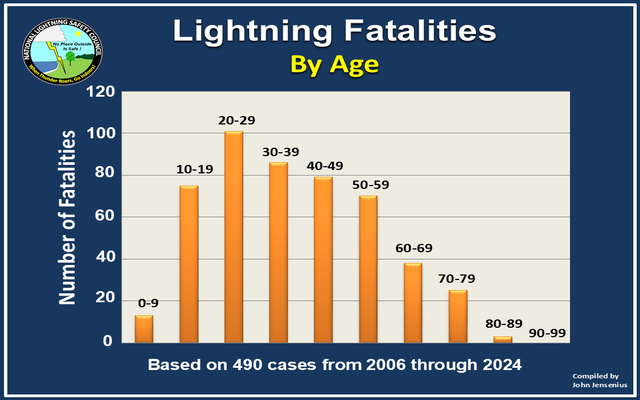
Lightning Fatalities from 2006 to 2024 by Age
By Gender
In terms of gender, men accounted for nearly 80% of fatalities. This disparity can be traced to work environments and leisure activities.
Many outdoor occupations, such as construction or agriculture, involve more men’s exposure to open environments where lightning is more likely to occur.
Recreationally, men also participate more in boating, golfing, or hunting - activities where quick shelter is not always accessible.
Social factors also play a role: men are more likely to underestimate storm danger or delay stopping activities when thunder is first heard.
By Day of the Week
Fatalities were reported on all days, but weekends, especially Saturdays, had the highest counts.
This trend is likely due to more people spending time outside for leisure, making them more susceptible when storms develop suddenly.
By Month
According to the National Weather Service, over 70% of lightning deaths occur in June, July, and August because these months coincide with both peak thunderstorm season and the busiest time for outdoor life.
Longer daylight extends outdoor recreation, while heat and humidity fuel strong storms in much of the US, which makes those times have the greatest number of lightning fatalities.
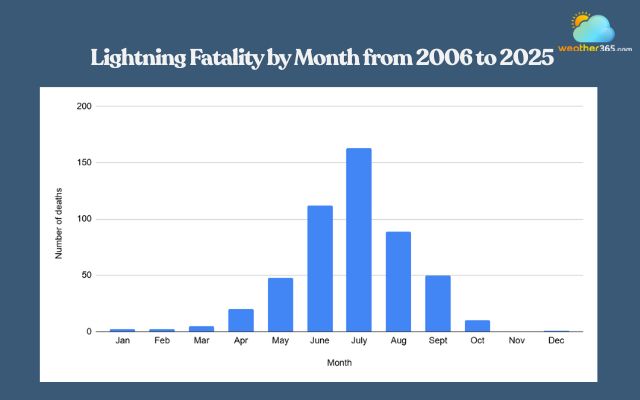
Lightning Fatality by Month from 2006 to 2025
Source: National Weather Service
By Year
It is reported by the National Weather Service that from 2006 to July 2025, lightning by far has caused a total of 505 fatalities in the US.
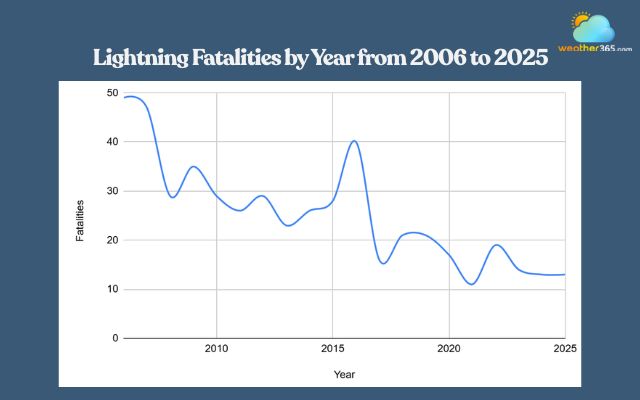
Lightning Fatalities by Year from 2006 to 2025
Source: National Weather Service
While the annual toll has gradually declined thanks to better awareness and safety campaigns, lightning remains a persistent hazard.
Where Does Lightning Strike The Most in The US?
Lightning is not evenly distributed across the country.
Some regions see far more strikes than others, driven by geography, climate, and local weather patterns.
Florida, Texas, and several Gulf Coast states consistently rank at the top, but other areas also stand out.
The "Lightning Alley" of Florida
Florida consistently ranks among the most lightning-prone places in the United States, averaging more than 110 lightning strikes per square mile each year.
Central Florida has an especially high strike density, making the region one of the country’s top lightning hotspots.
For the latest Florida weather updates, residents and visitors can monitor local thunderstorms and changing weather conditions.
Have you ever heard about the “Lightning Alley” of Florida?
It is the corridor from Tampa to Titusville where lightning strikes are especially active, with thunderstorms developing almost daily in summer.
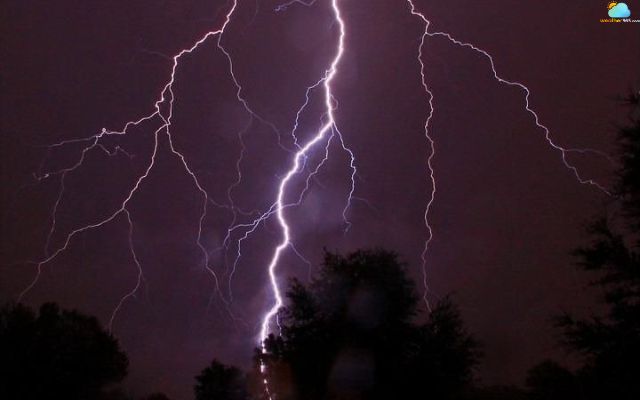
The "Lightning Alley" of Florida
Why Florida?
Florida lies between the Gulf of Mexico and the Atlantic Ocean, where sea breezes often collide over central areas.
These air clashes push warm, moist air upward, triggering frequent thunderstorm development.
The state’s long, hot, and humid summers create perfect conditions for storms to form almost daily.
As a result, Floridians face some of the highest lightning injury risks in the nation, particularly in central counties like Polk and Orange, where strike frequency is highest.
The Gulf Coast and Southeast
The Gulf Coast (Louisiana, Mississippi, Alabama, and parts of Texas) is another lightning hotspot.
States below do not match Florida’s density, but still record strikingly high numbers:
Louisiana: ~20.3 strikes per square mile per year
Mississippi: ~18.0 strikes per square mile
Alabama and Georgia regularly rank in the top 10 for lightning density
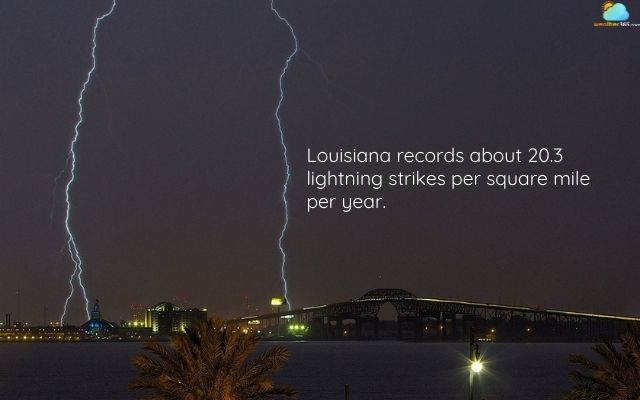
Lightning over Lake Charles, Louisiana
Why the Gulf Coast and Southeast?
Moist air streaming in from the Gulf acts as a steady source of energy, making frequent storms a defining feature of the region.
Weather systems moving inland often trigger widespread storm outbreaks.
Warm, unstable air in summer enhances lightning activity across the entire region.
The Great Plains
The Great Plains region also ranks among the top areas for overall lightning activity in the US, with:
Texas records with over 16 million strikes in some years, due to its massive land area.
Oklahoma ranks high in both total strikes and density, often exceeding 100 strikes per square mile annually.
In Limestone County, Texas, lightning density has reached 125 flashes per square mile, exceeding Florida’s statewide average.
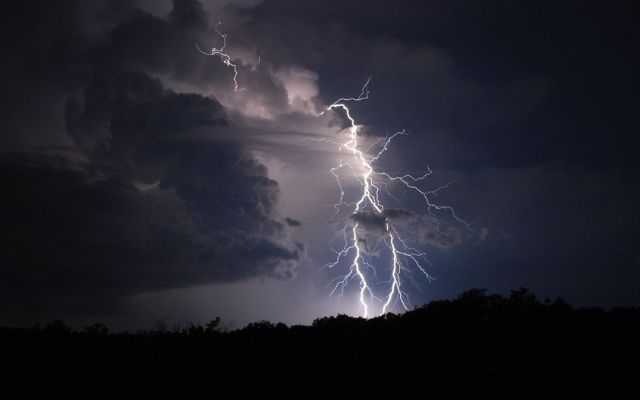
Lightning across the plains
Why the Plains?
The central US is a natural battleground where cold, dry Canadian air masses collide with warm, humid Gulf air, fueling powerful storms.
This collision fuels powerful thunderstorms, many of which are severe and produce intense lightning.
The Plains are also home to “Tornado Alley,” and the same storm systems that generate tornadoes often bring extreme lightning activity.
Other Notable Areas
Other parts of the US also face frequent lightning, though for different reasons:
Rocky Mountains (Colorado, Arizona): Mountain slopes force moist air upward, triggering daily thunderstorms in summer.
During Arizona’s July-September monsoon season, the state can experience over half a million lightning strikes annually.
In the arid Southwest, particularly in Arizona and New Mexico, lightning brings storms and triggers wildfires in dry landscapes. A single bolt in parched terrain can ignite large-scale forest or brush fires.
Mountain West: Colorado, known as the “Lightning Capital of the Rockies,” records over half a million strikes annually, especially at higher elevations where storms form easily.
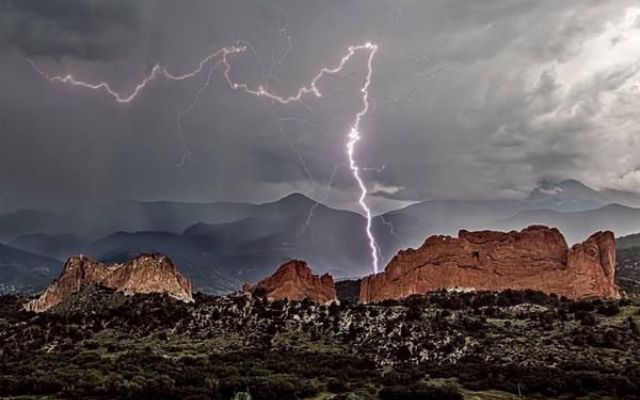
Lightning near the Garden of the Gods in Colorado Springs
These areas may not top national rankings, but their combination of terrain-driven storms and environmental hazards like wildfires makes lightning a significant local risk.
Safety Tips for High-Lightning Areas
According to the National Lightning Safety Council, lightning is responsible for an average of about 21 reported cases annually in the US.
Even though the risk is relatively low, people living in high-risk regions should take extra precautions.
Indoors: the key is to stay away from anything that conducts electricity, including corded devices, plumbing, and windows.
Outdoors: the safest option is to seek shelter in a sturdy building or vehicle and avoid tall objects or open spaces.
For a full guide on how to protect yourself during thunderstorms, see our article on Dangers of Lightning.
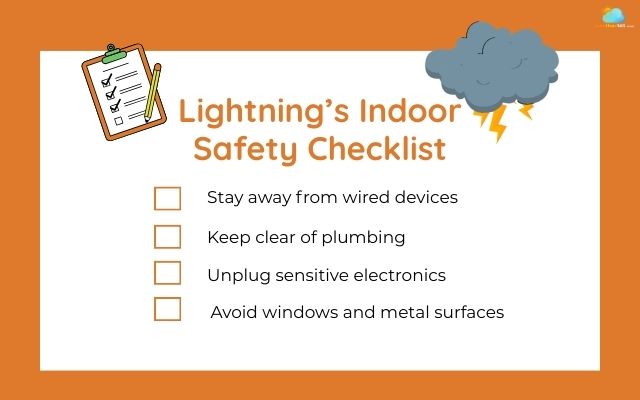
Indoor Safety Tips for High-Lightning Areas
Conclusion
Where does lightning strike the most in the US? The answer lies in regions like Florida, the Gulf Coast, and the Great Plains, where weather patterns create ideal storm conditions. While the numbers show clear hotspots, lightning remains a nationwide risk. Staying aware and practicing safety measures is the best way to reduce its dangers.
Frequently Asked Questions (FAQs)
Related post
Exploring Types of Thunderstorms and Their Unpredictable Impacts
 1702
1702
 8
8
 4.7
4.7
 15/09/2026
Can Lightning Strike Through A Window? Scientific Facts & Life-Saving Tips
1628
8
4.8
14/09/2026
Dangers of Lightning: Understanding Its Hazards and Key Safety Practices to Survive
1527
8
4.6
15/09/2026

8 Comment
Ayden Cooper
Why do the Great Plains get so much lightning?
weather365
It has a lot to do with the clash between cold, dry air from Canada and warm, humid air coming up from the Gulf. That combination can fuel some pretty powerful thunderstorms.
Hunter Perez
I’ve lived in an area where summer thunderstorms were basically an everyday thing, and honestly you start getting way too comfortable with them.
Adonis Hill
Is Florida still the most lightning-prone state if you compare the number of strikes per square mile instead of total strikes?
weather365
Yes, Florida is still one of the biggest hotspots by strike density. The article says Florida averages more than 110 strikes per square mile each year, with central Florida being particularly active.
Nicholas Jackson
Why does Florida get so much more lightning than some other states?
weather365
A big reason is the warm, humid air from both the Gulf of Mexico and the Atlantic. When the sea breezes meet over central Florida, they can help trigger thunderstorms, especially during summer.
Derek Green
I knew Florida got a lot of thunderstorms, but I didn't realize the difference was this big. “Lightning Alley” is such a fitting name 😂
Leave a comment
Your email address will not be published. Required fields are marked *