



What Is Stratospheric Warming? The Hidden Force Behind Extreme Cold


What is stratospheric warming, and why does it often signal sudden cold snaps instead of heat? This high-altitude atmospheric event can reshape winter weather in surprising ways. Let’s discover how it forms, why it matters, and what it means for real-world conditions.
What is stratospheric warming?
- What is stratospheric warming?
- Types of stratospheric warming?
- By Intensity
- By Wave Type
- Frequency and geographic patterns
- How does a stratospheric warming occur?
- How does a stratospheric warming affect weather patterns?
- How sudden stratospheric warming shapes winter climate
- Past sudden stratospheric warming events
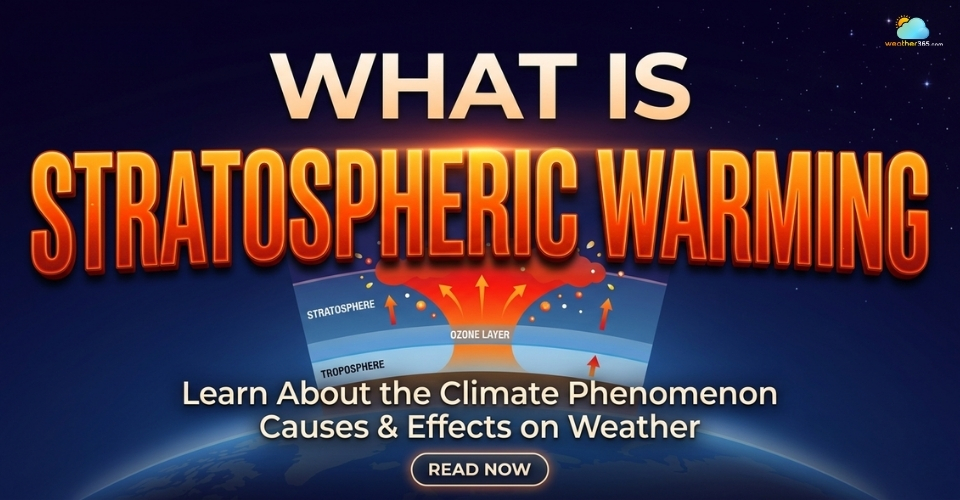
What is stratospheric warming?
Let’s first picture the structure of the atmosphere!
Above the layer where we live and experience daily weather (the troposphere) lies the stratosphere, stretching roughly from 10 km to 50 km above the Earth.
This is where one of the most surprising atmospheric events can take place.
Stratospheric warming is a significant rise in temperature
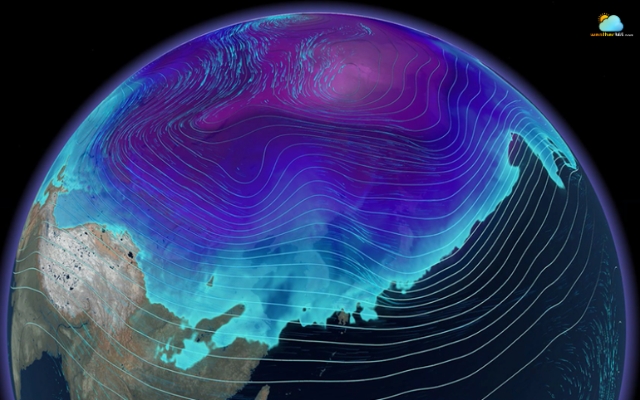
Stratospheric warming, often called sudden stratospheric warming (SSW), is a rapid and significant increase in temperature in this upper layer of the atmosphere.
In some cases, temperatures can rise by tens of degrees Celsius within just a few days, which is extremely unusual compared to normal atmospheric changes.
Not familiar with the Celsius degree? Learn how to convert between these two systems here!
What makes this phenomenon especially interesting is that it doesn’t behave the way you might expect.
Even though it’s called “warming,” its effects are often linked to colder weather at the Earth’s surface.
Types of stratospheric warming?
Not all stratospheric warming events behave the same way.
Some are strong enough to completely disrupt the polar vortex, while others only cause minor disturbances.
To better understand their impact, scientists usually classify them in two main ways: by intensity and by the type of atmospheric waves involved.
By Intensity
The most common way to group stratospheric warming events is based on how strongly they affect the polar vortex.
Major warming
A major sudden stratospheric warming is the most dramatic form.
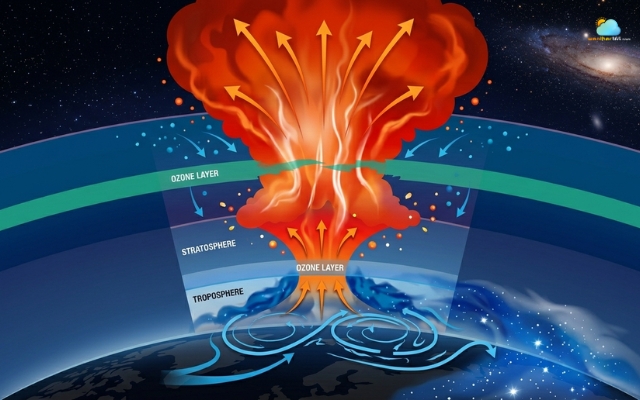
In this case, temperatures in the stratosphere rise rapidly, and more importantly, the usual west-to-east winds around the polar vortex slow down and even reverse direction.
Temperature in the major stratosphere rises rapidly
This reversal is a key signal that the vortex has been seriously disrupted. Sometimes it even splits into two smaller vortices, which makes the system unstable.
These major events are often linked to significant cold outbreaks at the surface in the following weeks.
Minor warming
In contrast, a minor stratospheric warming still involves a noticeable temperature increase, but the overall structure of the polar vortex remains more intact.
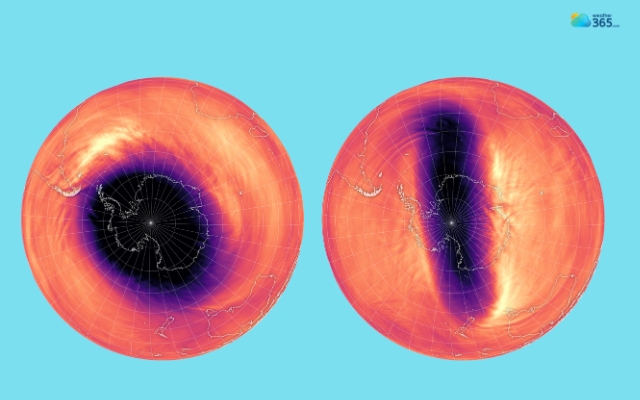
A minor warming causes less severe impacts
The winds may weaken, but they don’t fully reverse. Because of that, the effects on surface weather tend to be less consistent and less severe.
You might still see some shifts in weather patterns, but they are usually not as extreme or long-lasting.
By Wave Type
Another important way to understand stratospheric warming is by looking at the planetary waves (also called Rossby waves) that trigger it.
These large-scale waves move upward from the lower atmosphere and interact with the polar vortex.
Wave-1 pattern
When a wave-1 pattern dominates, the polar vortex is pushed off-center rather than broken apart.
Imagine the vortex being “shoved” to one side of the pole.
This type of event typically displaces the cold air, which can still lead to unusual weather patterns, but often in a more uneven or regional way.
Wave-2 pattern
On the other hand, a wave-2 pattern is more disruptive. Instead of just shifting the vortex, it can split it into two separate systems.
This split makes it much easier for cold Arctic air to spread into lower latitudes across multiple regions at once.
Because of this, wave-2 events are often associated with more widespread and intense winter weather impacts.
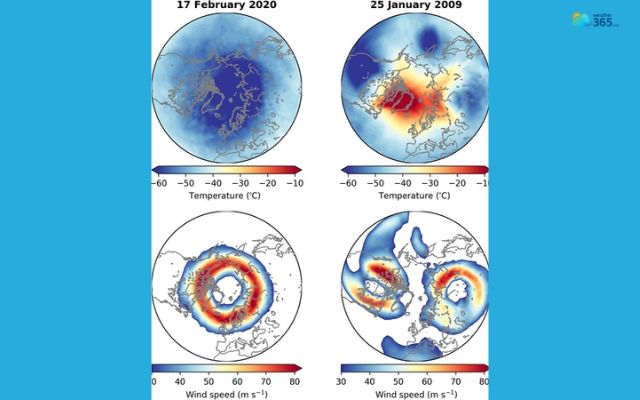
Difference between wave-1 and wave-2 pattern
Frequency and geographic patterns
Stratospheric warming follows clear seasonal and regional patterns that scientists have observed over decades.
In terms of frequency, these events occur most often in the Northern Hemisphere, typically once every 1–2 years.
However, not every winter will see a major event. Some seasons pass with only minor disturbances, while others experience strong disruptions that significantly affect weather patterns.
Geographically, the difference between hemispheres is important.
The Northern Hemisphere's uneven surface generates the atmospheric waves that frequently disrupt the polar vortex, causing sudden stratospheric warming.
In contrast, the Southern Hemisphere rarely experiences these events. Its more uniform ocean-covered surface leads to a more stable polar vortex that is harder to disrupt.
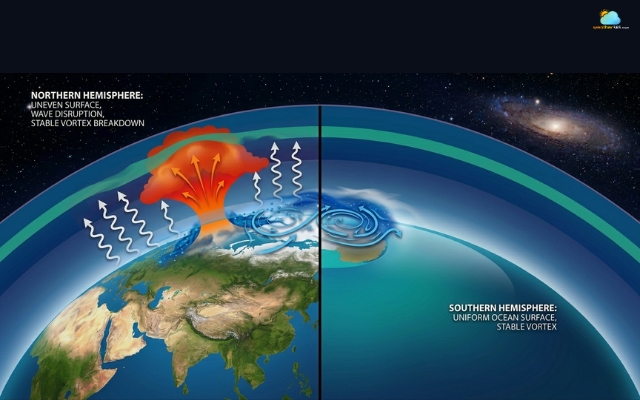
The Northern Hemisphere and Southern Hemisphere
Timing also plays a key role. Stratospheric warming events almost always occur during winter months, when the polar vortex is strongest and most active.
This is why their impacts are closely tied to winter weather, including cold spells and snowstorms.
How does a stratospheric warming occur?
Stratospheric warming happens when the normally stable polar vortex in winter gets disrupted from below.
Large atmospheric waves rise from the lower atmosphere into the stratosphere and begin to slow down or distort this circulation.
As the vortex weakens, air over the polar region starts to sink and compress, causing temperatures in the stratosphere to rise rapidly, sometimes within just a few days.
In stronger events, the winds can even reverse direction, signaling a major disruption.
This disturbance doesn’t stay up high. It gradually moves downward, altering the jet stream and setting the stage for changes in surface weather weeks later.
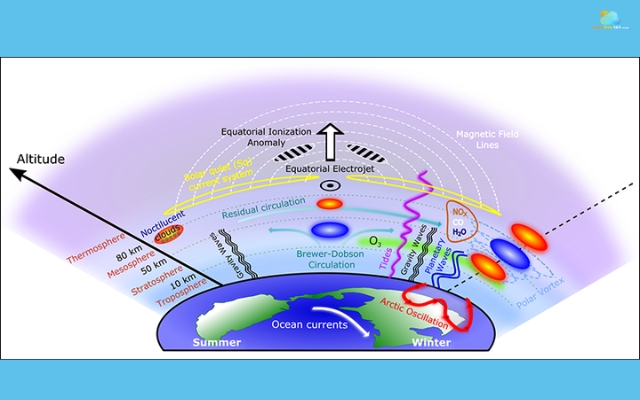
Stratospheric warming happens when the polar vortex gets disrupted
How does a stratospheric warming affect weather patterns?
Even though stratospheric warming happens high above the Earth, its first noticeable effects appear in how weather systems behave day to day.
The main connection is through the jet stream, which begins to lose its smooth, fast flow after the polar vortex is disrupted.
Instead of moving steadily west to east, it starts to bend and shift more unpredictably.
This change alters how weather systems travel. Some regions may experience sudden cold outbreaks as Arctic air moves south, while others see more storms or unsettled conditions.
In short, weather becomes less stable and more variable.
Rather than creating one uniform outcome, stratospheric warming tends to redistribute weather patterns, leading to sharp contrasts between regions at the same time.
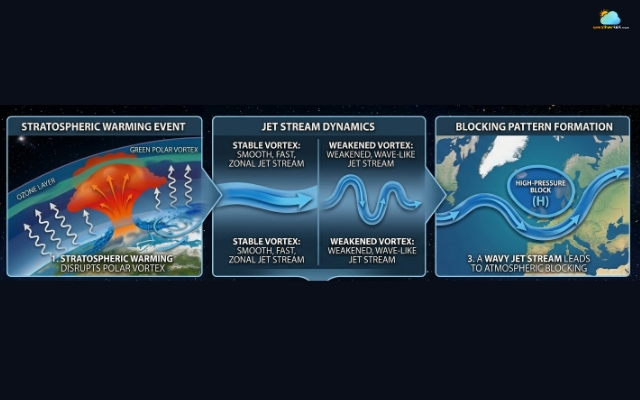
Stratospheric warming can cause sudden cold outbreaks
How sudden stratospheric warming shapes winter climate
While short-term weather becomes more changeable, sudden stratospheric warming can also influence the overall character of a winter season.
After the initial disruption, the atmosphere often shifts into a more persistent pattern.
The jet stream slows down and large-scale pressure systems become more stable, causing certain conditions to last longer than usual.
This is why winters influenced by SSW are more likely to include extended cold spells, especially across mid-latitude regions.
Sudden stratospheric warming disrupts the polar vortex, sending cold blasts to regions like the Midwest - a key factor tracked in the Minnesota 30-day polar vortex forecast.
Instead of brief cold snaps, temperatures can stay below average for weeks, often accompanied by repeated snow events.
At the same time, the impact remains uneven. Some areas may stay cold and dry, while others experience milder or wetter conditions for an extended period.
This contrast is a defining feature of winters shaped by stratospheric warming.
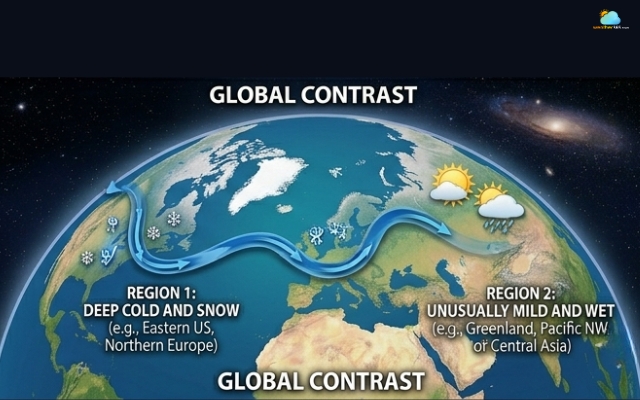
Stratospheric warming causes cold wave conditions in certain regions
Past sudden stratospheric warming events
Sudden stratospheric warming has been observed for more than 70 years, and over time, scientists have identified many events that have had clear impacts on winter weather.
The very first recorded event dates back to 1952 in Berlin, when meteorologist Richard Scherhag noticed a rapid and unusual temperature rise in the stratosphere.
Since then, improved observations have revealed that these events occur regularly and often coincide with major shifts in winter weather patterns.
Below is a simplified overview of some notable sudden stratospheric warming events:
Year | Type / Characteristics | Notable impact |
2002 | Major SSW (Southern Hemisphere, rare) | Antarctic polar vortex split, one of the few recorded SSW events in the Southern Hemisphere |
2009 | Major SSW (split vortex) | One of the strongest events on record, causing major atmospheric disruption across the Northern Hemisphere |
2010 | Multiple SSW events | A winter with repeated warming episodes, leading to unstable and prolonged winter conditions |
2013 | Major SSW | Contributed to extended cold spells in Europe and North America |
2018 | Major SSW (split type) | Triggered the “Beast from the East”, bringing extreme cold and snow to Europe |
2019 | Major SSW (complex structure) | Polar vortex became distorted and fragmented, affecting weather patterns for weeks |
2022 | Active SSW period | Increased atmospheric variability, influencing winter circulation patterns |
2024 | Two major SSW events in one winter | Rare occurrence of multiple strong events, leading to notable weather fluctuations |
Wrapping up
What is stratospheric warming, and why does it matter? This high-altitude event can change weather patterns and lead to colder winters in many regions. Understanding it helps you make sense of sudden cold waves and unusual winter conditions, so you’re better prepared for what’s coming.
Frequently Asked Questions (FAQs)
Related post
What Is The Highest Recorded Temperature In The World? Shocking Event Revealed
 449
449
 8
8
 4.8
4.8
 18/08/2026
What Is Air Temperature? Definition, Measurement, and Key Factors
431
8
4.8
18/08/2026
How To Measure Air Temperature? Step-by-Step Guide To Accurate Measurement
305
7
4.9
18/08/2026

8 Comment
Gabrielle Floyd
This is one of those weather topics that sounds complicated at first but becomes much easier to understand once the layers of the atmosphere are explained.
Stella Fleming
The atmosphere really works like a chain reaction. Something happening miles above the ground can potentially affect weather patterns far below.
Journee Martin
I’m starting to appreciate how many different pieces have to line up before a major weather pattern develops. Pretty cool read!
Annabelle Patterson
“Warming” and “winter weather” in the same topic sounded contradictory to me at first. This article explains why the atmosphere isn’t quite that straightforward.
Remington Barnes
Why is stratospheric warming important for weather forecasting?
weather365
Major warming events can alter the polar circulation and influence weather patterns for weeks afterward, making them important to monitor.
Katherine Meyer
Does stratospheric warming always mean warmer weather at the surface?
weather365
No. Stratospheric warming can disrupt atmospheric circulation and may contribute to changes in surface weather patterns, including cold outbreaks in some regions.
Leave a comment
Your email address will not be published. Required fields are marked *