




What AQI Is Unhealthy to Run In? Understanding Air Quality Risks


What AQI Is Unhealthy to Run In is a common question among runners, especially in areas affected by pollution, wildfire smoke, or heavy traffic. While running offers many health benefits, exercising in polluted air can increase exposure to harmful particles and gases. Understanding AQI levels can help you decide when it is safe to run outdoors and when it is better to move your workout indoors.
Understanding unhealthy AQI to run
- What AQI is unhealthy to run in?
- AQI Scale: Which Level Is Unhealthy?
- AQI vs PM2.5: What Is the Difference?
- How risky is running in polluted air?
- How to check the AQI of my area?
- How to run safely in polluted air?
- Check AQI Before Every Run
- Choose the Right Time to Run
- Pick Cleaner Running Routes
- Adjust Your Workout
- Stay Hydrated
- Move Indoors When Necessary
What AQI is unhealthy to run in?
AQI, or Air Quality Index, is a scale used to measure how clean or polluted the air is. It helps people understand the potential health risks of outdoor activities, including running.
For runners, air quality becomes more important because exercise increases breathing rate.
During a run, you may inhale 5 to 10 times more air than when resting. This means you also inhale more pollutants.
AQI Scale: Which Level Is Unhealthy?
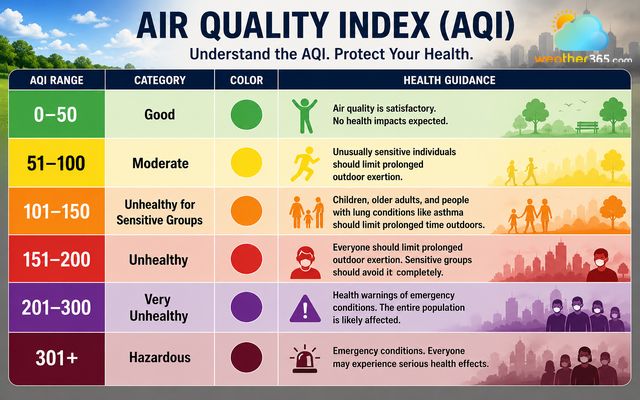
Air Quality Index
As a general rule, AQI above 150 is unhealthy for running.
Even healthy runners may experience throat irritation, coughing, shortness of breath, or reduced performance at these levels.
AQI vs PM2.5: What Is the Difference?
Many runners see both AQI and PM2.5 values in air quality reports. Although related, they measure different things.
AQI | PM2.5 |
A general air quality score | A specific pollutant measurement |
Includes pollutants such as ozone, PM2.5, PM10, carbon monoxide (CO), sulfur dioxide (SO2), and nitrogen dioxide (NO2) | Measures fine particles smaller than 2.5 micrometers |
Uses a scale from 0 to 500 | Usually measured in µg/m³ (micrograms per cubic meter) |
Determines overall health risk | Identifies exposure to fine particle pollution |
Easier to understand | More useful for detailed pollution analysis |
PM2.5 is especially important for runners because these tiny particles can travel deep into the lungs and even enter the bloodstream.
Many air pollution studies identify PM2.5 as one of the most harmful pollutants for endurance athletes.
How risky is running in polluted air?
Running in polluted air can increase health risks because your body needs more oxygen during exercise.
As you run, you breathe faster and deeper, which means you also inhale more pollutants such as PM2.5, ozone, and smoke particles.
Exposure to poor air quality can affect both your performance and your health.
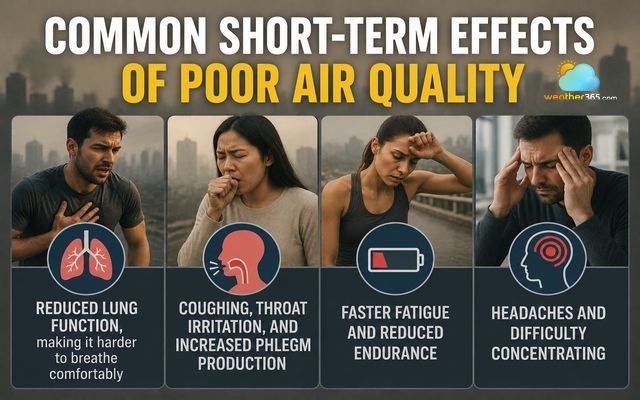
Common effects of poor air quality
Pollution can also trigger inflammation in the lungs and throughout the body. This may slow recovery after workouts and make training feel more difficult.
People with asthma, allergies, or heart conditions are often more sensitive to these effects.
Long-term exposure to polluted air may increase the risk of respiratory and cardiovascular diseases.
Studies have linked high levels of fine particulate matter (PM2.5) to reduced lung capacity and a higher risk of heart problems over time.
For runner-heavy high-altitude areas, this risk is even more pronounced.
For instance, wildfire smoke often traps pollutants at high elevations, forcing local athletes to constantly monitor the air quality in Denver before stepping outside.
Are you training in Colorado? Check Colorado air quality to ensure your lungs are breathing clean air on your next run!
How to check the AQI of my area?
Checking the Air Quality Index (AQI) before exercising outdoors is one of the easiest ways to protect your health.
Since air pollution levels can change throughout the day, monitoring local air quality helps runners make safer decisions about air quality and exercise.
Several free tools provide real-time AQI information and air pollution forecasts.
These platforms use data from government monitoring stations and air quality sensors to measure pollutants such as PM2.5, ozone, nitrogen dioxide, and particulate matter.
You can check AQI through:
AirNow
IQAir
Weather websites: Weather365.com, AccuWeather, Weather.com,...
Weather apps with air quality features
Most platforms display:
Current AQI
Hourly forecasts
PM2.5 levels
Health recommendations
Air quality maps
For example, if the AQI is 45, outdoor running is generally safe. If the AQI reaches 160, many experts recommend avoiding strenuous outdoor exercise.
Air quality can change significantly throughout the day due to traffic patterns, weather conditions, and pollution sources.
In many areas, air quality is often better in the early morning and worsens during rush hour.
Pollution levels may also rise during heat waves, while wildfire smoke can quickly create hazardous conditions.
Because air quality can fluctuate rapidly, checking the AQI immediately before your run is the best way to get the most accurate and up-to-date information.
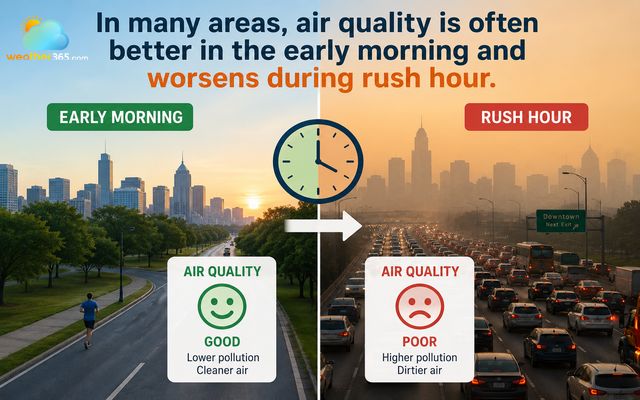
Air quality is often better in the early morning
How to run safely in polluted air?
Poor air quality does not always mean you have to skip your workout.
By making a few smart adjustments, you can reduce your exposure to pollutants and make safer decisions about air quality and exercise.
Check AQI Before Every Run
The first step is to monitor local air quality. Air pollution levels can change throughout the day due to traffic, weather, and industrial activity.
If you are unsure what AQI is unhealthy to run In, many experts recommend limiting outdoor exercise when AQI exceeds 100 and avoiding strenuous running when it rises above 150.
Choose the Right Time to Run
Timing can make a big difference. Pollution levels are often lower:
Early in the morning
After rainfall
On windy days
Try to avoid running during rush-hour traffic when vehicle emissions are highest. Ozone pollution also tends to peak in the afternoon during hot weather.
Pick Cleaner Running Routes
Where you run matters. Parks, trails, and green spaces generally have cleaner air than busy streets. Trees and vegetation can help filter some pollutants and create a healthier environment for exercise.
This is why runners navigating urban jungles like NYC heavily rely on Central Park to escape traffic emissions.
If you are pounding the pavement in the Big Apple, don't guess your exposure - check the live air quality in New York right now to find the safest routes for your outdoor session.

Choose parks, trails, and green spaces to run
Whenever possible, avoid:
High-traffic roads
Industrial zones
Construction areas
Adjust Your Workout
On days with moderate pollution, consider reducing your pace or distance.
Lower-intensity exercise decreases the amount of polluted air you inhale. Walking, easy jogging, or cross-training can be safer alternatives.
Stay Hydrated
Drinking water before and after a run supports recovery and helps your body function efficiently.
While hydration cannot remove pollutants from your lungs, it can help reduce the physical stress caused by exercise in poor conditions.
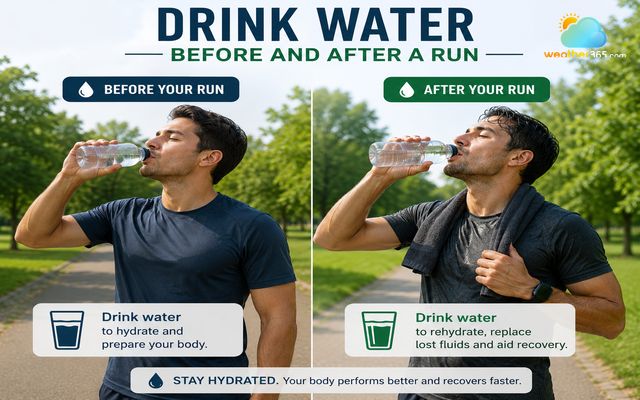
Drink enough water before and after a run
Move Indoors When Necessary
If AQI reaches unhealthy levels, indoor workouts are often the safest choice.
Running on a treadmill, riding a stationary bike, or exercising in a gym with air filtration can help maintain fitness while limiting exposure to pollution.
By checking AQI regularly, choosing cleaner routes, and adjusting your training plan, you can better manage air quality and exercise and reduce the risks associated with running in polluted air.
To sum up
Air quality can have a significant impact on both health and athletic performance. Checking AQI before a workout, understanding PM2.5 levels, and adjusting training plans during pollution events can help reduce health risks. As a practical guideline, outdoor running becomes increasingly risky when AQI rises above 150, making it important to understand what AQI is unhealthy to run in.
Frequently Asked Questions (FAQs)
If possible, avoid outdoor running and choose indoor exercise until air quality improves.
Related post

What is ground level ozone? Understanding ozone pollution and your health
 188
188
 8
8
 4.8
4.8
 17/09/2026

What Is PM2.5? Overview, Health Risks and Top Tips to Reduce PM Levels
73
8
5.0
09/09/2026
What Is an Air Quality Alert? A Complete Guide to AQI Warnings
57
8
4.8
17/09/2026

8 Comment
Kamila Larson
I’ve had days when the weather felt great but my run felt strangely uncomfortable. Checking AQI could explain some of those “why does the air feel awful today?” moments.
Remi Johnson
I think runners are probably more likely to obsess over pace, distance, and temperature than air quality. This is a good reminder that the air itself is part of the running environment.
Caroline Nelson
Should you only check AQI when there is visible smoke or haze?
weather365
No. Unhealthy pollutant levels can occur even when the air looks clear, so checking the AQI is more reliable than judging conditions by appearance alone.
Delilah Gill
Can wind make outdoor running conditions better when AQI is high?
weather365
Wind can sometimes disperse pollutants and improve air quality, although it can also transport pollution from another area.
Collins Young
Why can running be more affected by poor air quality than simply walking outside?
weather365
Exercise increases breathing rate and the amount of air inhaled, which can increase exposure to pollutants during a run.
Leave a comment
Your email address will not be published. Required fields are marked *