




What is ground level ozone? Understanding ozone pollution and your health


Wondering what is the ground level ozone? It is a harmful gas that forms near the Earth when pollutants mix in sunlight. Unlike the good ozone high in the sky, ground-level ozone damages lungs and harms health. This guide explains how it forms, who is at risk, and how to stay safe on high-ozone days.
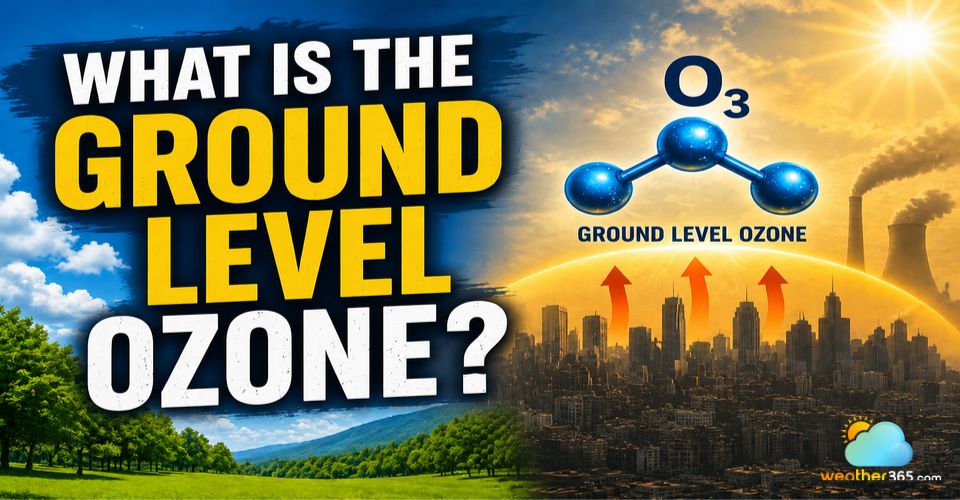
Ground level ozone meaning
What is ground level ozone?
To answer the question "what is the ground level ozone", it is important to understand that ozone exists in two different parts of the atmosphere.
Stratospheric Ozone
Stratospheric ozone forms a protective layer about 10 to 30 miles above the Earth's surface.
This "ozone layer" absorbs most of the sun's harmful ultraviolet (UV) radiation and helps protect humans, animals, and plants.
Ground-Level Ozone
Ground-level ozone, also known as tropospheric ozone, forms near the Earth's surface.
Unlike stratospheric ozone, it is considered a harmful air pollutant and a major component of smog.
Ozone itself is a gas made up of three oxygen atoms (O₃). While it has the same chemical structure in both locations, its effects are very different depending on where it is found.
In simple terms, if someone asks "what is ground level ozone explain", the answer is:
Ground-level ozone is a harmful air pollutant that forms near the Earth's surface when sunlight reacts with emissions from vehicles, power plants, industrial facilities, and other pollution sources.
Because it is not emitted directly into the air, scientists classify ozone as a secondary pollutant.
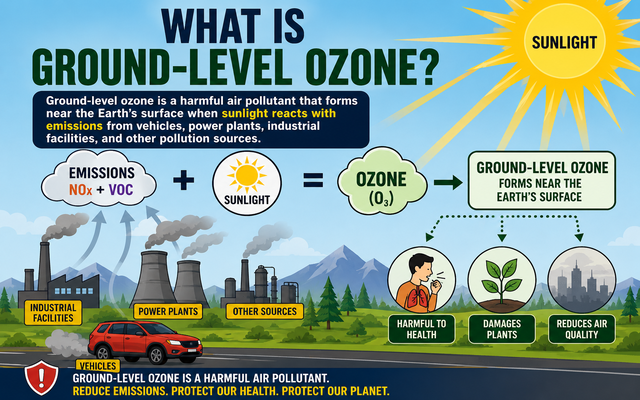
Definition of the ground-level ozone
View the Phoenix current air pollution levels to stay ahead of sudden smog alerts
How does ground level ozone form?
One of the most common questions about ozone pollution is "how does ground level ozone form?"
Unlike pollutants that come directly from smokestacks or vehicle exhaust, ozone forms through chemical reactions between two types of pollutants:
Nitrogen oxides (NOₓ) – from car exhaust, power plants, industrial boilers, and construction equipment
Volatile organic compounds (VOCs) – from gasoline, paints, solvents, cleaning products, and some natural sources like trees
These pollutants mix in the presence of sunlight and heat. The reaction creates ground-level ozone.
Ground-level ozone forms from pollutants released by a variety of human activities.
The primary sources of these ozone-forming pollutants, known as ozone precursors, include cars and trucks, power plants, industrial facilities, gas stations, chemical solvents, oil and gas operations, and even lawn and garden equipment.
These sources emit nitrogen oxides (NOx) and volatile organic compounds (VOCs), which react in the presence of sunlight to create ozone.
Ozone pollution tends to be highest during warm, sunny weather because strong sunlight speeds up the chemical reactions that produce ozone.
As a result, ground-level ozone levels often increase during the summer months.
For example, a city may experience moderate ozone concentrations during spring, but levels can rise significantly during a summer heatwave.
Wildfires can make the situation even worse by releasing large amounts of pollutants into the atmosphere, providing additional ingredients for ozone formation.
This combination of heat, sunlight, and pollution is why many cities issue ozone alerts on hot summer afternoons, especially when weather conditions favor the buildup of smog.
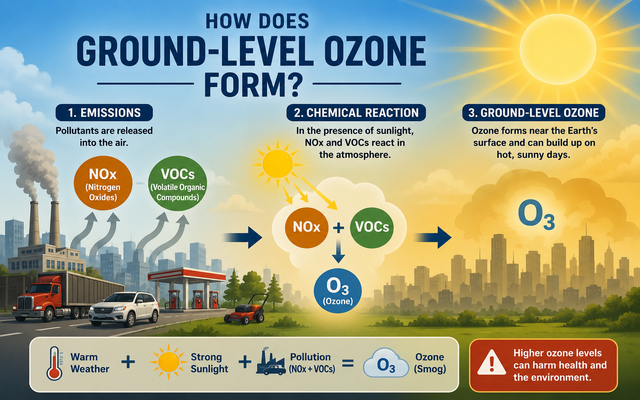
How does the ground-level ozone form
Ground level ozone levels
The Environmental Protection Agency (EPA) monitors ozone pollution through the National Ambient Air Quality Standards (NAAQS).
The current EPA standard for ozone is:
0.070 parts per million (ppm)
Equivalent to 70 parts per billion (ppb)
Measured over an 8-hour average period
Air quality agencies use the Air Quality Index (AQI) to communicate ozone risks to the public.
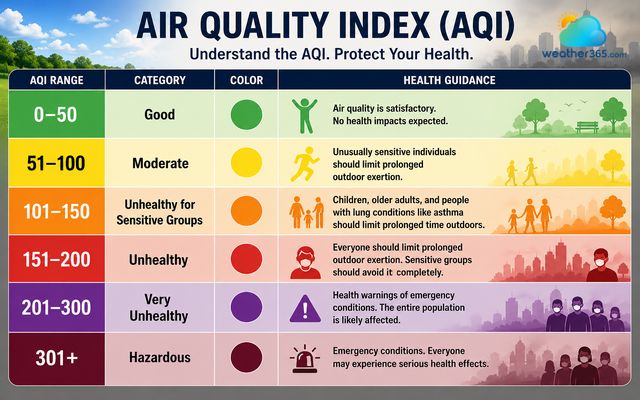
The AQI range
Real-world examples:
In Houston, Texas, summer ozone levels often reach 80–90 ppb, above the EPA standard.
In Los Angeles, ozone frequently exceeds 100 ppb during hot spells, hitting the “Unhealthy for Sensitive Groups” range.
During the 2020 wildfire season, parts of California saw ozone levels above 120 ppb even in rural areas.
These high ground level ozone levels trigger air quality alerts and lead schools to cancel outdoor activities.
Health effects of ground-level ozone
Ground-level ozone is highly reactive. When inhaled, it can irritate and damage lung tissue.
Many health experts compare ozone exposure to a "sunburn inside the lungs."
Even relatively low ozone levels can cause symptoms.
Common Symptoms
Exposure to elevated ozone concentrations may lead to:
Coughing
Throat irritation
Chest discomfort
Painful breathing
Wheezing
Shortness of breath
For more information, see our guide on Symptoms of Poor Air Quality.
Effects on Lung Function
Ozone can inflame and narrow the airways, making it harder to breathe.
Research has shown that ozone exposure can:
Reduce lung function
Increase airway inflammation
Make exercise more difficult
Increase emergency room visits during high-ozone days
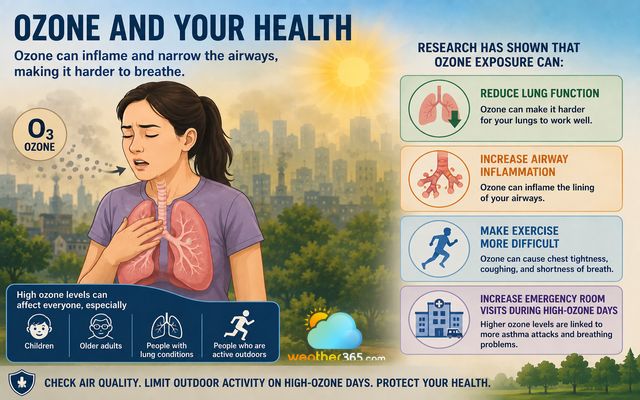
Ground-level ozone affect your health
Long-Term Health Concerns
Repeated exposure to ozone pollution may contribute to:
Chronic respiratory diseases
Reduced lung development in children
Increased asthma severity
Greater vulnerability to respiratory infections
Who is at risk most?
The EPA identifies these groups as most vulnerable:
Children: Their lungs are still developing, and they breathe more air per body weight. They also spend more time outdoors.
Older adults: Aging lungs and weaker immune systems increase risk.
People with lung disease: Asthma, COPD, emphysema, and chronic bronchitis worsen quickly with ozone exposure.
People active outdoors: Runners, construction workers, athletes, and coaches face higher exposure.
People in urban or industrial areas: Higher NOₓ and VOC levels lead to more ozone.
How to reduce ground-level ozone?
Reducing ground-level ozone starts with lowering emissions of nitrogen oxides (NOx) and volatile organic compounds (VOCs), the pollutants that react in sunlight to form ozone.
Because vehicles, power plants, industrial facilities, and gasoline-powered equipment are major sources of these emissions, both individual actions and community efforts play an important role in improving air quality.
If you are looking for how to reduce air pollution, one of the most effective steps is to reduce vehicle emissions.
Driving less, carpooling, using public transportation, walking, or cycling can help decrease the amount of ozone-forming pollutants released into the atmosphere.
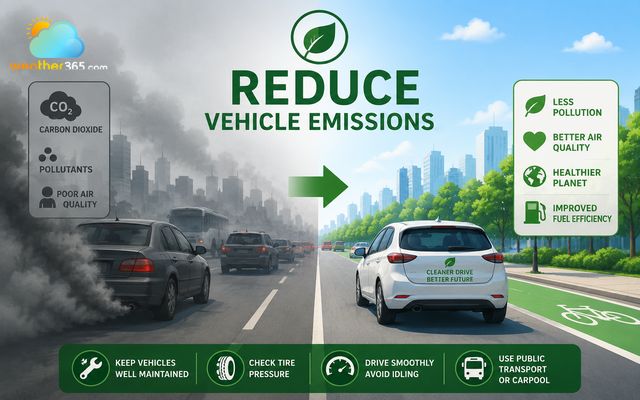
Reduce vehicle emissions for a better life
For example, replacing short car trips with walking or biking can significantly reduce local emissions, especially in urban areas.
Other ways to help reduce ground-level ozone include:
Avoid idling your vehicle when parked.
Refuel cars during cooler evening hours to reduce gasoline vapor emissions.
Use electric lawn mowers and garden equipment instead of gasoline-powered models.
Choose low-VOC paints, cleaners, and household products.
Reduce electricity use by turning off unused lights and using energy-efficient appliances.
These actions help lower the emissions that contribute to ozone formation.
It is also important to pay attention to local air quality forecasts.
During hot summer days, ozone levels often rise because sunlight speeds up the chemical reactions that create ozone.
Many cities issue ozone alerts when pollution is expected to reach unhealthy levels.
On these days, limiting driving and postponing activities that produce emissions can make a difference.
Reducing ground-level ozone is a shared responsibility.
By making small changes in daily habits and supporting cleaner energy and transportation options, individuals can help reduce air pollution, improve air quality, and protect public health for future generations.
Check the air quality in your location on Weather365 before heading out to safeguard your lungs!
In conclusion
Ground-level ozone is a serious pollutant that harms lungs, triggered by heat and sunlight reacting with NOₓ and VOCs. Knowing what is the ground level ozone helps you protect your health on bad air days. Check AQI daily, limit outdoor activity when ozone is high, and take steps to reduce emissions in your community.
Frequently Asked Questions (FAQs)
Related post

What Is Air Pressure? Understanding Atmospheric Pressure
 192
192
 0
0
 5.0
5.0
 18/08/2026
How To Measure Air Temperature? Step-by-Step Guide To Accurate Measurement
186
0
4.9
18/08/2026
What Is the Air Quality Index? Understanding AQI Levels and Health Risks
1
0
5.0
02/09/2026

0 Comment
Leave a comment
Your email address will not be published. Required fields are marked *