




What Causes Wildfires? Primary Environmental & Human Factors


What causes Wildfires? Wildfires can start naturally through lightning strikes or from human activities such as unattended campfires, equipment failures, and power lines. During extreme heat, drought, and strong winds, these ignition sources can rapidly spread fires across forests, grasslands, and other fire-prone ecosystems worldwide.
What is the cause of wildfire?
- What causes wildfires: Natural causes
- Lightning
- Volcanic eruptions
- Spontaneous Combustion
- What causes wildfires: human causes
- Arson
- Unattended Campfires
- Burning Debris
- Equipment, Machinery, and Infrastructure
- Discarded Cigarettes
- Where Do Wildfires Occur?
- Are wildfires getting worse?
- How to prevent wildfires?
What causes wildfires: Natural causes
Natural causes of wildfires include lightning strikes, volcanic eruptions, and, rarely, extreme heat from the sun. These events depend on a region’s climate, vegetation, and terrain.
Lightning
Lightning is the leading natural cause of wildfires, often striking power lines, trees, shrubs, or dry grass and triggering fast-spreading fires.
There are two types of lightning: hot and cold. Hot lightning, which carries lower voltage but lasts longer, generates intense heat, and, unlike short-lived cold lightning, it is responsible for most naturally ignited wildfires.
You can look at several examples to see its devastating impact:
In August 2020, dry lightning storms in California sparked over 650 wildfires, burning 1.5 million acres and forcing hundreds of thousands to evacuate.
In British Columbia, Canada, 60% of wildfires annually are caused by hot lightning.
The 2020 Bay Area fires, fueled by lightning following intense heat waves, destroyed 5 million acres and over 10,000 structures, killing 33 people.
Although lightning is unpredictable, proper land and fire management can reduce wildfire intensity and limit damage to people, wildlife, and property.
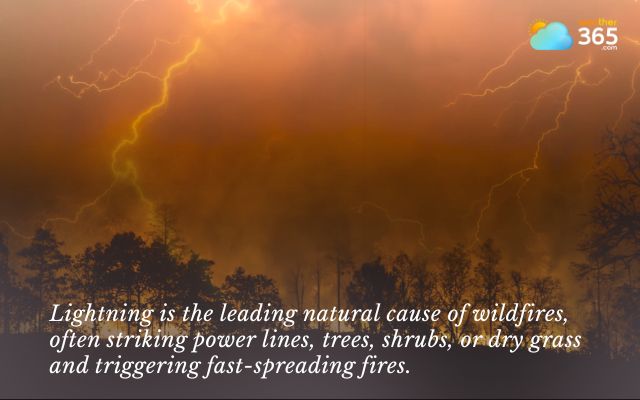
Lightning is the leading natural cause of wildfires
Volcanic eruptions
Apart from lightning, what causes forest fires?
If you’re comparing terms, see difference between wildfire and bushfire
It’s volcanic eruptions - another natural cause of wildfires.
When magma escapes from beneath the Earth’s crust, it erupts as lava and flows down mountainsides, spreading across forest floors and igniting vegetation.
Because lava reaches extremely high temperatures (1,292°F to 2,192°F), it burns everything in its path, including materials that are normally not very flammable.
These fires can spread quickly, causing significant damage to ecosystems and nearby communities.
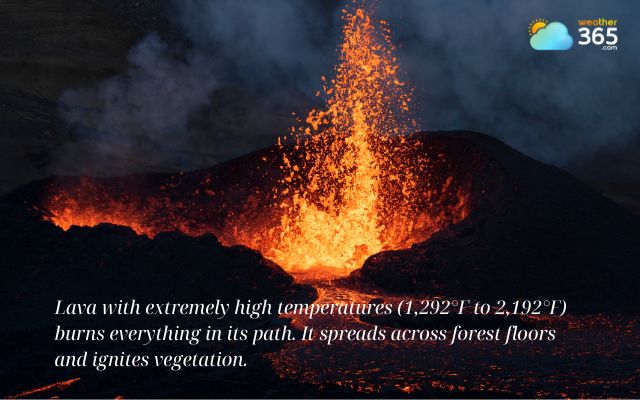
Volcanic eruptions can cause wildfires
Spontaneous Combustion
Climate conditions often amplify these fire events.
Decomposing organic matter, such as piles of dry leaves, mulch, or compost, can generate heat as it breaks down.
If this heat builds up to a critical level, it can spontaneously ignite a fire.
Dry vegetation, caused by prolonged heat and low rainfall, acts as fuel for ignition.
Australia’s record-hot 2019 with reduced rainfall contributed to a catastrophic bushfire season, burning 11 million hectares of land.
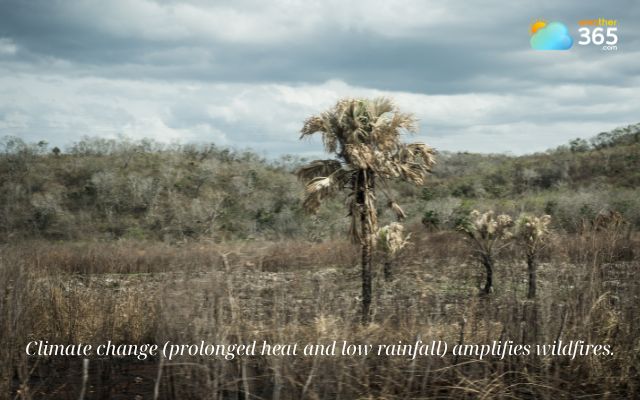
Climate change amplifies wildfires
Read more:
What causes wildfires: human causes
Human activity is a major cause of wildfires. In British Columbia, about 40% of wildfires each year are linked to human activities.
In the United States, that number rises to 85% of nearly 100,000 wildfires annually, according to the National Park Service.
Human-made wildfires have tripled the length of wildfire seasons in North America, extending them from 46 days in 1992 to 154 days in 2012.
If you’re planning for long events, read how long can a forest fire last.
The leading causes include debris burning and arson, while campfires and fireworks account for only 5% of incidents.
Recent studies in California also show that human-sparked wildfires are more destructive, spreading twice as fast as natural fires and covering 1.83 km per day.
Keep reading to analyze each cause more deeply.
Arson
A disturbing reality about forest fires is that many are intentionally set as acts of arson.
The motives behind arson often include real estate speculation, land clearing, or pasture management.
According to the National Fire Protection Association (NFPA), between 2014 and 2018, there were 52,260 intentional fires annually in the U.S.
These fires caused an estimated 400 civilian deaths, 950 injuries, and $815 million in property damage each year.
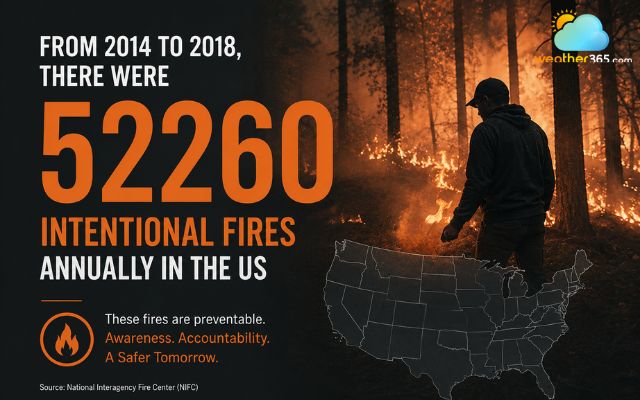
Many wildfires were the result of arson
Unattended Campfires
How do forest fires start? They could start from unattended or improperly extinguished campfires.
When left burning, campfires can quickly spread out of control, sending embers and ash into nearby dry vegetation, which can ignite new fires within minutes.
Local authorities often enforce strict fire safety rules, requiring campfires to be built only in designated rock-ringed fire pits with a shovel and plenty of water nearby.
However, these rules are frequently ignored, with many campfires lit outside regulated areas. This makes them harder to monitor and control.
Even after being “extinguished,” simmering embers can stay hot for hours or even days. In hot, dry, and windy conditions, these embers can reignite and trigger massive wildfires.
A stark example is the Ham Lake Fire of 2007, caused by an unattended campfire.
This blaze destroyed 75,000 acres of forest and hundreds of properties along Minnesota’s Gunflint Trail.
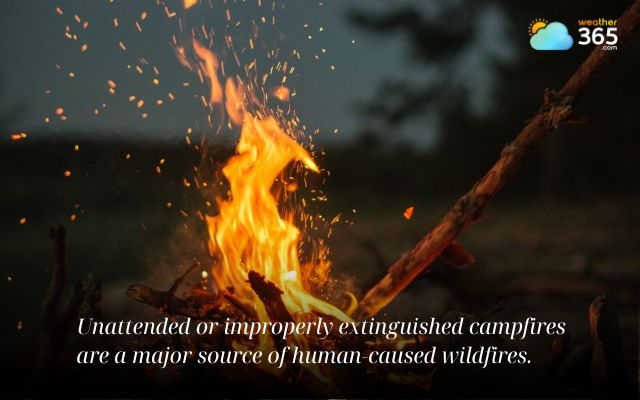
Campfires can cause wildfires
Burning Debris
Careless debris burning is another common cause of wildfires.
Under the right weather conditions, burning yard waste or leaves can quickly turn into an uncontrolled blaze.
Even a light wind can carry flames or hot embers from a burning pile to nearby vegetation, sparking new fires in unexpected areas.
One of the biggest risks comes from fires that appear extinguished but still smolder underneath.
A single hot ember can be carried by the wind and ignite a completely new fire elsewhere, especially in dry and windy conditions.
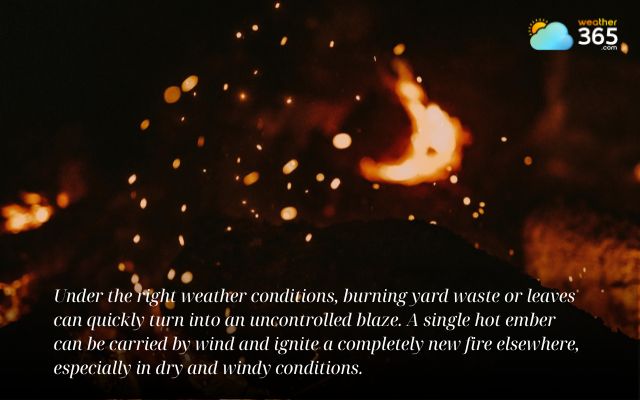
Careless debris is a common cause of wildfires
Equipment, Machinery, and Infrastructure
Research shows faulty or broken power lines are responsible for around 10% of fires in California each year (about 400 wildfires annually).
In the right conditions, a single spark is enough to ignite a forest fire.
This is why equipment malfunctions and engine sparks from farm machinery, construction tools, or vehicles are a major global fire risk.
While many machines now have spark arrestors, these devices cannot completely eliminate sparks. Under dry and windy weather, even one stray spark can trigger a devastating wildfire.
Historic examples include:
Zaca Fire (2007): Sparked by a metal grinder, it became California’s fifth-largest wildfire.
Carr Fire (2018): Caused by sparks from a broken trailer wheel rim, ranking as the state’s seventh-most destructive fire.
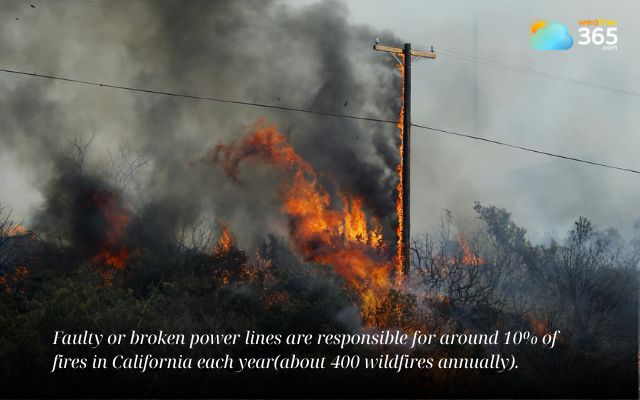
Faulty or broken power lines are responsible for around 10% of fires in California each year
You may also like this: What is the biggest wildfire in US history?
Discarded Cigarettes
Lit cigarettes tossed from cars, buildings, or sidewalks can easily ignite dry grass, leaves, and other flammable materials, triggering fast-spreading wildfires.
The impact is costly and devastating: in the U.S. alone, discarded cigarette butts were linked to $6 billion in property damage from wildfires in 2017.
This is not just a U.S. problem. In Canada, seven separate fires on Vancouver Island in 2019 were confirmed to have started from cigarette butts during a dry weather spell.
Similarly, in Southern France, firefighters report that 16% of bushfires originate from cigarettes thrown from passing vehicles.
Proper disposal of cigarettes and increased awareness remain crucial steps to prevent these avoidable wildfires.
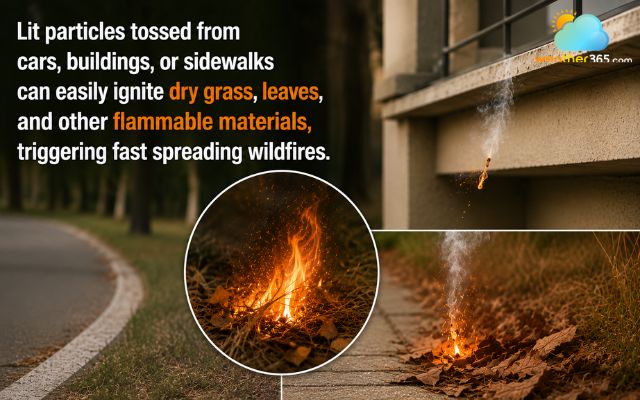
What are causes of forest fires? Discarded cigarette causes wildfires
Where Do Wildfires Occur?
Wildfires are most common in regions with dry climates, abundant vegetation, and a history of fire activity.
Hotspots include the Western United States, southern and eastern Australia, Mediterranean Europe (Spain, Portugal, Italy, Greece), the Amazon Rainforest in Brazil, Siberia and parts of Russia, and Southeast Asia (Indonesia, Malaysia, Thailand, Vietnam).
For a country-by-country breakdown, see what country has the most wildfires
Local drought, high temperatures, and flammable vegetation fuel these fires, while climate change is increasing their frequency and severity.
These conditions make wildfire prevention and early detection crucial worldwide.
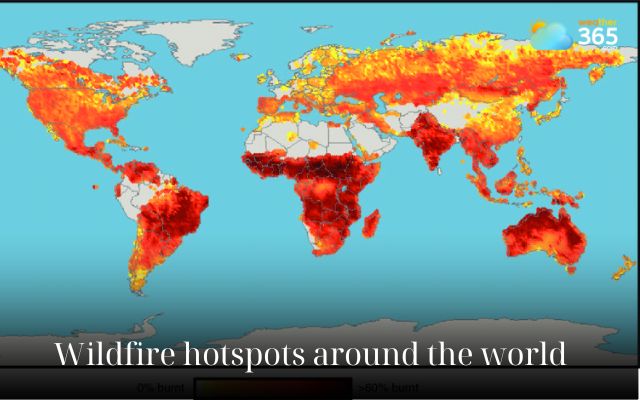
Wildfire hotspots worldwide
Are wildfires getting worse?
Unfortunately, the answer is YES.
Wildfires are increasing in frequency, size, and the number of people they displace.
This rise is driven by multiple factors, including climate change, prolonged drought, and human activity.
Climate change is causing higher global temperatures and drier conditions, creating the perfect environment for wildfires to ignite and spread rapidly.
To understand how these conditions are monitored and warned, see fire weather zone forecast.
Severe and frequent droughts further dry out vegetation, turning it into highly flammable fuel.
Combined with human-caused ignition sources, these conditions are fueling more destructive and widespread wildfires than ever before.
Look at the numbers below to see how wildfires are getting worse
Wildfires are now destroying more than double the amount of tree cover each year compared to two decades ago.
The year 2024 marked the most extreme wildfire season on record, with at least 13.5 million hectares of forest burned—an area roughly the size of Greece. Compared to 2023, the number is just 11.9 million hectares.
Between 2023 and 2024, wildfires accounted for 44% of all annual tree cover loss, a sharp increase from the 2001–2022 average of 25%.
Wildfire smoke causes an estimated 1.5 million deaths annually.
For practical guidance on symptoms and protection, read wildfire smoke health effects
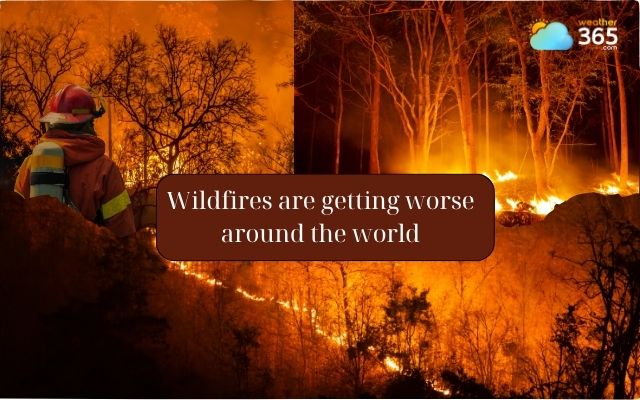
Worldwide wildfires are getting worse
How to prevent wildfires?
How to prevent a wildfire? Actually, it’s not as difficult as you think.
Follow these things below, and you are able to limit the chance of fires.
Extinguish campfires completely: Use plenty of water, stir ashes, and ensure everything is cold to the touch before leaving.
Avoid debris burning during high-risk days: Check local regulations and weather conditions to prevent accidental wildfires.
Dispose of cigarettes safely: Use designated ashtrays and never toss lit cigarettes from vehicles or near dry vegetation.
Maintain power lines and outdoor equipment: Regularly inspect electrical lines and ensure machinery has spark arrestors to prevent sparks.
Create defensible space around your property: Clear dry leaves, branches, and flammable materials at least 30 feet around your home.
Follow fire bans and local restrictions: Stay updated on wildfire danger levels and adhere to fire safety laws.
Conclusion
Understanding the causes of wildfires is essential for prevention and protection. While natural factors like lightning and volcanic activity play a role, human activities remain the leading cause of these destructive events. Knowing what causes wildfires empowers communities to take action and build a safer, more resilient environment.
Frequently Asked Questions (FAQs)
Related post
What Country Has The Most Wildfires? Analyzing Global Hotspots
 565
565
 8
8
 4.8
4.8
 20/05/2026
What is a wildfire? Core Definition, Characteristics & Key Facts
251
9
4.9
20/05/2026
Wildfire Smoke Health Effects: Symptoms, Risks, and Protection Tips
233
8
4.8
20/05/2026

8 Comment
Riley Larson
Does wind actually make a bigger difference than temperature when a wildfire is spreading?
Angelina Lindsey
I never really thought about campfires being a wildfire risk until seeing how dry forests can get. I guess one small mistake is enough.
Ruth Nelson
Wait, can a wildfire start even after a period of rain? I always assumed rain meant the risk was basically gone.
weather365
The risk can drop, but it doesn't disappear. Vegetation can dry out again, especially during a hot, dry stretch.
Caleb Houston
Dry vegetation + strong winds sounds like a recipe for disaster. How quickly can a small fire actually turn into a major wildfire?
weather365
It can happen surprisingly fast when conditions are hot, dry, and windy.
Gabrielle Floyd
I knew wildfires could start from lightning, but I didn't realize how many different things can actually trigger one. Which cause is the hardest to prevent?
weather365
Probably the ones linked to human activity. Some can be prevented, while natural causes like lightning are much harder to control.
Leave a comment
Your email address will not be published. Required fields are marked *