




Which is The Most Accurate Weather Forecast? A Complete Guide


Have you ever checked the weather forecast, only to find out it wasn't 100% accurate? And wondered if the most accurate weather forecast even exists? You're landing on the right place! Scrolling down to learn how forecasting works, how accurate it really is, and how you can find the most accurate weather forecast in the world for your needs.
Find out “the most accurate weather forecast” myth
- Is There Really a Most Accurate Weather Forecast?
- What Makes a Weather Forecast Accurate?
- How Accurate Are Weather Forecasts?
- Today's forecast
- 1–3 day forecast
- 5-day forecast
- 7-day forecast
- Factors Affecting Forecast Accuracy
- The 4 Most Accurate Weather Forecasts
- ECMWF (European Centre for Medium-Range Weather Forecasts)
- GFS (Global Forecast System)
- ICON (ICOsahedral Nonhydrostatic Model)
- Local National Weather Services
- Why Different Weather Websites Show Different Forecasts?
Is There Really a Most Accurate Weather Forecast?
Many people assume there must be one website or app that always delivers the most accurate weather forecast.
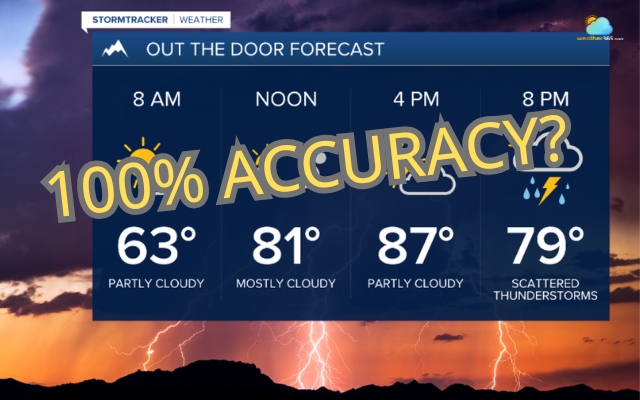
Is there a 100% accuracy weather forecast?
In reality, forecasting is much more complex.
Weather predictions are created using massive data systems, atmospheric models, and supercomputers.
Because the atmosphere is constantly changing, even the best models cannot predict conditions perfectly every time.
Accuracy usually depends on several factors, such as your location, the forecast timeframe, the model used by the service, or, importantly, how frequently data is updated.
This means that asking which weather forecast is the most accurate does not have a universal answer.
Some services perform better in certain regions, while others excel at long-range predictions.
For example, meteorologists often compare multiple forecast models to create the most reliable outlook.
This process improves reliability rather than relying on just one prediction.
If you're trying to get the most accurate weather forecast, the best strategy is usually to check trusted sources and compare them.
What Makes a Weather Forecast Accurate?
A weather forecast is most accurate when it combines high-quality observations, advanced weather models, frequent data updates, and a good understanding of local geography.
Even the world's best forecasting systems depend on these factors working together to produce reliable predictions, especially for short-term forecasts.
Observation quality
Every forecast begins with real-time weather observations collected from satellites, weather radar, weather stations, ocean buoys, aircraft, and weather balloons.
These systems measure temperature, humidity, air pressure, wind, and precipitation.
The more complete and accurate the observations are, the more reliable the forecast will be.
Weather models
Meteorologists use numerical weather prediction (NWP) models to simulate how the atmosphere will change over time.
Leading models such as ECMWF, GFS, and the UK Met Office Unified Model each have different strengths, so forecasters often compare multiple models or use ensemble forecasting instead of relying on just one prediction.
Update frequency
Because the atmosphere changes continuously, forecasts must be updated regularly.
Major forecasting models like NOAA's GFS run four times a day, allowing new observations to be incorporated and helping improve short-term forecast accuracy as weather conditions evolve.
Local terrain
Geography also plays an important role. Mountains, coastlines, forests, and large cities all influence local weather.
For example, coastal areas often experience sea breezes, while mountains can trigger sudden rainfall.
Forecasts become more accurate when they combine global weather models with local observations that capture these regional effects.
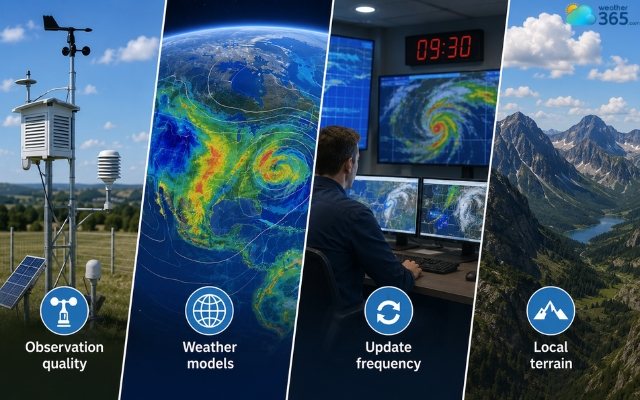
Factors affecting weather forecasts’ accuracy
How Accurate Are Weather Forecasts?
Weather forecasting has improved dramatically over the past few decades.
Modern satellites, radar systems, and advanced computing allow meteorologists to simulate the atmosphere with remarkable precision.
However, accuracy still decreases the further we look into the future.
Today's forecast
Forecasts for today are usually the most accurate because meteorologists have access to real-time observations from satellites, radar, weather stations, and aircraft.
These forecasts are updated frequently throughout the day, making them highly reliable for deciding whether to carry an umbrella, plan outdoor activities, or travel.
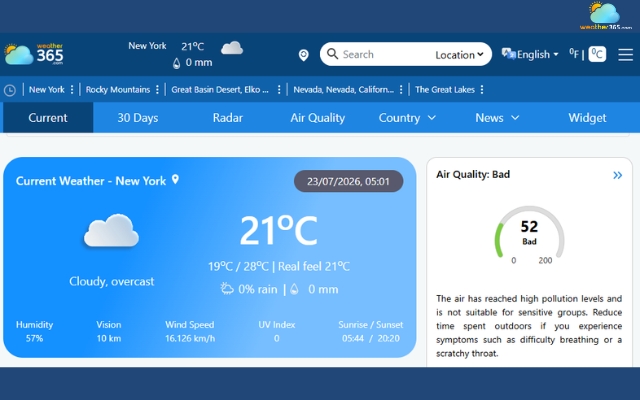
Today’s forecast is the most accurate
1–3 day forecast
A 1–3 day forecast remains highly dependable, with an average accuracy of 90–95%.
Weather systems are generally well understood over this time frame, allowing meteorologists to predict temperature, rainfall, and wind conditions with a high level of confidence.
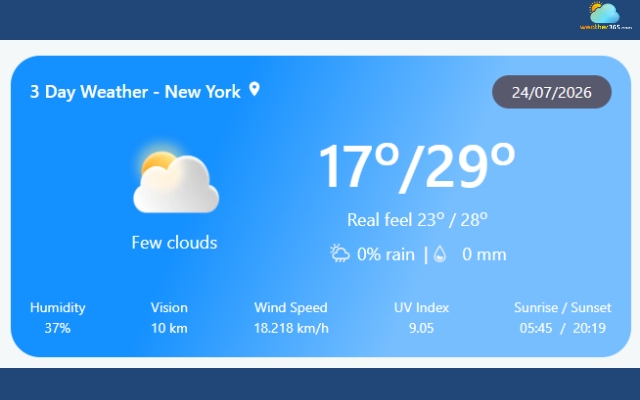
1–3 day forecast is highly dependable
5-day forecast
A 5-day forecast is still considered reliable for most planning purposes, with an average accuracy of around 90%.
While the overall weather pattern is often predicted correctly, small details such as the exact timing of rain or storm intensity may change as new data becomes available.
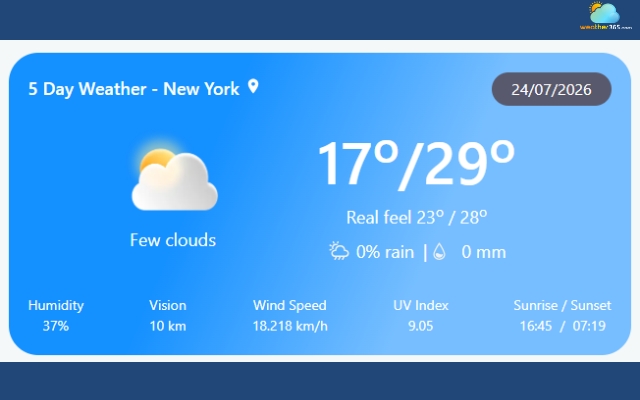
A 5-day forecast is reliable for most planning purposes
7-day forecast
A 7-day forecast provides a good indication of the general weather trend, but confidence begins to decrease.
With an average accuracy of about 80%, forecasts at this range are best used to understand whether the week is likely to be warm, cool, dry, or unsettled rather than to plan activities around a specific hour.
As a general rule, short-term forecasts are far more dependable than long-range predictions.
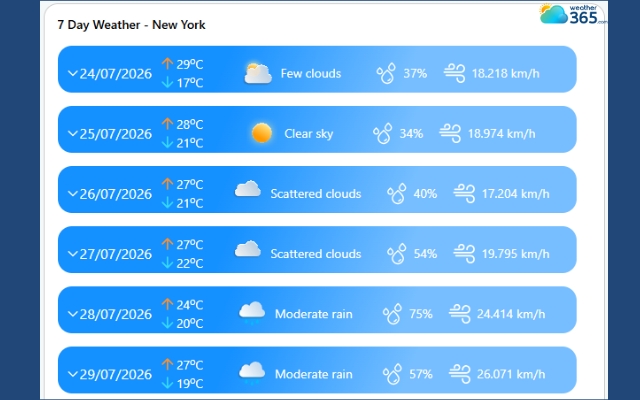
A 7-day forecast can indicate the weather trend
The most accurate weather forecast is usually the one covering the next few days rather than the next two weeks.
Forecast Period | Typical Accuracy | Best Use |
Today's forecast | 95–99% | Planning daily activities |
1–3 day forecast | 90–95% | Outdoor events, short trips |
5-day forecast | Around 90% | General weekly planning |
7-day forecast | Around 80% | Identifying overall weather trends |
10+ day forecast | About 50% | Long-range outlook only |
Factors Affecting Forecast Accuracy
Forecast accuracy is influenced by several scientific and environmental factors. Even the most advanced forecasting systems cannot control these variables completely.
One of the biggest influences is location.
Weather behaves differently depending on geography.
Coastal regions, mountainous areas, and tropical climates often experience rapid weather changes that are harder to predict.
For example, sea breezes or sudden storm development can alter conditions within a short time.
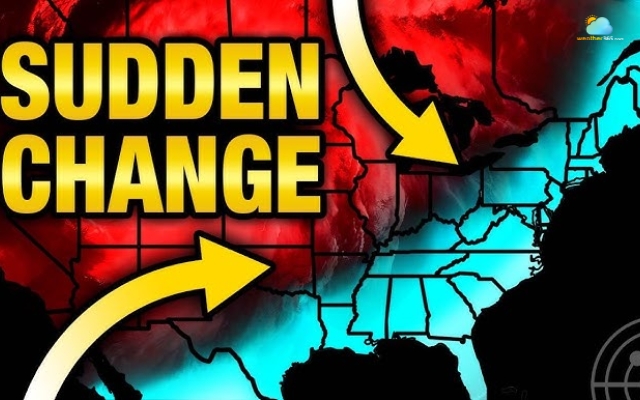
Location significantly affects the weather pattern
Another important factor is timing.
The further into the future a forecast tries to predict, the more uncertainty it contains.
Weather models simulate how atmospheric systems may evolve, but tiny differences in initial data can produce different outcomes over time.
This phenomenon is sometimes described as the “butterfly effect” in atmospheric science.
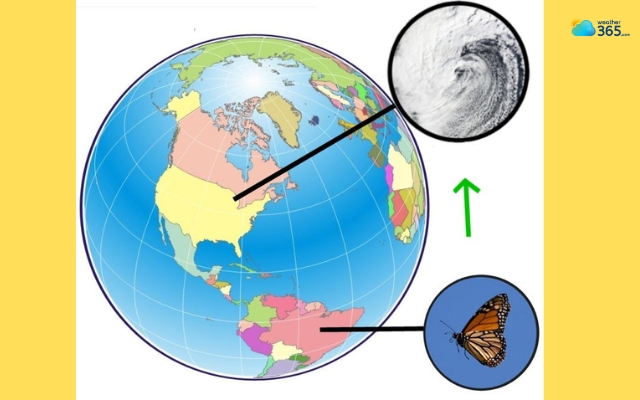
Butterflies effect in weather forecast
Technology also plays a major role in improving forecast reliability.
Modern meteorology relies on satellites, weather balloons, radar systems, and thousands of ground stations that constantly collect atmospheric data.
These observations feed into sophisticated computer models that simulate weather patterns around the world.
As computing power continues to grow, these models become more detailed and accurate.
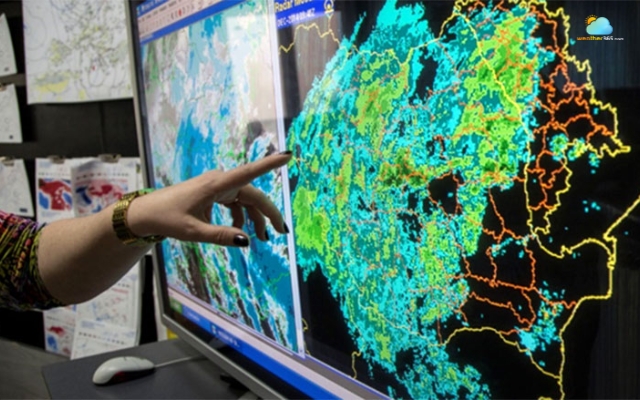
Technology plays an important part in weather forecasting
However, even with advanced technology, forecasting remains a process of probability rather than certainty.
Meteorologists often compare several models and combine their results to produce the most realistic prediction.
Because of this, finding the most accurate weather forecast in the world is less about choosing one perfect source.
Instead, it’s more about using reliable services that update their predictions frequently and use high-quality data.
The 4 Most Accurate Weather Forecasts
There isn't a single weather forecast that is always the most accurate everywhere. Different forecasting systems perform better depending on the region, weather conditions, and forecast range.
Below are four of the world's most trusted weather forecasting systems used by meteorologists and weather services to produce reliable forecasts.
ECMWF (European Centre for Medium-Range Weather Forecasts)
ECMWF is widely regarded as one of the world's most accurate weather forecasting systems, particularly for 3–10 day forecasts.
Developed by the European Centre for Medium-Range Weather Forecasts, it uses advanced numerical models and one of the most powerful supercomputers dedicated to weather prediction.
Its ensemble forecasting system runs multiple simulations simultaneously, helping meteorologists estimate both the most likely weather scenario and the level of forecast uncertainty.
Because of its consistently strong performance, ECMWF data is used by weather agencies, airlines, emergency services, and researchers worldwide.

ECMWF is one of the world's most accurate weather forecasting systems
GFS (Global Forecast System)
The Global Forecast System (GFS) is NOAA's global weather prediction model and one of the most widely used forecasting systems.
It provides forecasts for nearly every location on Earth up to 16 days ahead and updates four times daily, ensuring forecasts reflect the latest atmospheric observations.
Combining satellite imagery, radar, and weather models ensures maximum precision for US accurate weather forecast data.
While GFS may not always outperform ECMWF for medium-range forecasts, its frequent updates and global coverage make it an essential forecasting tool.
Many weather websites and mobile apps rely on GFS data for daily weather updates.
Explore details about this system in What is the GFS weather model!
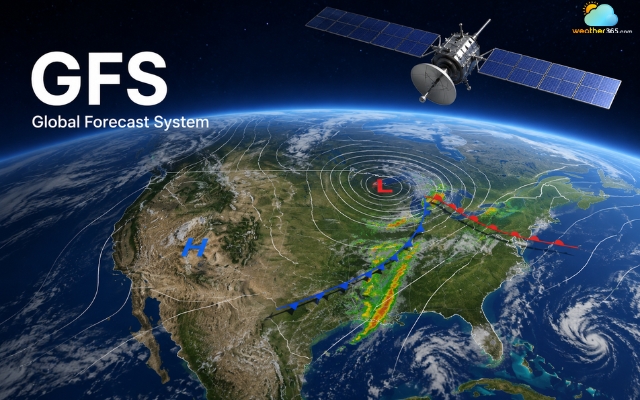
The Global Forecast System (GFS) is widely used
ICON (ICOsahedral Nonhydrostatic Model)
Developed by the German Weather Service (DWD), ICON is a modern weather model designed for both global and regional forecasting.
It uses a high-resolution grid that helps simulate atmospheric processes more accurately, especially for heavy rainfall, thunderstorms, and rapidly changing weather.
ICON has become increasingly popular in Europe and is often compared with ECMWF and GFS.
Many meteorologists use it alongside other models to improve forecast confidence.
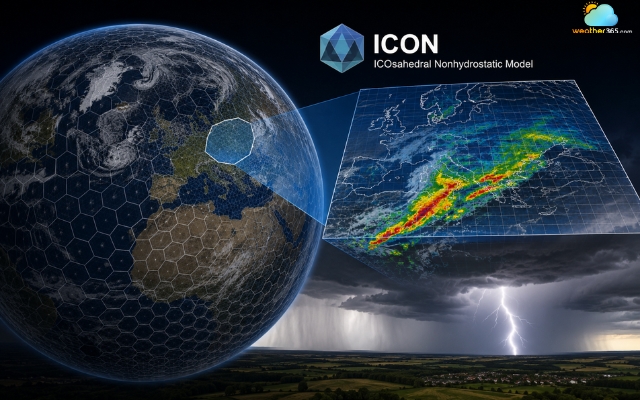
ICON is a weather model designed for both global and regional forecasting
Local National Weather Services
Although global models provide the foundation for weather forecasting, local national weather services often deliver the most practical forecasts for everyday use.
Agencies such as the National Weather Service (U.S.), the UK Met Office, Environment and Climate Change Canada, and many national meteorological organizations combine global model data with local observations, radar, and regional models.
This local expertise allows them to better capture the effects of mountains, coastlines, urban areas, and other regional features.
As a result, their forecasts are often more accurate for specific cities or communities than forecasts based solely on global weather models.
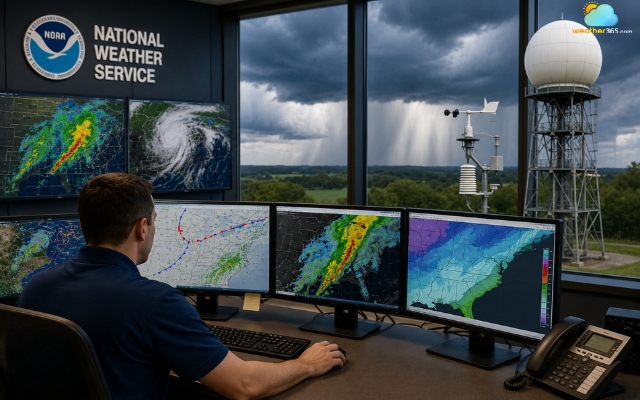
Local national weather services are more accurate for specific cities
Choose the most suitable weather forecast for your needs based on the comparison table below!
Forecast System | Best For | Key Strength | Possible Limitation |
ECMWF | Medium-range forecasts (3–10 days) | Industry-leading accuracy, excellent ensemble forecasting | Updates less frequently than GFS |
GFS (NOAA) | Global weather and longer-range forecasts (up to 16 days) | Worldwide coverage, updates 4 times daily, widely available | Medium-range accuracy can be lower than ECMWF in some situations |
ICON (DWD) | Short- to medium-range forecasts, severe weather | High-resolution model, strong performance for storms and heavy rainfall | Primarily optimized for Europe, with more limited adoption elsewhere |
Local National Weather Services | City- and region-specific forecasts | Combine global models with local radar, observations, and regional expertise | Forecast quality depends on each country's observation network and forecasting resources |
Why Different Weather Websites Show Different Forecasts?
It's normal for weather websites to show different forecasts.
While most services use similar observations from satellites and weather stations, they often rely on different forecast models, update schedules, and forecasting methods.
These differences can lead to slightly different predictions for temperature, rainfall, wind, or the timing of storms.
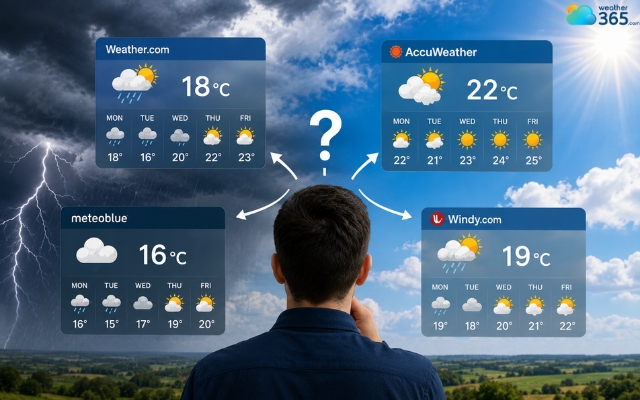
Different weather websites depends on different forecast models
One reason is that weather providers may use different numerical weather prediction models, such as ECMWF, GFS, or ICON.
Since each model processes atmospheric data differently, their forecasts will not always match.
Forecasts also vary because websites update their data at different times.
Some refresh several times a day, while others may still display results from an earlier model run.
As weather conditions change continuously, newer data can produce different predictions.
In addition, some providers simply display model output, while others combine multiple models with local radar observations and expert analysis.
This helps improve forecasts for specific regions, especially in areas with complex terrain or rapidly changing weather.
Rather than searching for one website that is always right, it's better to use trusted weather services and compare forecasts when severe weather or important outdoor plans are involved.
Looking for a consistent trend across reliable sources is often more useful than relying on a single prediction.
Want the most reliable forecast for your area? Check the latest local weather updates on Weather365, where forecasts are refreshed regularly using trusted meteorological data to help you make better daily plans.
Final Thought
Long story short, the idea of a single most accurate weather forecast is partly a myth. Forecast accuracy depends on location, timeframe, and the technology used to analyze atmospheric data. Remember to use trusted sources and check updated data regularly to get the most accurate weather forecast.
Frequently Asked Questions (FAQs)

0 Comment
Leave a comment
Your email address will not be published. Required fields are marked *