




Record High Tides Trigger Coastal Flooding Across Southern California


Record high tides are flooding Southern California's coastline, breaking records in San Pedro and inundating streets in Newport Beach and Long Beach. With elevated sea levels expected to persist through Thursday, low-lying communities face continued flood risks. Here's what residents need to know.

Record high tides in Southern California
Record High Tides Break San Pedro Records
A record high tide at San Pedro on Monday morning surpassed the previous record of 7.93 feet, set on January 10, 2005.
The preliminary reading of 8.02 feet was the highest recorded at the tide gauge since records began in November 1923, according to the NWS.
The effects were also visible in Orange County.
Newport Beach recorded a high tide of 8.3 feet on Monday, flooding streets in low-lying areas, including parts of Balboa Island and the Balboa Peninsula.
Officials expected water levels to reach 8.5 feet on Tuesday, raising concerns about further flooding.
The city activated pumps and reinforced sand barriers to protect vulnerable neighborhoods.
Officials also distributed sandbags and temporarily suspended parking enforcement to give residents more time to move vehicles away from flood-prone streets.
Coastal flooding also disrupted transportation.
Metrolink suspended service on part of its Orange County Line between Laguna Niguel/Mission Viejo and Oceanside, with trains terminating at Laguna Niguel/Mission Viejo during the disruption.

Record high tide at San Pedro reached 8.02 feet
Which Southern California Areas Face the Highest Flood Risk
Orange and San Diego counties face some of the greatest coastal flood risks. The NWS issued a coastal Flood Warning for these areas through 1 p.m.
Thursday, October 29, citing the potential for seawater to reach homes, businesses and critical infrastructure in low-lying locations.
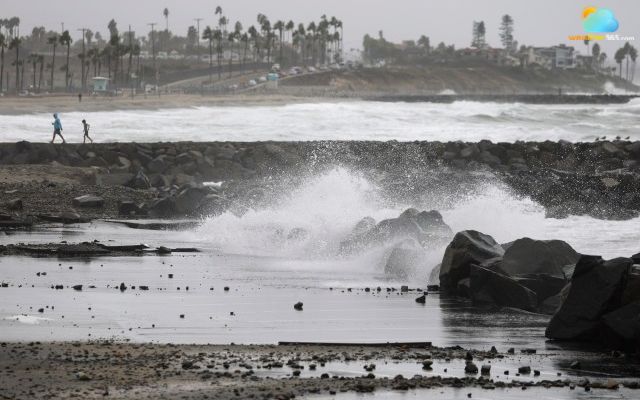
Orange and San Diego counties face greatest flooding risks (Photo: K.C. Alfred)
Los Angeles and Ventura counties are also under a coastal flood advisory.
Beach parking lots, harbor walkways, bike paths and exposed sections of coastline are particularly vulnerable to flooding.
Areas with little remaining beach sand or a history of coastal damage could experience more serious impacts.
Officials have urged residents near the shoreline to move vehicles to higher ground, protect property with sandbags or temporary flood barriers, and avoid flooded roads.
High tides may also cause beach erosion and temporary road closures.
Follow official NWS alerts for the latest flood warnings and safety guidance.
Location | Potential impacts |
Record-high water levels and possible coastal flooding | |
Flooded streets and low-lying neighborhoods | |
Coastal flooding, beach erosion, and exposed properties | |
Flooding in low-lying coastal communities | |
Los Angeles and Ventura counties | Localized flooding near beaches, harbors, and waterfront paths |
The unusually high water levels reflect several factors working together, including the October 26 full moon, warmer-than-normal ocean temperatures, El Niño-related conditions and a Kelvin wave that has raised sea levels along the Pacific Coast.
→ Incoming moon phase in California
Scientists reported that ocean conditions had pushed water levels roughly 1.25 to 1.8 feet above what astronomical tides alone would produce in parts of the region.
With further high tides expected later in the week, coastal communities remain vulnerable to flooding.
Officials are also watching for additional risks as Southern California approaches a potentially rainy Halloween weekend.
References
USA Today
LA Times
LAmag
MyNewsLA
Related post

Super Typhoon Champi Officially Claimed as the Strongest Storm of 2026
 1736
 0
 4.8
 21/10/2026

New Mexico Tornado Watch Issued for Western Counties
66
0
4.7
23/10/2026

Four Corners Flooding: Southwest Region Braces for More Heavy Rain and Storms
39
0
4.8
26/10/2026

0 Comment
Leave a comment
Your email address will not be published. Required fields are marked *