




Four Corners Flooding: Southwest Region Braces for More Heavy Rain and Storms


Four Corners flooding remains a concern as more rain threatens the southwestern United States after days of heavy downpours. On Sunday, October 25, the National Weather Service issued a flood watch for much of the region, while officials continued assessing damage and monitoring the risk of further flooding.

Four Corners flooding continues
Quick Takeaways
The NWS issued a flood watch for much of the Four Corners region as additional rain threatened saturated ground.
Evacuations, power outages and flood damage continued in Farmington and surrounding communities.
Damaged utilities, contaminated floodwater and further rainfall could pose dangers even as river levels recede.
Four Corners Flooding Prompts New Flood Watch
Four Corners flooding remains a concern across the southwestern United States as more showers and thunderstorms threaten areas already affected by days of heavy rain.
On Sunday, October 25, 2026, the National Weather Service (NWS) issued a Flood Watch for much of the Four Corners region, where Arizona, Colorado, New Mexico and Utah meet.
The warning came as rivers began to recede in parts of the region, but officials continued to assess flood damage and prepare for further rainfall.
Since Wednesday, October 21, heavy rain has caused rivers to rise, flooded homes and prompted water rescues.
Saturated ground has increased the risk of additional flooding, particularly along small creeks and streams that can overflow after relatively little additional rain.
A tornado also touched down in Santa Fe, New Mexico, at around 7 p.m. on Saturday, October 24, according to weather officials. (Read more: New Mexico tornado watch)
Forecasters were investigating whether other tornadoes had occurred elsewhere in the state.
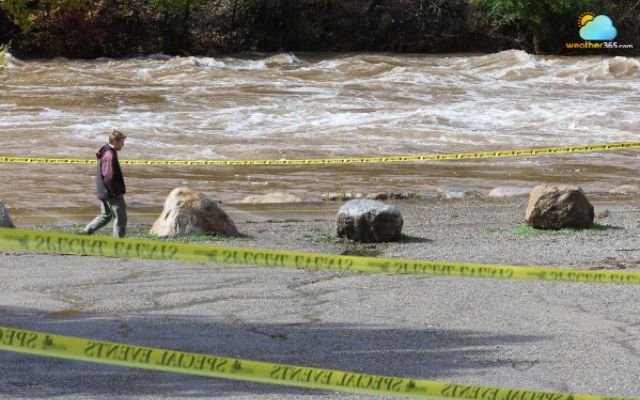
Flooding remains a concern in the Four Corners (Photo: AP News)
Check current weather conditions in Santa Fe to monitor rainfall and changing conditions as the region recovers.
Evacuations and Power Outage in New Mexico
In the Farmington area of northwestern New Mexico, floodwaters receded on Sunday, but many residents remained evacuated, and hundreds were still without electricity.
Officials had not confirmed the total number of damaged homes or evacuees in San Juan County.
However, they reported no known deaths in the county at the time.

Residents are evacuated due to severe damage to homes (Photo: AP News)
The flooding left significant damage to homes and infrastructure.
San Juan County Sheriff Shane Ferrari reported that about 4 feet (1.2 meters) of water had entered his home.
Emergency crews continued checking evacuated neighborhoods for damaged utilities, downed power lines and other hazards.
Officials warned that these inspections could take several days before residents could safely return.
Flooding also damaged wastewater facilities and water-holding ponds in Shiprock, within the Navajo Nation.
The damage caused sewage to enter the San Juan River, although officials had not determined how much wastewater had been released.
In Colorado's Archuleta County, emergency teams carried out welfare checks and aerial surveys to assess the destruction.
Local officials described the damage as severe, while the full extent of losses remained unclear.
Location | Reported impact |
Farmington, New Mexico | Evacuations and power outages |
Shiprock, Navajo Nation | Wastewater damage and sewage release |
Archuleta County, Colorado | Severe flood damage assessment |
The threat is not over, as additional showers and thunderstorms could bring more water to already saturated ground.
Forecasters have linked the prolonged wet pattern to tropical moisture moving inland from the Pacific, with El Niño also cited as a possible factor in the unusually heavy rainfall.
Even where rivers are falling, floodwater may leave sewage-contaminated mud and expose residents to damaged electrical, gas and propane lines.
People should avoid flooded roads, stay out of restricted areas, and wait for officials to confirm that evacuated neighborhoods are safe.
Continued monitoring of NWS alerts is essential as weather conditions and recovery efforts develop.
References
NBC News
ABC News
AP News
WRAL
Related post

Super Typhoon Champi Officially Claimed as the Strongest Storm of 2026
 1615
 0
 4.8
 21/10/2026
October Nor'easter Triggers Severe Mid-Atlantic Coastal Flooding
78
0
4.7
20/10/2026
New Mexico Tornado Watch Issued for Western Counties
49
0
4.7
23/10/2026

0 Comment
Leave a comment
Your email address will not be published. Required fields are marked *