




Frost advisory in the Piedmont for Tuesday, temperatures as low as 33


At 2:01 a.m. Monday, the National Weather Service Raleigh NC office issued a frost advisory in the Piedmont, in effect from 2 a.m. to 8 a.m. Tuesday. The advisory spans much of central and northern North Carolina, including Person, Granville, Vance, Warren, Halifax, Forsyth, Guilford, Alamance, Orange, Durham, Franklin, Nash, Edgecombe, Davidson, Randolph, Chatham, Wake, Johnston, Wilson, and Lee counties.
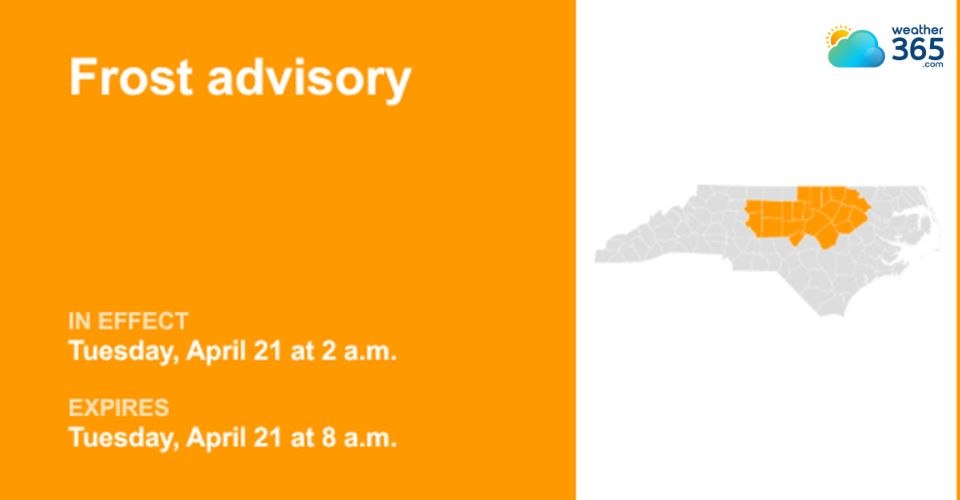
Frost advisory in Piedmont
According to forecasters, temperatures early Tuesday morning are expected to drop into the lower to middle 30s—conditions that are favorable for frost formation, especially in rural and low-lying areas where cold air tends to settle.
In contrast, urban locations may remain a few degrees warmer due to the heat-retaining effects of buildings and pavement, making widespread frost less likely in those areas.
Officials caution that even a brief period of frost can be harmful to sensitive vegetation. Unprotected plants, particularly those already budding or newly planted, could suffer damage or be killed by the cold.
Gardeners and farmers are encouraged to take preventative measures, such as covering plants, bringing potted vegetation indoors, or using protective materials to limit exposure.
The advisory underscores the potential for localized impacts during the early morning hours and remains in place until 8 a.m. Tuesday, when temperatures are expected to rise after sunrise and reduce the frost threat.
What to do if there is a frost advisory
When a frost advisory is issued in the Piedmont, it signals that temperatures may drop low enough to damage sensitive plants, especially overnight and in the early morning.
Taking a few practical steps can help reduce the risk:
Cover vulnerable plants: Use lightweight fabric, sheets, or frost cloths to trap heat. Avoid plastic directly on leaves, as it can cause damage if temperatures drop further.
Bring potted plants indoors: Move containers inside a garage, shed, or home where temperatures stay above freezing.
Water the soil before sunset: Moist soil retains heat better than dry soil, which can help protect plant roots during colder hours.
Use mulch for insulation: Apply a layer of mulch around the base of plants to help regulate soil temperature and protect roots.
Prioritize sensitive vegetation: Focus on newly planted flowers, vegetables, and tropical plants that are most vulnerable to cold.
Avoid pruning before a frost: Fresh cuts can make plants more susceptible to cold damage.
Protect outdoor plumbing: Wrap exposed pipes or disconnect hoses to prevent freezing and cracking.
Check local forecasts: Follow updates from the National Weather Service for timing and severity changes.
Delay planting if possible: If a frost advisory is expected, wait until temperatures stabilize before putting new plants in the ground.
Uncover plants in the morning: Once temperatures rise after sunrise, remove coverings so plants can receive sunlight and airflow.
Frost advisories are common during transitional seasons in the Piedmont, particularly in spring and fall. Acting early can make the difference between healthy plants and significant garden damage.
Related post
Severe Weather Including Tornadoes Expected In Midwest South And Plains
 547
547
 8
8
 5.0
5.0
 17/04/2026
Cat 5 Super Typhoon Sinlaku poses a major threat to Guam
249
8
4.8
13/04/2026

Super El Nino 2026: NOAA Warns of Historic Record-Breaking Winter Impact
229
8
4.8
14/10/2026

8 Comment
Aaliyah Kelly
Can frost damage plants even if the temperature never reaches 32°F?
weather365
Yes. Sensitive vegetation can be damaged by frost even when the official air temperature remains a few degrees above freezing.
Evie Baker
Does a frost advisory mean that a hard freeze is coming?
weather365
Not necessarily. A frost advisory generally covers conditions favorable for frost, while a freeze warning is used when temperatures are expected to reach freezing levels defined by the local NWS office.
Brynn Patel
Why can frost form when the air temperature is still above freezing?
weather365
Surfaces such as plants and cars can cool below the air temperature overnight, especially under clear skies and light winds, allowing frost to develop even when the reported air temperature stays above 32°F.
London Long
What temperature usually leads to a frost advisory?
weather365
The exact criteria can vary by location, but the National Weather Service Raleigh defines a Frost Advisory as minimum temperatures around 33–36°F when conditions favor frost formation.
Leave a comment
Your email address will not be published. Required fields are marked *