




Longest And Shortest Day Of The Year: What You Need To Know About Solstices


We all experience the longest and shortest day of the year, but most people don’t really know why they happen. If you’re curious about why daylight stretches or shrinks over time, this article will explain it most simply. Scrolling down now!
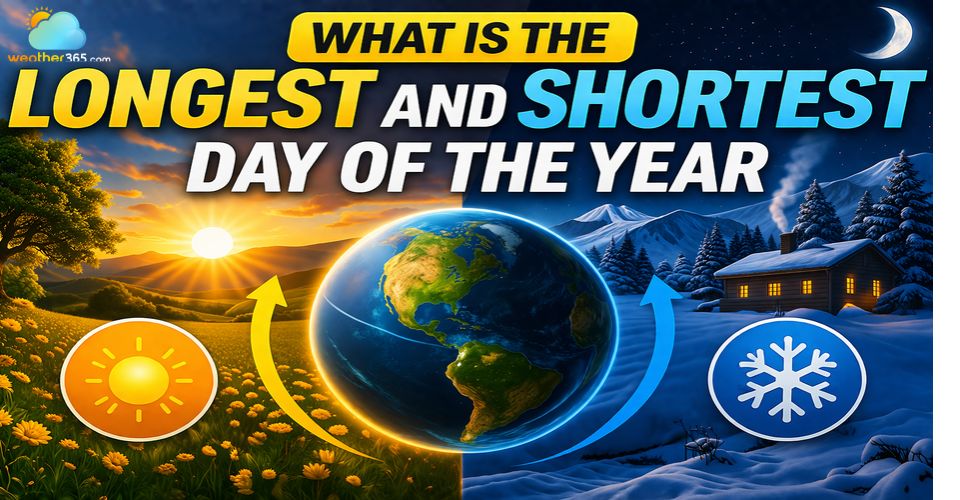
What are the longest and shortest day of the year?
What Is Solstice And Equinox?
An equinox is when day and night are nearly equal in length.
A solstice marks the longest or shortest day of the year, when the Sun reaches its highest or lowest point in the sky.
The Solstice
A solstice happens when the Sun reaches its most extreme position in the sky relative to Earth’s equator.
In simple terms, this is when one hemisphere is tilted the most toward or away from the Sun.
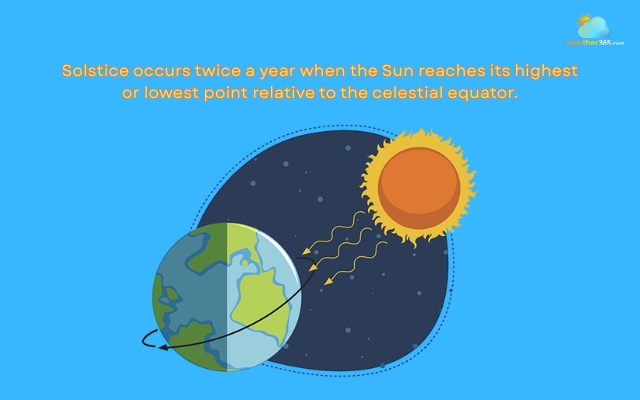
The solstice occurs twice a year
The word solstice comes from Latin, meaning “sun stands still.”
This refers to how the Sun’s apparent movement north or south seems to pause briefly before changing direction.
There are two solstices each year.
Around late June, the Northern Hemisphere experiences the summer solstice, when the Sun travels its longest path across the sky, creating the longest day of the year.
Around late December, the winter solstice occurs, when the Sun stays lower in the sky, and daylight is at its shortest.
What’s really driving this isn’t distance from the Sun, but Earth’s 23.5-degree tilt.
As Earth orbits the Sun, this tilt changes how directly sunlight hits different parts of the planet, which is why daylight hours stretch or shrink over time.
The Equinox
An equinox is the moment when day and night are almost equal in length across the entire world.
The name comes from Latin words meaning “equal night,” which gives you a good hint of what’s happening.
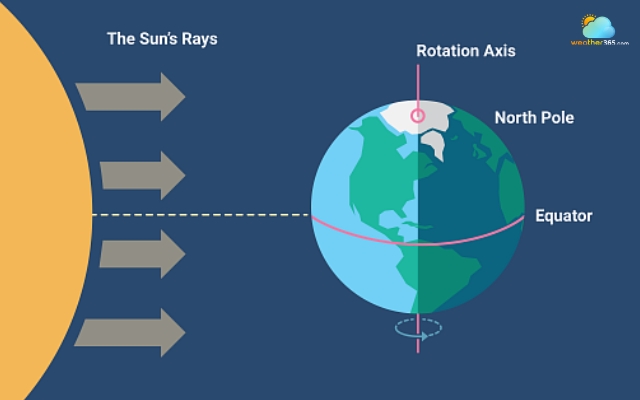
Equinox is when day and night are almost equal in length
During an equinox, the Sun sits directly above the equator, so both hemispheres receive nearly the same amount of sunlight.
This balance happens twice a year, around March and September.
The March equinox usually marks the beginning of spring in the Northern Hemisphere, while the September equinox signals the start of autumn.
Unlike solstices, which bring extremes, equinoxes feel more like a transition point between seasons.
Why do the dates of the equinoxes and solstices vary?
If you check a calendar, you’ll notice these events don’t fall on the exact same date every year, and there’s a good reason for that.
First, a full orbit of Earth around the Sun takes about 365.24 days, not a clean 365.
That extra fraction of a day might seem small, but it adds up over time. Leap years help correct this, but slight shifts still happen.
Second, Earth’s orbit isn’t a perfect circle, and its rotation has small variations. These tiny differences affect the precise timing of when the Sun reaches those key positions in the sky.
As a result, solstices and equinoxes usually move within a small range of dates, typically between the 20th and 23rd of their respective months.
It’s a subtle reminder that while our calendars are neat and structured, the universe doesn’t run on perfectly fixed dates.
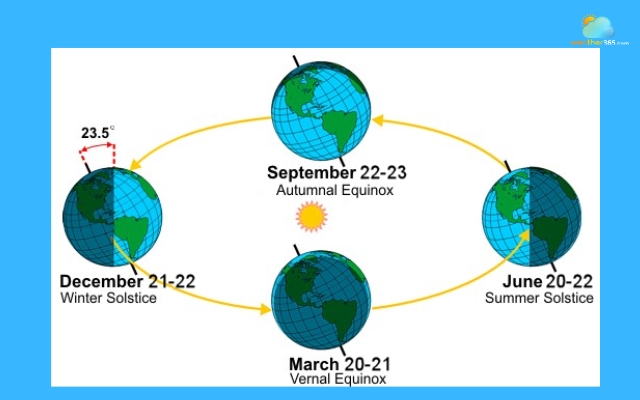
The dates of the solstice and equinox do not totally fix
You may also like this:
What Are Longest And Shortest Day Of The Year?
Now that you understand how solstices work, it’s easier to see what creates the longest and shortest day of the year.
These moments happen when Earth’s tilt causes one hemisphere to receive the most or least sunlight during its orbit.
In the Northern Hemisphere, this shift is especially noticeable, with clear differences in daylight between summer and winter.
But depending on where you are on the planet, the effect can feel either dramatic or barely noticeable.
Longest day in the North
The longest day of the year in the Northern Hemisphere usually falls between June 20 and June 22, during the summer solstice.
Because daylight hours vary drastically based on latitude, the exact moment the sun crosses the horizon depends entirely on where you live.
You can easily figure out your local daylight duration by learning how to calculate sunrise and sunset times for your specific location.
On this day, the North Pole is tilted most directly toward the Sun, allowing sunlight to travel a longer path across the sky.
What does that mean in everyday life? The Sun rises earlier, sets later, and stays visible for more hours than on any other day of the year.
The higher the Sun climbs in the sky, the longer it takes to dip below the horizon, which stretches daylight.
In places closer to the Arctic Circle, this effect becomes extreme. Some regions experience the Midnight Sun, where the Sun doesn’t set at all for a period of time.
On the other hand, areas near the equator don’t feel much difference; the length of day and night stays fairly consistent year-round.
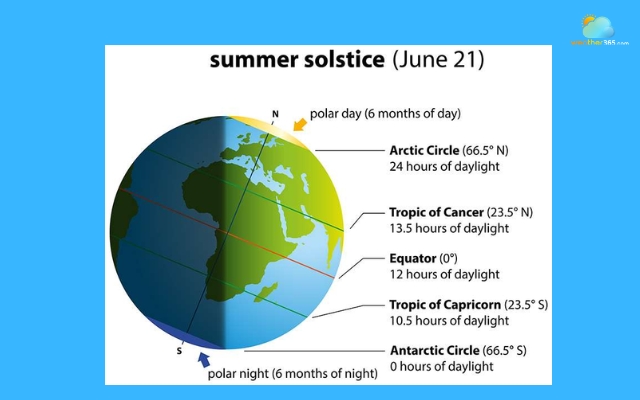
The longest day of the year usually falls between June 20 and June 22
To make this more concrete, let’s look at a few examples across the United States.
In New York, the longest day brings about 15 hours of daylight, with sunrise before 5:30 AM and sunset after 8:30 PM.
Move further north to Minnesota, and daylight extends to roughly 15.5-16 hours.
In Anchorage, Alaska, the effect becomes dramatic, with nearly 19 hours of daylight.
Solstice day lengths vary drastically in high-latitude regions featured on Alaska daylight weather conditions.
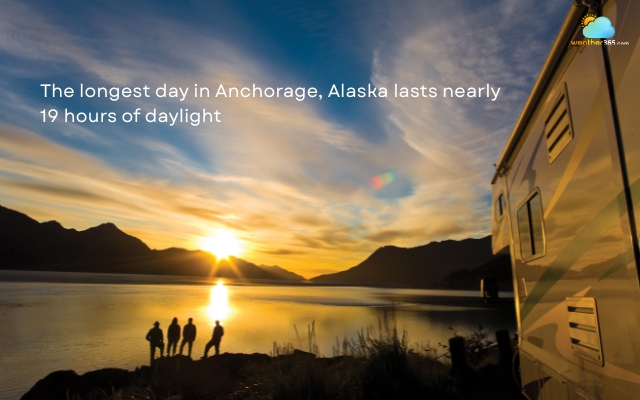
The longest day in Anchorage (Alaska) lasts nearly 19 hours of daylight
In some parts of Alaska, the Sun doesn’t set at all for a period of time - this is known as the Midnight Sun.
Closer to the equator, the difference is much smaller.
For example, in Florida, the longest day still feels long but only reaches around 13.5-14 hours of daylight, which is far less extreme compared to northern states.
Shortest day in the South
The shortest day of the year in the Northern Hemisphere occurs between December 20 and December 23, during the winter solstice.
At this point, the Northern Hemisphere is tilted away from the Sun, so sunlight arrives at a lower angle and for a shorter period of time.
As a result, days feel noticeably shorter. The Sun rises later, sets earlier, and never climbs very high in the sky.
This is why winter days can feel dim and brief, even when the weather isn’t particularly harsh.
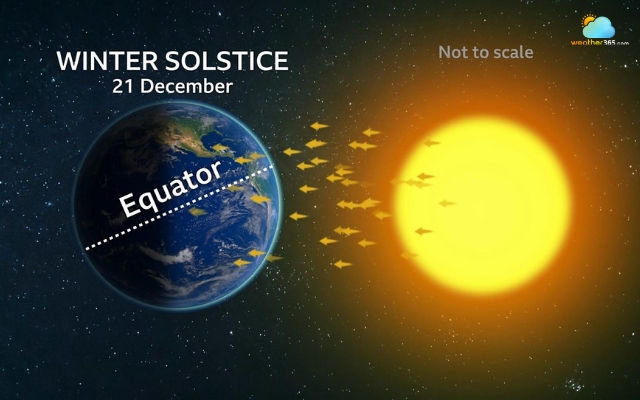
The shortest day of the year occurs between December 20 and December 23
In regions near the Arctic, the effect can be extreme in the opposite direction. Some places experience polar night, where the Sun doesn’t rise at all for days or even weeks.
Meanwhile, near the equator, this change is much less dramatic, with only small differences in daylight throughout the year.
Interestingly, while we often talk about the “shortest day” in one hemisphere, the opposite is happening at the same time in the other.
When the Northern Hemisphere has its shortest day, the Southern Hemisphere is actually experiencing its longest, another reminder of how Earth’s tilt balances sunlight across the globe.
Looking at real examples across the United States makes this easier to picture.
In New York, the shortest day brings only about 9 hours of daylight, with sunrise around 7:15 AM and sunset before 4:30 PM.
In Minnesota, daylight drops even further to roughly 8.5-9 hours.
Head up to Anchorage, Alaska, and the effect becomes extreme - there are only about 5.5 hours of daylight, and the Sun barely rises above the horizon.
In some parts of northern Alaska, the Sun doesn’t rise at all for a period of time, creating what’s known as polar night.
On the other hand, southern states like Florida experience a milder version, with around 10-10.5 hours of daylight, so the change feels less dramatic.
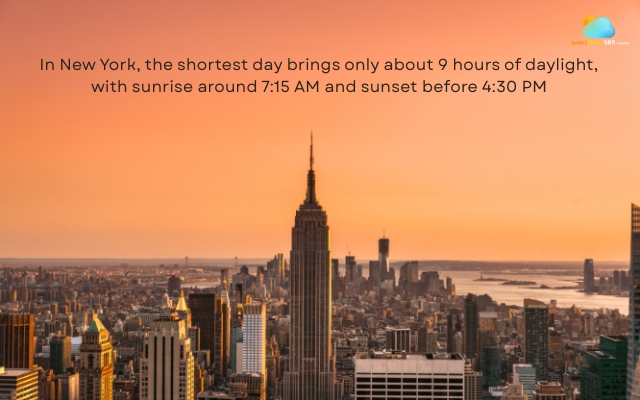
New York experiences the shortest day with only 9 hours of daylight
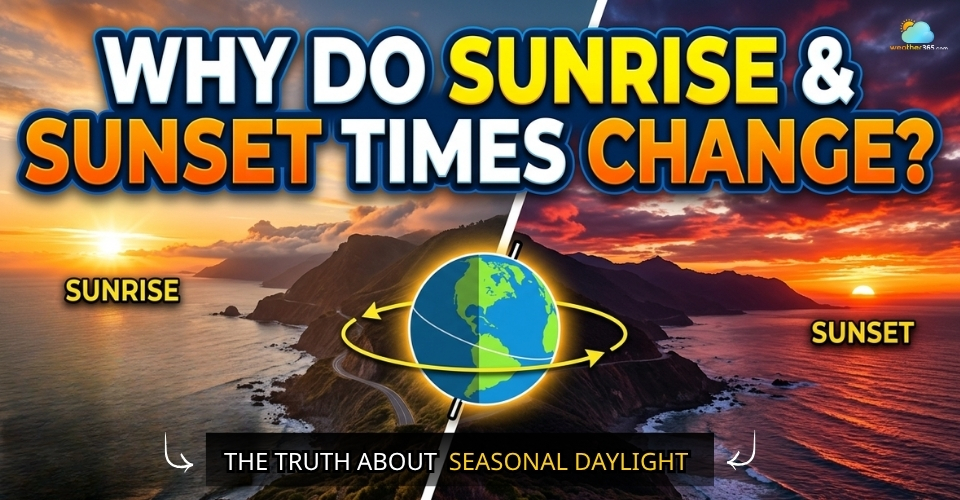
If you want to dive deeper into how Earth's orbit causes these daily schedule shifts, check out our guide on why sunrise and sunset times change throughout the year.
Relationship between the length of the day and temperature
The length of the day affects how much solar energy a place receives.
During longer days, sunlight lasts for more hours, giving the ground, oceans, and air more time to absorb heat.
That’s why temperatures generally rise as we move from spring into summer. On the flip side, shorter days in winter mean less incoming sunlight, so the Earth gradually loses heat and temperatures drop.
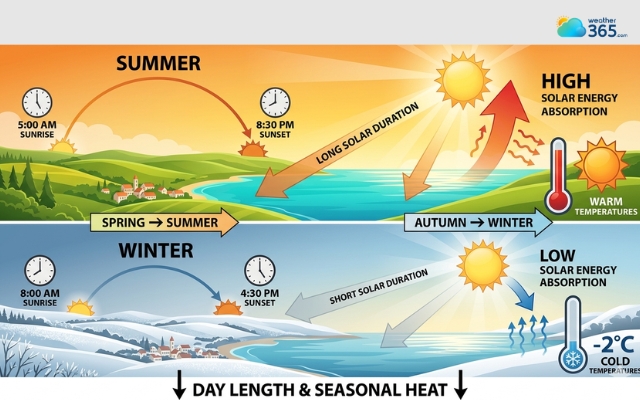
Longer days mean more time to absorb heat
But here’s the part that often confuses people: the hottest and coldest days don’t line up exactly with the solstices.
Even though the summer solstice brings the most daylight, temperatures usually peak weeks later, often in July or August in the Northern Hemisphere. This delay is known as seasonal lag.
The reason is simple: land and water don’t heat up instantly.
They absorb and store energy over time, so the warming effect continues even after daylight starts decreasing.
The same thing happens in winter. The shortest day occurs in late December, but the coldest days often come later, in January or February.
By that point, the Earth has been losing more heat than it gains for weeks, allowing temperatures to reach their lowest levels.
Location also plays a big role in how strongly day length affects temperature.
Coastal areas tend to have milder changes because oceans absorb and release heat slowly, while inland regions heat up and cool down more quickly.
Near the equator, where day length barely changes, temperature differences across seasons are also much smaller.
So while the length of daylight sets the stage for seasonal temperature changes, it doesn’t act alone.
It works together with heat storage, geography, and atmospheric conditions to create the weather patterns we experience every year.
A report on seasonal patterns in Albuquerque shows that even after the longest day in late June, temperatures continue to rise and typically peak in July.
This reinforces the idea that daylight and temperature don’t increase at the same pace, as the Earth needs time to absorb and release heat.
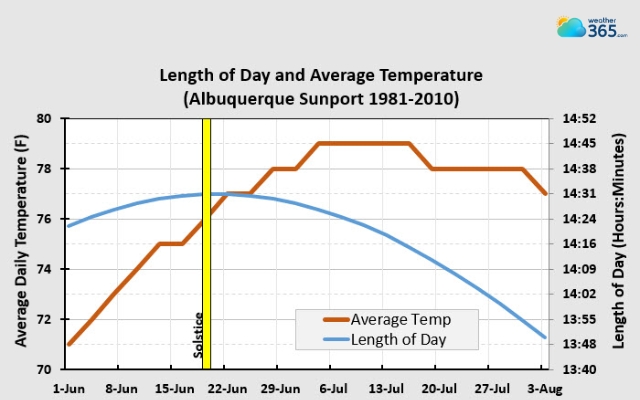
Length of day and average temperature in Albuquerque
Wrap up
The longest and shortest day of the year are a direct result of Earth’s tilt and orbit around the Sun. Solstices mark the extremes of daylight, while equinoxes bring balance. Once you understand these patterns, it becomes much easier to see how our seasons, and even our daily lives are shaped by the movement of the Earth in space.
Frequently Asked Questions (FAQs)
Related post
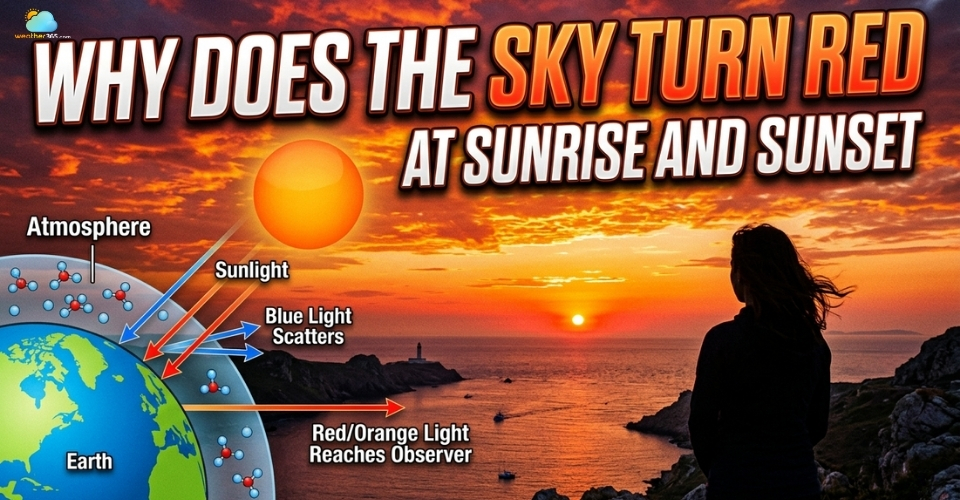
Why Does The Sky Turn Red At Sunrise And Sunset? Simple Science Explained
 722
722
 8
8
 4.9
4.9
 18/08/2026
Why Do Sunrise And Sunset Times Change? Unveiling The Science Behind
449
8
5.0
18/08/2026

7 Comment
Marcus Smith
There’s something oddly satisfying about knowing that the amount of daylight is constantly changing by tiny amounts, even when we barely notice it day to day.
Harrison Webster
Why are the seasonal differences in daylight much smaller near the equator?
weather365
Because of Earth’s geometry, locations near the equator receive relatively consistent amounts of daylight throughout the year compared with higher latitudes.
Erik Green
Does the longest day have the same amount of daylight everywhere on Earth?
weather365
No. The length of daylight at a solstice depends strongly on latitude, with much larger seasonal differences farther from the equator.
Jack Mills
Why doesn’t the latest sunset occur on the longest day of the year?
weather365
The timing of solar noon shifts throughout the year because of Earth’s orbit and axial tilt, so sunrise and sunset don’t move symmetrically around the solstice.
Leave a comment
Your email address will not be published. Required fields are marked *