




Why Do Sunrise And Sunset Times Change? Unveiling The Science Behind


What exactly explains why do sunrise and sunset times change throughout the year? You’ve probably noticed longer summer days and shorter winter ones, but the reason goes deeper than it seems. Let’s uncover the science in a simple way, so you can truly understand it!
Why do sunrise and sunset times change?
Why Do Sunrise And Sunset Times Change?
Sunrise and sunset times change because of Earth's 23.5-degree axial tilt and its oval orbit around the Sun.
Tilted Axis and Orbit
The most important reason behind changing sunrise and sunset times is Earth’s axial tilt.
Our planet is tilted about 23.5 degrees relative to its orbit around the Sun.
As Earth travels around the Sun during the year, this tilt causes different parts of the planet to receive different amounts of sunlight.
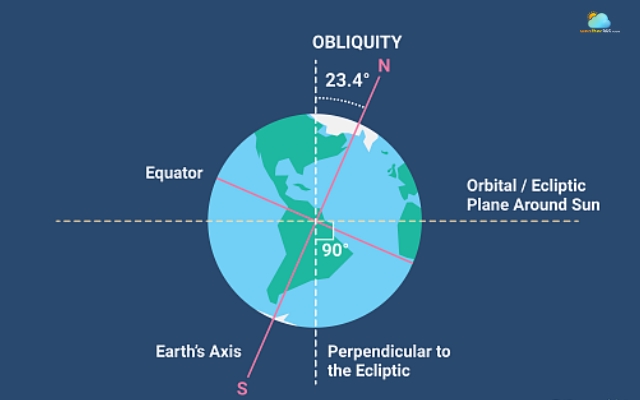
A tilted axis causes different amounts of sunlight in different places
When your hemisphere tilts toward the Sun, daylight lasts longer, so the sun rises earlier and sets later.
When it tilts away, daylight shortens, leading to later sunrises and earlier sunsets.
This is also why the change doesn’t happen suddenly but gradually.
Each day, the angle between your location and the Sun shifts slightly, creating the steady progression of earlier or later sunrise and sunset times.
Seasonal Lag
Even though the tilt explains most of the pattern, it doesn’t tell the whole story. There’s also a subtle effect called seasonal lag.
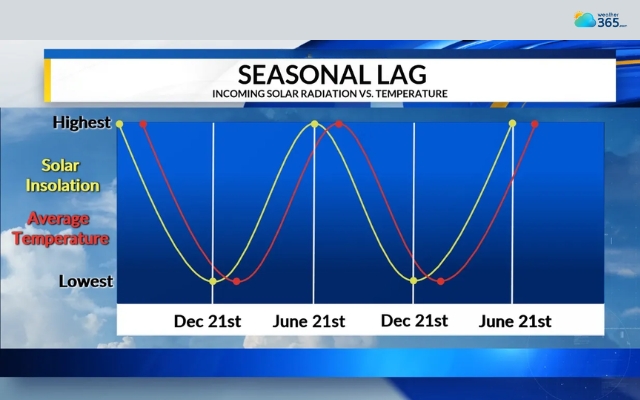
Seasonal lag describes the delay in peak temperatures
You might expect the earliest sunrise and latest sunset to happen exactly on the longest day of the year (the summer solstice), but they usually don’t.
That’s because Earth, especially its oceans, absorbs and releases heat slowly.
This delay affects how energy is distributed in the atmosphere, slightly shifting the timing of sunrise and sunset changes.
As a result, the longest day doesn’t perfectly match the earliest sunrise or latest sunset, adding another layer to the pattern we observe.
Latitude Location
Your location on Earth plays a huge role in how noticeable these changes are.
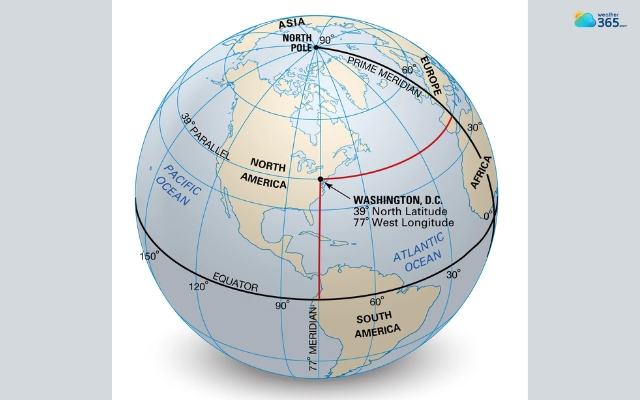
Days are longer in places closer to the poles
Near the equator, sunrise and sunset times remain fairly stable throughout the year. Day and night are almost equal, with only small variations.
But as you move toward higher latitudes, the differences become much more dramatic.
In places closer to the poles, summer brings very long days with early sunrises and late sunsets, while winter brings the opposite.
For instance, Earth's axial tilt alters twilight times continuously across New York daylight time weather schedules.
This happens because the angle at which sunlight reaches Earth changes more drastically at higher latitudes, amplifying the effect of Earth’s tilt.
Daylight Saving Time
Not all changes in sunrise and sunset times come from nature. Some are the result of human decisions, specifically, Daylight Saving Time (DST).
In many countries, clocks are set forward by one hour in spring and back again in autumn.
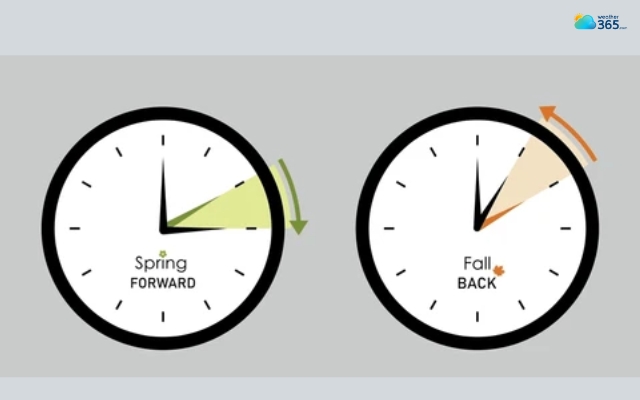
Clocks are set forward by one hour in spring and back again in autumn
This shift makes it seem like the sun suddenly rises later or sets later, even though its actual position in the sky hasn’t changed.
DST is designed to make better use of daylight during the evening, but it can temporarily disrupt how we perceive sunrise and sunset patterns.
Related articles
Why Do Sunrise and Sunset Times Vary Across Different Locations?
Sunrise and sunset times vary across different locations due to the angle of the Sun’s path, Earth’s tilt, and your position on the planet.
At the most basic level, sunrise and sunset are not just single moments; they are processes where the Sun gradually crosses the horizon.
The speed of this process depends on the angle at which the Sun moves relative to that horizon.
Near the equator, the Sun rises and sets almost vertically. This steep angle means it crosses the horizon quickly, so sunrise and sunset are relatively short.
But as you move toward higher latitudes, the Sun’s path becomes more slanted.
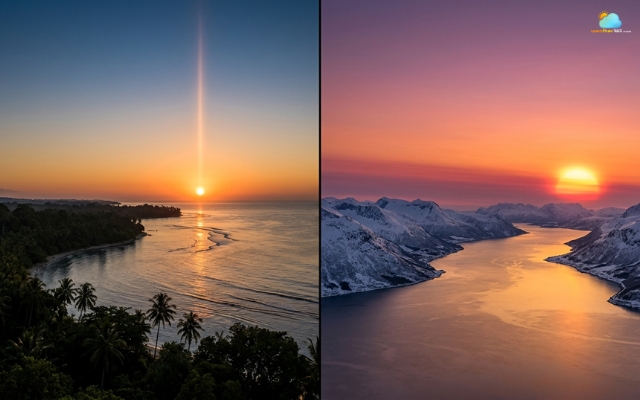
The Sun rises and sets vertically near the equator
Instead of moving straight up or down, it travels diagonally, which stretches out the time it takes to fully rise or set.
This is why twilight can feel much longer in places far from the equator.
Another important factor is Earth’s axial tilt, which creates opposite seasons in the Northern and Southern Hemispheres.
Because of this tilt, the distribution of sunlight changes throughout the year, affecting not only when the Sun rises and sets, but also how long those transitions last.
Summer Solstice
Around the summer solstice, your hemisphere is tilted most directly toward the Sun. During this time, the Sun takes a higher and longer path across the sky.
At higher latitudes, this causes the Sun to move very slowly near the horizon during sunrise and sunset.
As a result, these transitions can last much longer than usual, sometimes creating extended periods of soft light.
This is also when days are at their longest, and in extreme cases near the poles, the Sun may barely dip below the horizon at all.
Still confused about the summer solstice? Discover here!
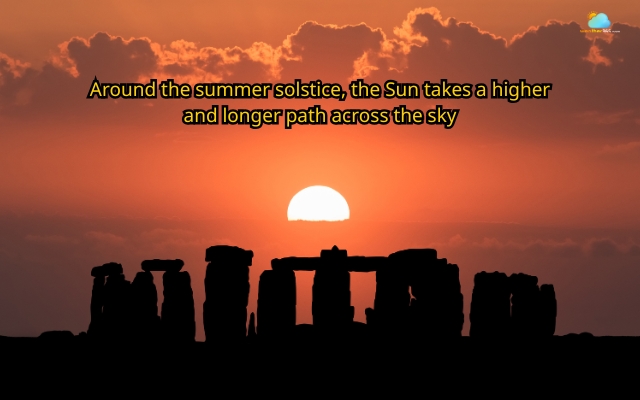
“Sun time” changes during the summer solstice
Winter Solstice
The opposite happens during the winter solstice. Your hemisphere is tilted away from the Sun, and the Sun follows a much lower path across the sky.
In many locations, especially closer to the poles, the Sun rises and sets at a very shallow angle.
While daylight is shorter overall, the low angle can still stretch sunrise and sunset slightly, but the limited sunlight makes the transition feel dimmer and more compressed.
In extreme polar regions, the Sun may not rise at all for a period of time, eliminating sunrise entirely.
Learn details about the Winter solstice here!
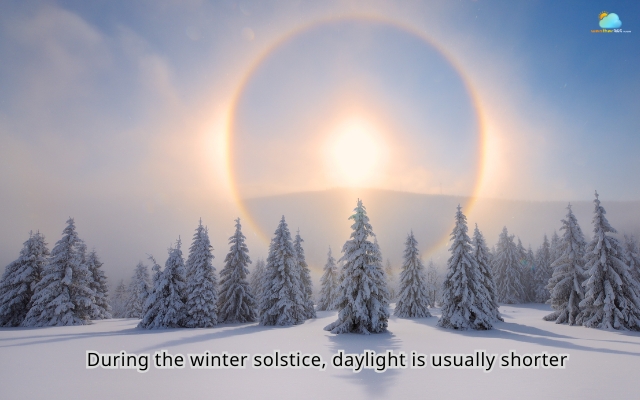
Daylight is shorter during the winter solstice
Why Do Some Places Never See Sunsets?
Some places never see sunsets because the 23.5-degree tilt of Earth's axis causes the Sun to remain visible for 24 hours straight.
It might sound unbelievable, but there are places on Earth where the Sun does not set for days, or even months.
This phenomenon is real, and it happens in regions close to the North and South Poles.
To understand this, we need to go back to the same key idea behind changing sunrise and sunset times: Earth’s axial tilt.
Our planet is tilted by about 23.5 degrees, and as it orbits the Sun, this tilt causes different parts of Earth to receive sunlight in very uneven ways.
In regions within the Arctic Circle and Antarctic Circle, this tilt creates something called the Midnight Sun.
During summer in one hemisphere, that part of Earth is tilted continuously toward the Sun.
As a result, even though Earth is still rotating, the Sun never dips below the horizon; it just circles across the sky.
In extreme cases, like at the North Pole or South Pole, this effect becomes even more dramatic.
The Sun can remain visible for about six months straight before finally setting.
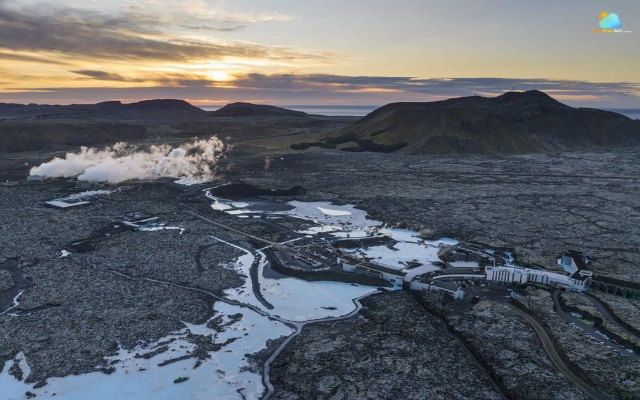
The sky in Blue Lagoon (Iceland) never turns dark during summer
What’s interesting is that this doesn’t mean the Sun stays fixed in one spot. Instead, it appears to move in a circular path, staying above the horizon the entire time.
This creates long, continuous daylight - very different from the regular cycle of sunrise and sunset most of us experience.
Of course, the opposite also happens.
When that same region tilts away from the Sun, it enters a period called polar night, when the Sun doesn’t rise at all for an extended time.
Wrapping up
So, why do sunrise and sunset times change? Long story short, it is due to Earth’s tilt, orbit, and your location on the planet. While it may seem like a small daily detail, it’s actually a reflection of how our planet moves through space.
Frequently Asked Questions (FAQs)
Related post

Best Places To Watch Sunset In The World: Top 18 Stunning Spots You Should Not Miss
 999
999
 8
8
 4.8
4.8
 18/08/2026
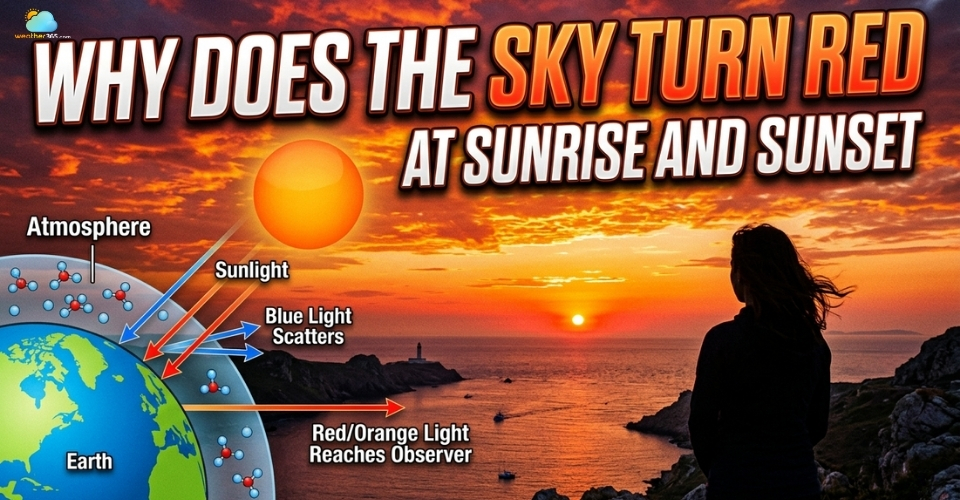
Why Does The Sky Turn Red At Sunrise And Sunset? Simple Science Explained
685
8
4.9
18/08/2026


8 Comment
Collins Young
I always notice the later sunsets first, but I rarely think about why the timing changes differently throughout the year. Pretty interesting read.
Aaron King
I never realized how much the timing of daylight is constantly shifting. Nature really doesn’t run on a perfectly fixed schedule.
Charlie Thomas
Why does the earliest sunset not always happen on the shortest day of the year?
weather365
Because the timing of solar noon changes throughout the year, the earliest sunset and latest sunrise can occur on different dates from the winter solstice.
Erick Hoffman
Why can two places at the same latitude have slightly different sunrise or sunset times?
weather365
Longitude, local geography, and the exact position of each location within its time zone can all affect the clock time of sunrise and sunset.
Carter Taylor
Why don’t sunrise and sunset times shift by exactly the same amount each day?
weather365
Earth’s axial tilt and its orbit around the Sun affect the length of daylight and the timing of solar noon, so the changes are not perfectly uniform.
Leave a comment
Your email address will not be published. Required fields are marked *