




How To Calculate Sunrise And Sunset Times: Science-Based Guide To Accurate Calculation


Struggling to calculate sunrise and sunset times accurately for your plans or content? It can feel confusing with all the variables involved. Don’t panic, we’ll break it down into simple, clear steps so you can understand and predict daylight with confidence. Diving in!
How to calculate sunrise and sunset times?
How To Calculate Sunrise And Sunset Times?
Sunrise and sunset times are calculated based on Earth’s rotation, tilt, and your exact position on the planet.
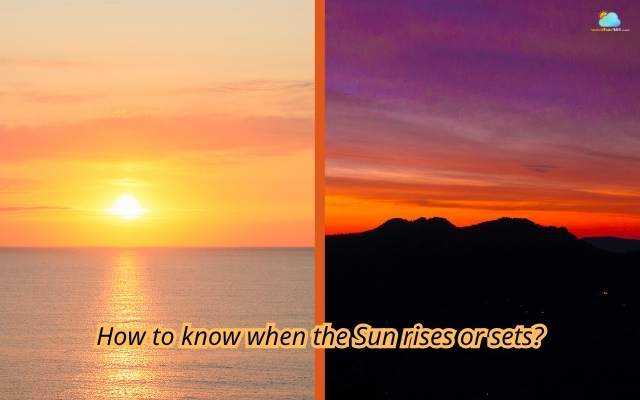
When does the Sun rise and set?
Sunrise and sunset happen when the Sun crosses the horizon. Scientists calculate sunrise and sunset times based on Earth’s rotation, tilt, and your exact position on the planet.
Key data required:
Latitude (φ): Your position north or south of the equator
Longitude (λ): Your position east or west on Earth
Date: Specifically, the day of the year (for example, January 1 = 1, February 1 ≈ 32)
Time zone: Your local offset from UTC
Step 1: Calculate the Day of the Year
First, convert your date into a number representing its position in the year.
For example:
January 1 → n = 1
March 1 → n ≈ 60
This value is important because the Sun’s position changes slightly every day due to Earth’s orbit.
Step 2: Calculate the Solar Declination Angle (δ)
Next, you determine the Sun’s position relative to the equator. This is called the solar declination angle, and it shifts throughout the year.
δ = 23.45∘ x sin (360365 x (n-81) |
Step 3: Calculate the Hour Angle (ω₀)
Now comes the key step: finding the hour angle, which tells you how far the Earth must rotate before sunrise or sunset occurs.
cos(ω0) = sin(-0.83∘) - sin(ϕ) x sin(δ)cos(ϕ) x cos(δ) |
Note: -0.83∘ accounts for standard atmospheric refraction and sun diameter.
Step 4: Convert the Result into Local Time
Once you have the hour angle, you can convert it into actual clock time:
Convert degrees into hours (15° = 1 hour)
Apply longitude correction
Adjust for your time zone
From there:
Sunrise = 12h − ω₀ (converted to time)
Sunset = 12h + ω₀ (converted to time)
While the method above is scientifically accurate, it’s not always practical for everyday use.
If you just want quick and reliable results, you can skip the calculations and use a tool like Weather365.
With Weather365, you can not only check the sunrise/sunset times, but also the weather forecast up to 30 days, including humidity, visibility, UV index, and even wind speed!
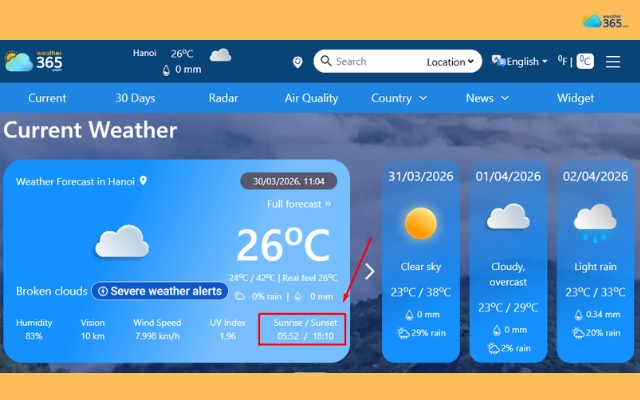
Check sunrise/sunset times with Weather365
Factors Affect Sunrise And Sunset
Why do sunrise and sunset times change so much from place to place, and even day to day?
The answer lies in a combination of astronomical and environmental factors. Each one plays a role in shaping when the Sun appears and disappears on your horizon.
If you’re curious about this, you can explore details in our guide on why do sunrise and sunset times change!
Earth’s tilt
The biggest reason sunrise and sunset times change throughout the year is Earth’s tilt.
Our planet is tilted at about 23.5°, which means different parts of Earth receive different amounts of sunlight as it orbits the Sun. This is what creates the seasons.
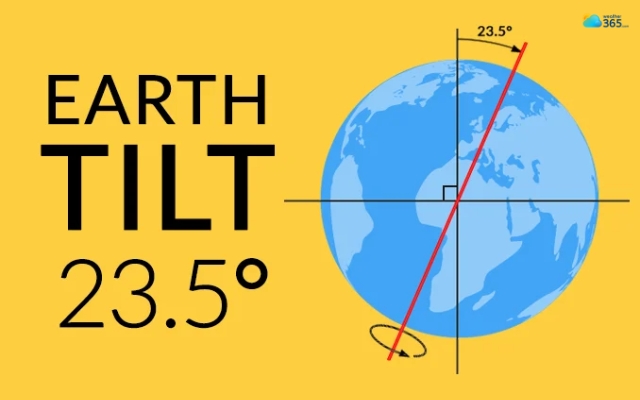
Earth’s tilt is approximately 23.5 degrees
During summer in your hemisphere, your region is tilted toward the Sun. The Sun rises earlier, sets later, and stays higher in the sky, giving you longer days.
In winter, the opposite happens. The Sun takes a shorter path across the sky, leading to later sunrises and earlier sunsets.
Without this tilt, day and night would be almost equal all year round.
Due to the Earth’s tilt, we have the longest and shortest day of the year, where daylight duration reaches its maximum and minimum!
Latitude
While Earth’s tilt explains seasonal changes, latitude explains why those changes feel so different depending on where you are.
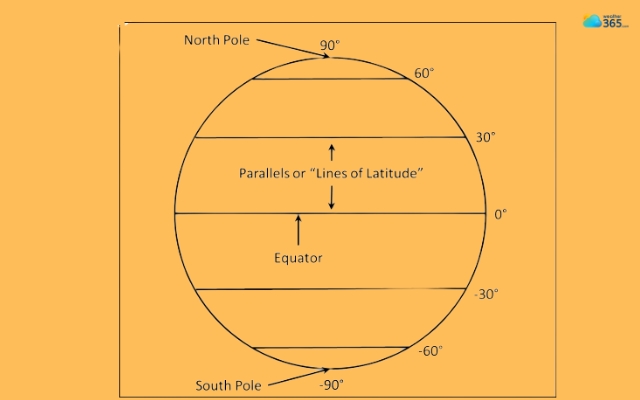
Latitude can affect the sunrise and sunset times
Near the equator, sunrise and sunset times stay relatively stable throughout the year. Day and night are nearly equal, with only small variations.
For instance, calculating solar hours depends on latitude and seasonal tilt as seen on Florida daylight hours weather.
But as you move toward the poles, the difference becomes dramatic. In high-latitude regions:
Summer days can stretch close to 24 hours
Winter days can shrink to just a few hours, or disappear entirely
This is why some places experience phenomena like the “midnight sun” or polar night.
So, the further you are from the equator, the more extreme your sunrise and sunset variations will be.
Atmospheric refraction
This is a factor many people don’t think about, but it has a real impact.
Atmospheric refraction bends light as it passes through Earth’s atmosphere.
Because of this bending, you can actually see the Sun before it has physically risen above the horizon, and still see it after it has technically set.
That’s why scientists don’t define sunrise at exactly 0° altitude. Instead, they use about -0.83° to account for this effect.
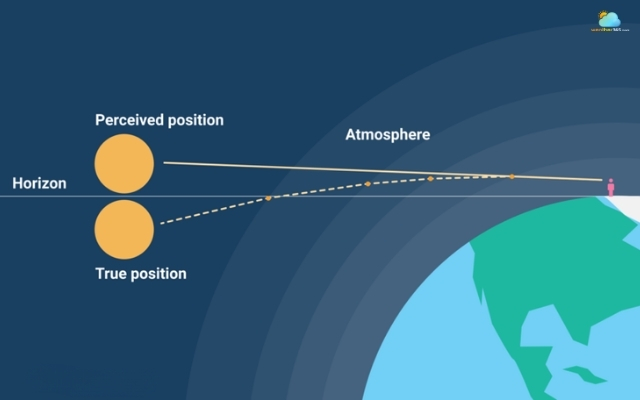
You can actually see the Sun before it has risen above the horizon
Altitude
Your elevation above sea level also changes how you experience sunrise and sunset.
If you’re standing on a mountain or in a high-rise building, your horizon is lower compared to someone at sea level.
This allows you to see the Sun earlier at sunrise and later at sunset.
The difference might only be a few minutes, but it becomes noticeable at higher elevations.
Altitude also slightly affects air density, which can enhance or reduce atmospheric refraction, adding another small variation.

You can see the sunrise earlier from a higher place
Longitude
Finally, longitude determines the exact timing of sunrise and sunset within your time zone.
Earth rotates from west to east, so locations further east will experience sunrise earlier than those to the west, even if they share the same latitude.
This is why two cities in the same country can have noticeably different sunrise times.
Time zones help standardize this difference, but they don’t eliminate it completely.
The farther you are from the center of your time zone, the more noticeable the shift becomes.
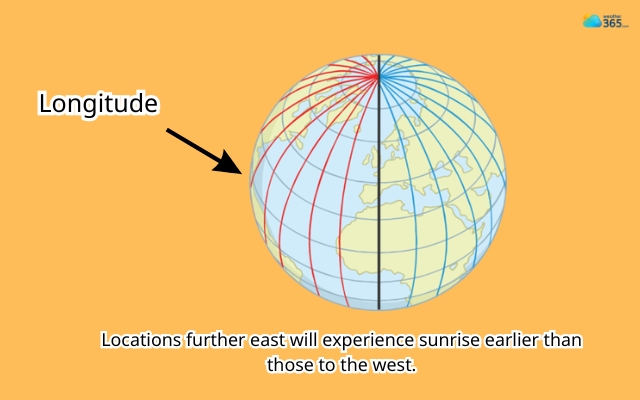
Longitude determines the timing of sunrise and sunset
How Sunrise And Sunset Impact Mental Health?
Sunrise and sunset help regulate our body’s natural sleep-wake cycle. Morning light boosts mood and alertness, while evening light helps the brain relax and prepare for sleep.
Body clock regulation
One of the biggest influences comes from your body’s internal clock, also known as the circadian rhythm. This system depends heavily on natural light.
When the sun rises, early morning light signals your brain to wake up, reduce sleep hormones, and increase alertness.
That’s why stepping outside in the morning can make you feel more refreshed, even without coffee.
As the sun sets, the fading light does the opposite. It tells your body it’s time to slow down, helping you transition into rest mode more naturally.

Sunlight resets your internal clock every day
Mood affect
Sunrise and sunset also affect your mood in subtle but powerful ways.
Morning sunlight is linked to higher serotonin levels, which play a key role in feeling positive and emotionally balanced.
This is one reason people who get regular natural light exposure often feel more stable and energized throughout the day.
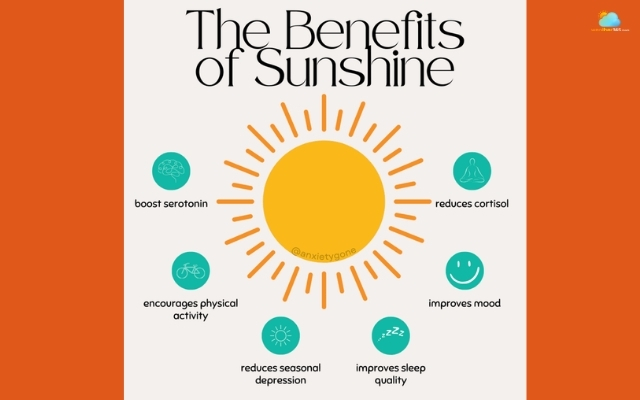
Sunshine has huge benefits for human life
In contrast, the softer light at sunset creates a calming effect, helping your mind unwind after hours of stimulation.
This is where the idea of “sunset therapy” comes in. It’s not a medical treatment, but more of a mindful habit.
Watching the sun go down encourages you to pause, slow your thoughts, and simply observe.
The gradual shift in colors and light creates a natural sense of closure, which can reduce stress and bring a feeling of calm.
In a busy routine, even a few quiet minutes like this can make a noticeable difference.
Light wavelengths
Another interesting factor is the change in light wavelengths.
Morning light tends to be cooler and more energizing, while sunset light shifts into warmer tones like orange and red.
These warmer wavelengths are easier on your eyes and signal relaxation, helping your body prepare for sleep without sudden changes.
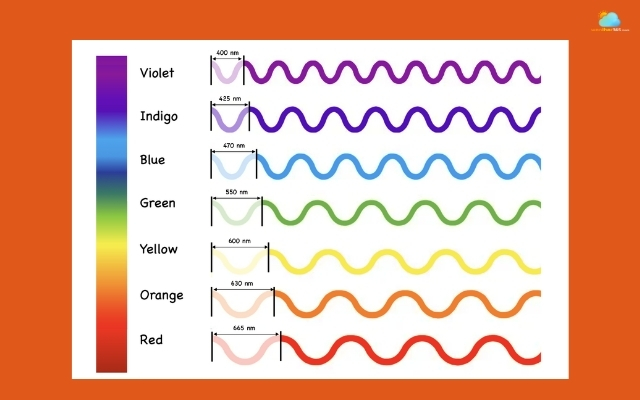
Sunset light is in warmer tones like orange and red
Final Word
Calculate sunrise and sunset times is not too complicated if you see how it all connects. With a bit of insight and the right tools, you can easily keep track of daylight changes, and maybe even start appreciating those quiet transitions a bit more each day.
Frequently Asked Questions (FAQs)
Related post

Best Places To Watch Sunset In US: Discover Top 15 Spots With The Best Views
 837
837
 8
8
 4.7
4.7
 18/08/2026
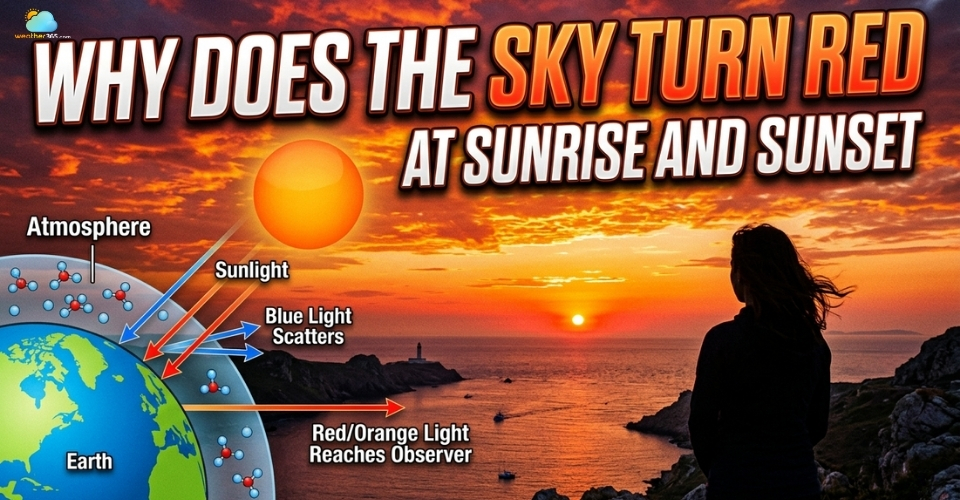
Why Does The Sky Turn Red At Sunrise And Sunset? Simple Science Explained
722
8
4.9
18/08/2026
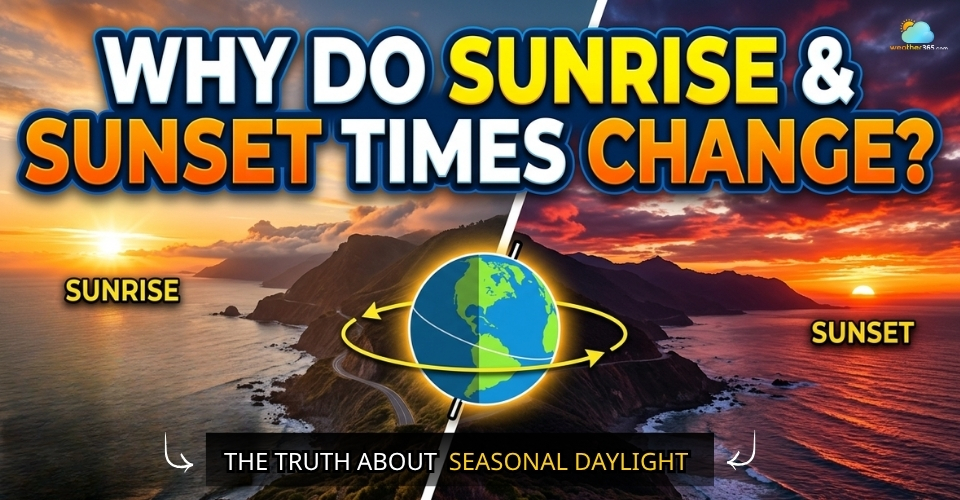
Why Do Sunrise And Sunset Times Change? Unveiling The Science Behind
449
8
5.0
18/08/2026

8 Comment
Gracie Anderson
The math behind something as ordinary as sunrise is way more interesting than I expected. Suddenly that little “sunrise” icon on my phone has a lot more meaning.
Kamila Larson
I like how this connects everyday planning with actual astronomy. It also explains why sunrise times can differ even between nearby places.
Remi Johnson
Why do sunrise and sunset calculations use the horizon as a reference?
weather365
The apparent crossing of the Sun’s position relative to the horizon provides a practical reference for defining sunrise and sunset.
Caroline Nelson
Does elevation make a difference when calculating sunrise or sunset?
weather365
Yes. A higher observer can see the Sun slightly earlier at sunrise and later at sunset because the horizon is farther away.
Delilah Gill
Why does your exact location matter when calculating sunrise and sunset?
weather365
Even small changes in latitude and longitude can affect the angle and timing at which the Sun appears above or below the horizon.
Leave a comment
Your email address will not be published. Required fields are marked *