




What Causes An Earthquake: Uncover the Science Behind Quakes


Earthquakes have frightened humans for centuries. As one of the most unpredictable phenomena in Severe Weather anomalies, understanding them is crucial. But what causes an earthquake? Is it the restless movement of tectonic plates, or can human activity play a role too? This article will dive deep into both natural and man-made causes, explain where earthquakes strike most often, and what you can do to stay safe. Let’s explore!
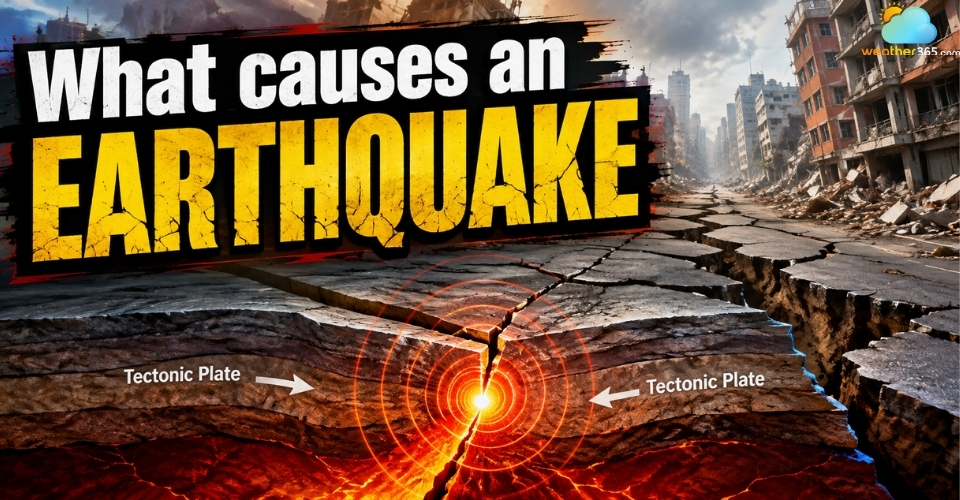
What Causes An Earthquake?
- What Causes An Earthquake
- Natural causes
- Human Causes
- Where do earthquakes happen?
- Ring of Fire
- Alpide earthquake belt
- The sub-merged mid-Atlantic Ridge
- How earthquakes are detected
- Seismometer
- Seismograph
- Earthquakes Impacts
- Physical impacts
- Secondary impacts
- Human and Economic Impacts
- Earthquakes’ safety tips
What Causes An Earthquake
Earthquakes are primarily caused by the sudden release of energy along volcanic faults or tectonic plate boundaries, although human activities can also induce them.
Scientists prove that the main cause of these shakings is due to the shifting of tectonic plates.
Besides, some human activities also contribute to this phenomenon.
Let’s break this down clearly!
Natural causes
Most earthquakes occur due to natural processes deep within the Earth.
They are mainly linked to the slow but powerful movement of tectonic plates and the stress that builds along faults.
When this stress is suddenly released, the ground shakes.
Below are the main natural factors that explain what causes an earthquake to happen.
Tectonic Plates Movement and Convection
The Earth’s crust is not a single solid shell. It is broken into giant slabs called tectonic plates, which float on the hot, slowly moving mantle beneath.
This mantle movement, called convection - pushes and drags the plates in different directions.
At plate boundaries, stress accumulates until the rocks break.
Depending on how plates interact, earthquakes vary in size and strength:
Convergent boundaries: Plates collide. One plate may sink under another, building extreme pressure that can unleash powerful quakes.
Divergent boundaries: Plates move apart. New crust forms, but the pulling motion creates smaller, frequent earthquakes.
Transform boundaries: Plates slide past each other. Stress builds up sideways until the rock slips suddenly.
These interactions result in various types of earthquake, each behaving differently based on geological fault structures.
This constant plate movement is the primary driver of earthquakes worldwide.
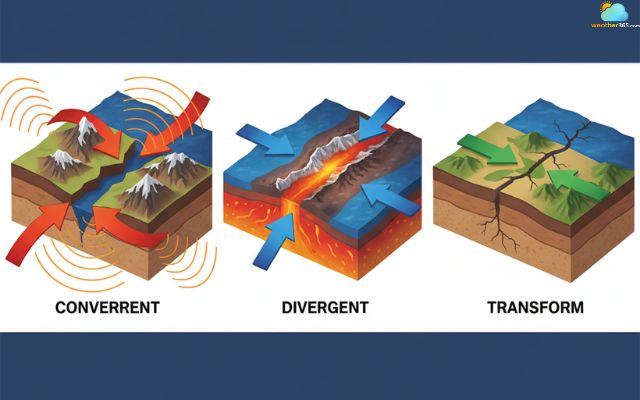
Three main types of tectonic plate boundaries
Faults
Faults are cracks forming in the crust where plates meet. These faults act like weak spots where stress is concentrated.
Depending on how rocks shift, faults are classified as:
Normal faults: Rocks drop down as the crust is stretched apart.
Reverse faults: Rocks are thrust upward as the crust is compressed.
Strike-slip faults: Rocks slide past each other horizontally.
Each fault type responds differently to stress, but all can generate earthquakes once the built-up energy overcomes resistance.
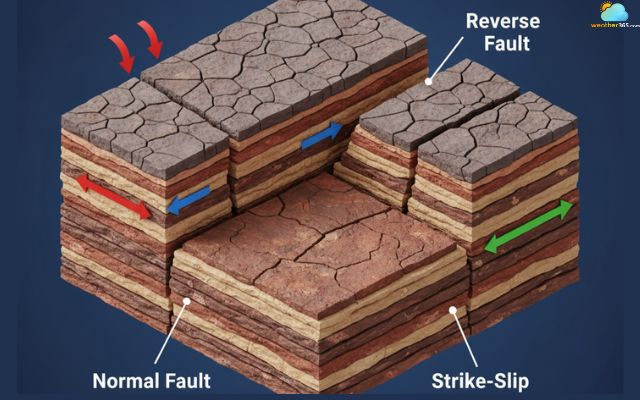
Three types of faults
Stress and Friction & Elastic Rebound Theory
As rocks press against each other along a fault, friction locks them in place. Stress builds quietly for decades or even centuries.
When the stress finally exceeds the friction, the rock suddenly snaps.
According to the elastic rebound theory, the rock “springs back” to a new position.
This sudden shift is what causes the violent shaking we feel on the surface.
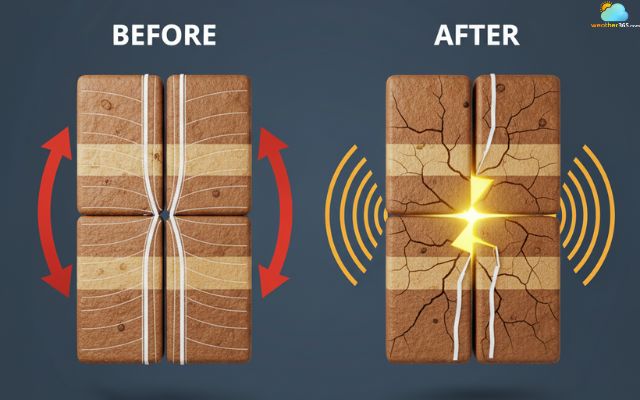
Why do we feel shaking on the surface during the earthquake?
Sudden flip & Energy Release
The breaking of rock is a sharp flip that releases stored energy.
Imagine bending a stick until it suddenly snaps.
In earthquakes, this energy radiates outward as seismic waves. The larger the stress that was stored, the stronger the quake.
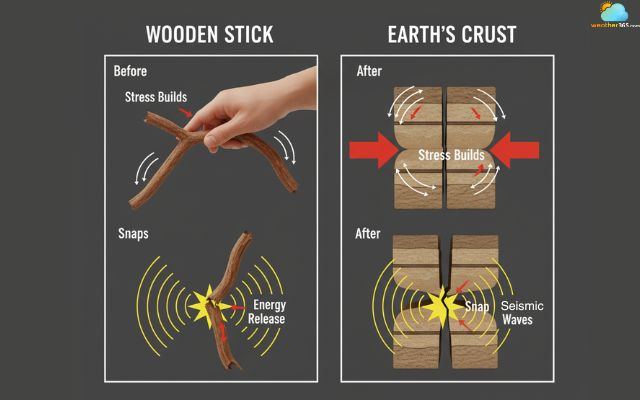
Stored energy is released after the rock breaks
Seismic Waves
Seismic waves are the carriers of stored energy. They travel outward from the earthquake’s focus in every direction.
There are two main types of seismic waves:
Body waves: Travel through the Earth’s interior, moving quickly but causing less surface damage.
Surface waves: Travel along the crust, rolling the ground violently. These waves are slower but are responsible for most destruction.
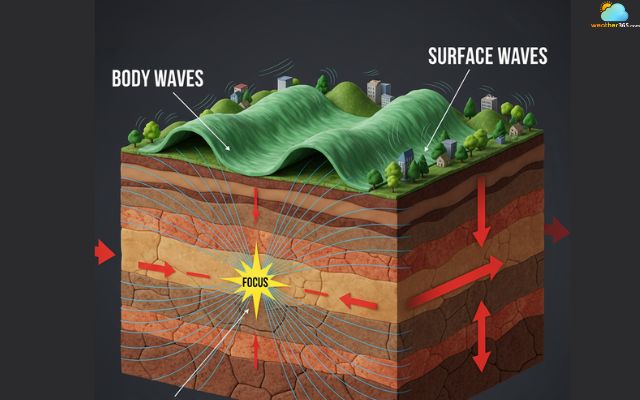
Two main types of seismic waves
In short, an earthquake is the result of a long process:
Plate movement builds stress → faults lock it in → rocks eventually snap → the stored energy is released as seismic waves.
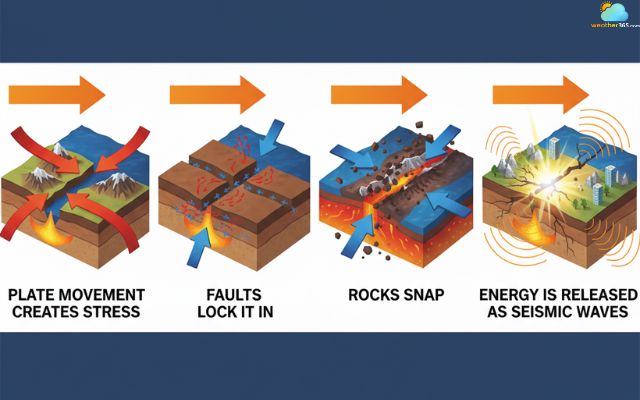
What causes an earthquake to happen?
Human Causes
While nature is the main driver, humans can also disturb the Earth’s balance.
These are often called induced earthquakes.
Mining and Resource Extraction
Deep mining removes massive amounts of rock. This creates empty spaces and redistributes stress underground.
In some mining regions, collapses and 5 magnitude or more quakes have been recorded.
Reservoir-Induced Seismicity
When a reservoir fills behind a dam, billions of tons of water press on the crust.
Water also seeps into cracks, reducing friction on faults. In some cases, this has triggered earthquakes close to populated areas.
Oil & Gas / Fracking
Extracting oil and gas alters underground pressure. Hydraulic fracturing (fracking) injects fluid deep into the crust, which can destabilize existing faults.
Regions of the United States and Canada have seen a sharp rise in small to medium earthquakes linked to this activity.
Nuclear Explosions
Underground nuclear tests release sudden bursts of energy.
Though less common today, these blasts have historically produced seismic shocks that mimic small natural earthquakes.
Although these human activities often cause minor shaking, understanding the exact difference between earthquake and tremor helps clarify when a minor vibration becomes a major threat.
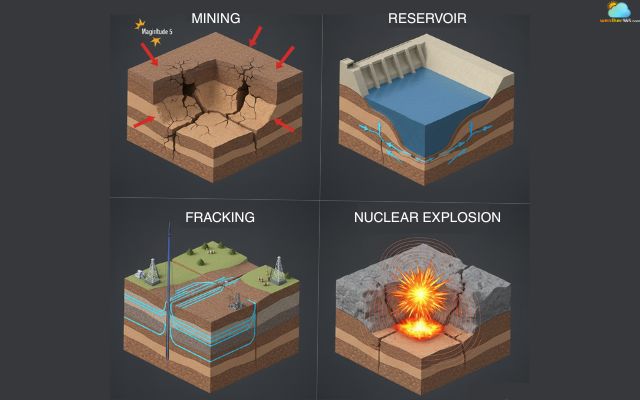
Human activities are also causes of earthquakes
Where do earthquakes happen?
Earthquakes tend to occur in certain zones on Earth where tectonic forces are intense.
Below are three major regions where seismic activity is most common:
Ring of Fire
The “Ring of Fire” is the world’s most active earthquake zone. It circles the Pacific Ocean, stretching from South America up to North America, across to Asia, and down to New Zealand.
About 90% of all earthquakes occur here. The reason is that the Ring of Fire sits on multiple tectonic plate boundaries.
These plates collide, slide past each other, or sink into the Earth’s mantle, creating intense seismic activity.
Countries like Japan, Indonesia, Chile, and the United States often experience powerful earthquakes because they are located within this belt.
Tectonic plate movements drive seismic shocks across northern regions, elevating the Alaska earthquake risk within this active zone.
In fact, some of the Biggest Earthquakes In US History have been triggered along this dangerous tectonic zone.
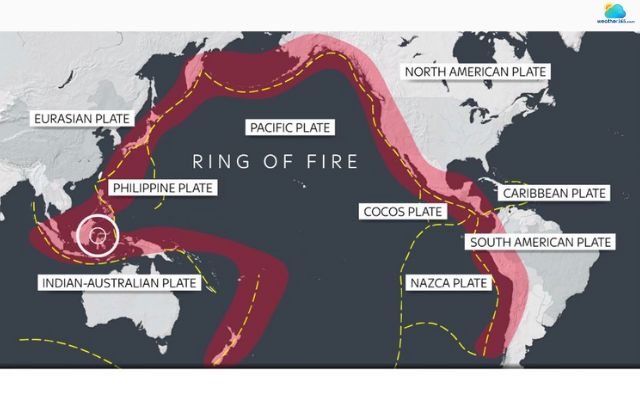
The “Ring of Fire” causes over 90% of the world's earthquakes
Alpide earthquake belt
The Alpide belt is the second most active earthquake region.
It runs across southern Europe into Asia, stretching from the Mediterranean, through Turkey, the Middle East, and into the Himalayas.
This zone exists because the African, Indian, and Eurasian plates are pushing against each other.
As a result, areas like Greece, Iran, and northern India often experience damaging earthquakes.
The Himalayas, still rising as India continues to press into Asia, are a clear example of how tectonic collisions create constant seismic stress.
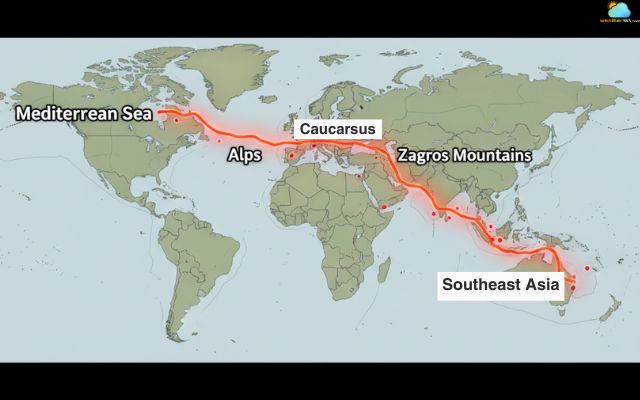
The Alpide belt is responsible for 17% of the world’s largest earthquakes
The sub-merged mid-Atlantic Ridge
The mid-Atlantic Ridge is very different from the Ring of Fire and the Alpide belt.
Instead of plates colliding, here they are moving apart.
This underwater mountain chain runs down the center of the Atlantic Ocean. As the plates pull away from each other, magma rises and forms new ocean floor.
The movement generates frequent but usually smaller earthquakes compared to other belts. While these quakes are less destructive, they show how even the middle of an ocean can be seismically active.
Iceland, which sits right on top of the Mid-Atlantic Ridge, is a rare place where these earthquakes are felt on land.
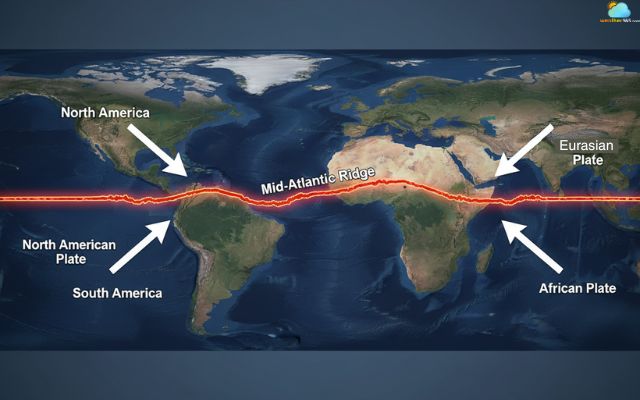
The Mid-Atlantic Ridge is home to small earthquakes
How earthquakes are detected
Detecting earthquakes relies on sensitive instruments that pick up ground motion and translate it into data we can analyze.
Below are the three key tools used in seismology: the seismometer and the seismograph.
Seismometer
A seismometer is the core sensor in earthquake detection. It measures ground motion.
Inside, a mass is suspended to resist movement (inertia) when the Earth shakes.
The mass stays almost fixed while the surrounding frame moves with the ground. The relative motion is detected and converted into electrical signals.
Modern seismometers often record motion in three directions (up/down, north/south, east/west) to capture the full shaking picture.
Modern devices filter, amplify, and log the signal to computers or servers for analysis.
Once these ground motions are logged, scientists apply the Earthquake Magnitude Scale to calculate the exact energy and strength of the quake.
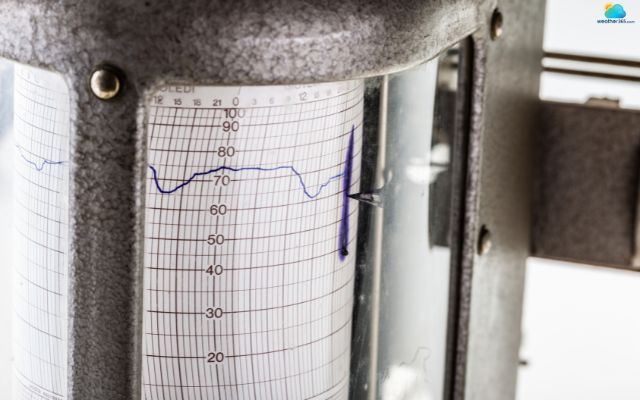
A seismometer is used to detect ground motion
Seismograph
The seismograph is the full instrument setup that uses a seismometer along with amplifiers, recording systems, and sometimes data transmission electronics.
While the seismometer senses ground movement, the seismograph records it, often digitally today.
Older seismographs used mechanical linkages and drum paper to trace ground motion. Modern devices filter, amplify, and log the signal to computers or servers for analysis.
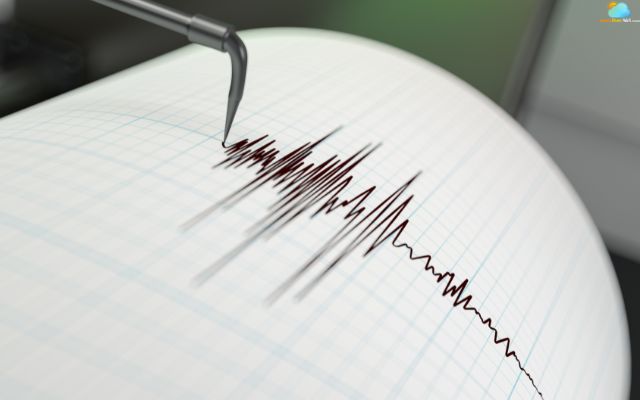
A seismograph is an instrument including the seismometer and the recording system
Earthquakes Impacts
Earthquakes are sudden and powerful, and their effects are often devastating and far-reaching.
Their impact reaches buildings, communities, and entire economies, leaving lasting consequences that can persist long after the shaking stops.
Physical impacts
The first and most immediate consequences of an earthquake appear in the physical environment.
Ground Shaking and Structural Damage
The most immediate effect of an earthquake is ground shaking. Buildings, bridges, and roads can crack, tilt, or collapse.
The closer to the epicenter, the stronger and more destructive the shaking.
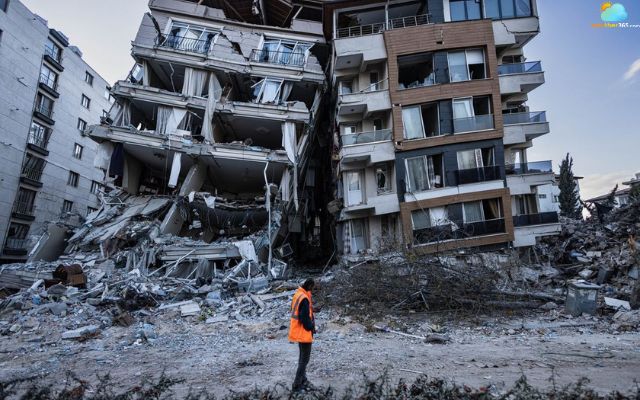
An earthquake caused serious building damage in Turkey
Liquefaction
In water-saturated soils, the ground can lose its strength and behave like liquid. This is called liquefaction.
A famous case is the 1964 Niigata Earthquake in Japan, which caused entire buildings tilted or sank into the ground due to soil liquefaction.
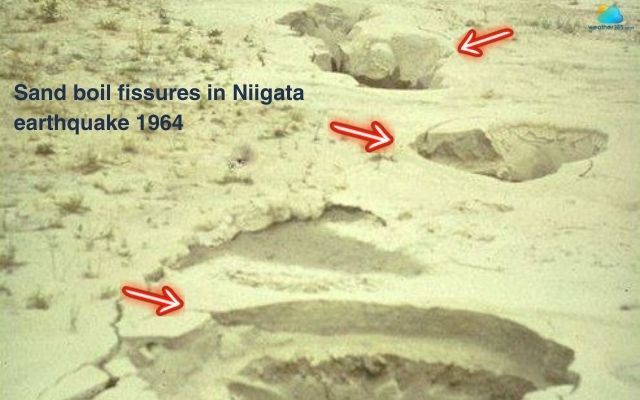
Sand boils due to earthquake in Niigata 1964
Landslides, Surface Rupture, and Tsunamis
Landslides often strike mountainous or hilly areas, where loose soil and rocks are shaken loose.
Surface fault rupture occurs when the earthquake fault reaches the surface, tearing apart roads, pipelines, and infrastructure.
Tsunamis happen when undersea earthquakes displace huge volumes of water, sending massive waves toward coastlines.
In 2008, Wenchuan earthquake in China triggered thousands of landslides that buried villages and blocked rivers, creating deadly "quake lakes."
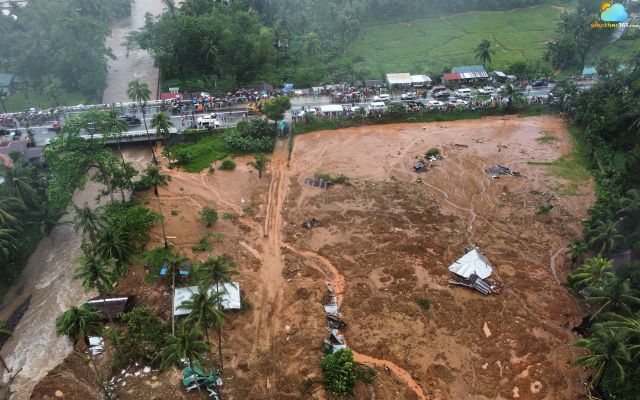
An earthquake can cause serious landslides
Secondary impacts
Earthquakes often trigger a chain of secondary hazards. Landslides, fires, floods, and tsunamis can cause more damage than the original tremor.
Fires and Utility Failures
Broken gas lines and downed power cables often trigger fires after major earthquakes. These fires can spread quickly if water supply systems are damaged.
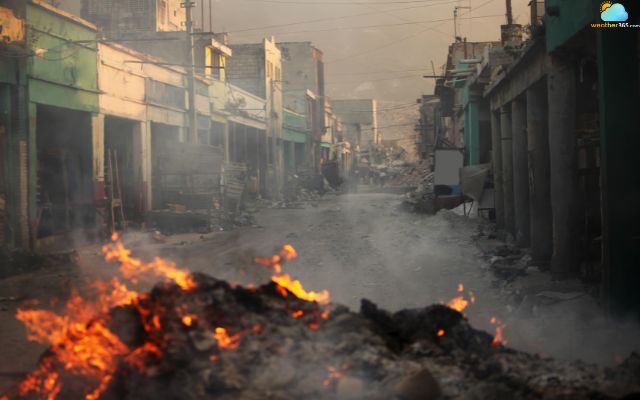
Fire after earthquake in Haiti
Service and Infrastructure Disruptions
Earthquakes frequently destroy transportation networks and utilities:
Roads and bridges collapse, cutting off rescue routes.
Electricity, clean water, and communication systems are lost.
Hospitals and emergency services struggle to operate effectively.
Specifically, after the 2010 Haiti earthquake (magnitude 7.0), 80% of the capital Port-au-Prince’s water system was damaged, and power outages left millions without access to clean water or reliable communication for weeks.
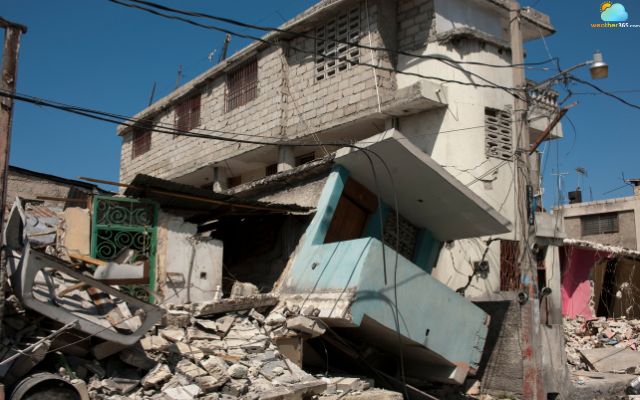
Center of Port au Prince after the earthquake in 2010
Environmental Hazards
Some earthquakes weaken natural systems, leading to:
Floods from dam failures.
Increased risk of landslides after rainfall.
Altered river courses due to ground shifts.
Specifically, the 2008 Wenchuan earthquake in China caused over 800 dams to suffer varying levels of damage, with some collapsing and triggering deadly floods.
The quake also destabilized steep mountain slopes, which later produced thousands of landslides during heavy rains.
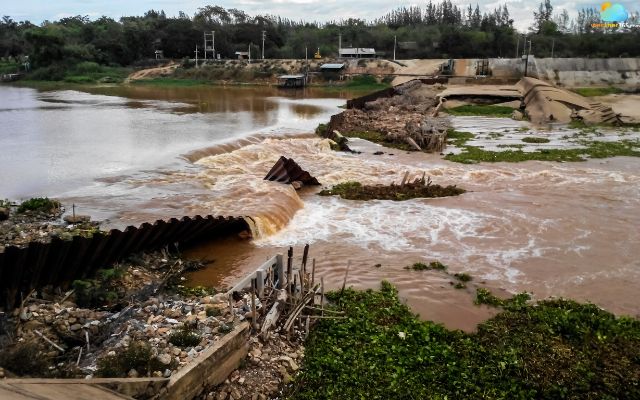
An earthquake can damage dams and result in deadly flood
Human and Economic Impacts
Earthquakes also take a heavy toll on human lives and societies.
Fatalities, injuries, displacement, and economic losses can leave lasting scars on communities.
Fatalities & Injury
One of the most devastating consequences of earthquakes is the loss of human life.
Powerful quakes can kill tens of thousands of people within minutes, with many more trapped or injured under collapsed buildings.
For example, the 2010 Haiti Earthquake (magnitude 7.0) caused over 220,000 fatalities and left more than 300,000 people injured, making it one of the deadliest disasters in modern history.
Similarly, the 2008 Sichuan Earthquake in China claimed nearly 87,000 lives, with countless others left with long-term disabilities.
The fatality toll often depends not only on magnitude but also on building standards, rescue response time, and population density in the affected area.
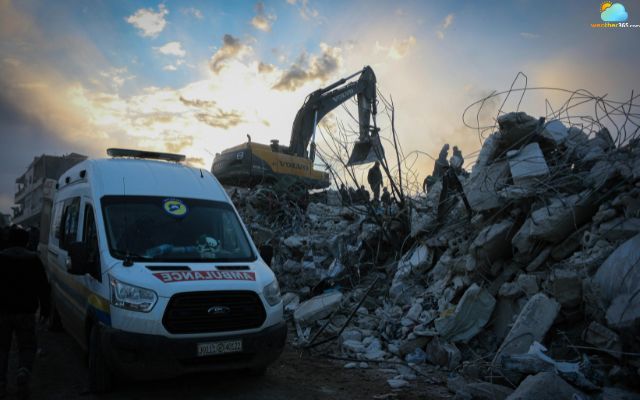
Fatality is the most devastating impact of earthquakes
Economic impact
Earthquakes also bring enormous financial consequences, often crippling economies for years.
Damage extends far beyond collapsed buildings - it includes the destruction of infrastructure, loss of businesses, and massive recovery costs.
The 2011 Tōhoku Earthquake and Tsunami in Japan caused an estimated $235 billion in damages, making it the costliest natural disaster in history.
The impact was not just physical: factories shut down, supply chains were disrupted worldwide, and energy production was crippled after the Fukushima nuclear crisis.
In 2023, Turkiye-Syria earthquake inflicted about $34.2 billion in direct losses which equaled nearly 4% of Turkey’s GDP.
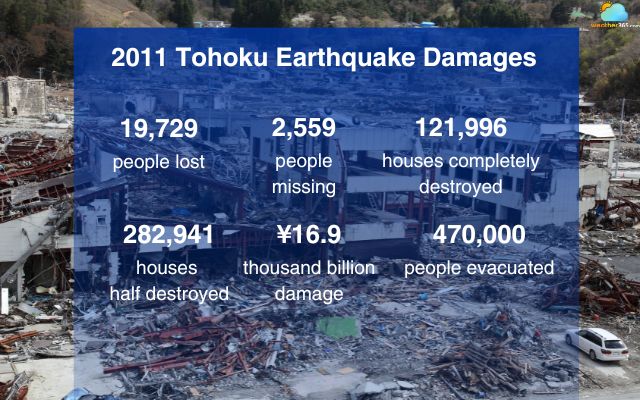
The 2011 Tōhoku Earthquake and Tsunami stands as one of the most devastating natural disasters in modern history
Also read: Largest earthquakes in the world
Communities isolation
Beyond immediate destruction, earthquakes often leave lasting scars on societies. Millions of people can be displaced from their homes, forced into temporary shelters, or even permanently resettled.
In the 2015 Nepal Earthquake, more than 2.8 million people were displaced, with many forced to live in makeshift camps for months due to destroyed housing.
Communities in remote mountainous regions remained isolated for weeks because landslides blocked access roads, delaying rescue and relief.
Long-term, survivors face disruptions in education, healthcare, and employment.
Children may lose years of schooling, and families struggle to rebuild livelihoods.
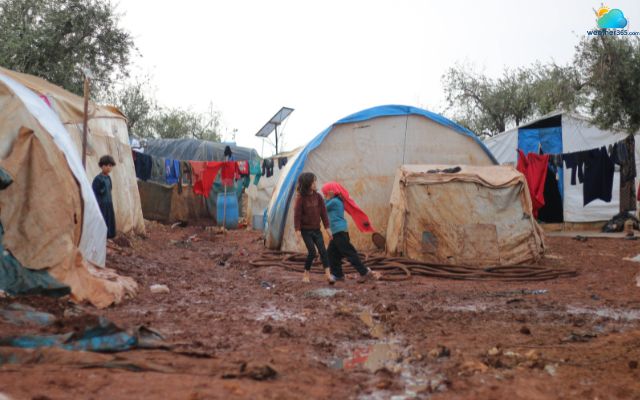
A serious earthquake causes millions of people displaced
Earthquakes’ safety tips
Earthquakes are sudden and unpredictable. Recognizing the early natural signs of earthquake, as well as knowing how to prepare, react, and recover can save lives and minimize damage.
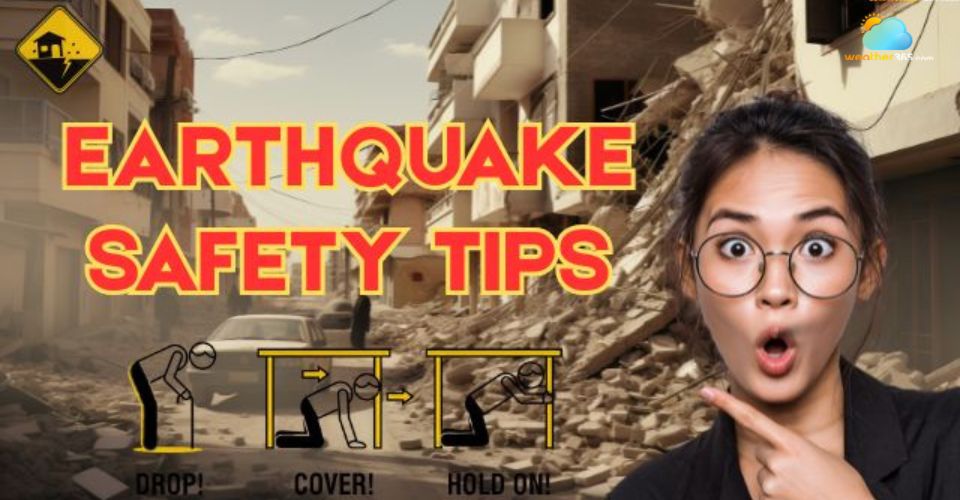
During an Earthquake, remember the gold rule: Drop, Cover, and Hold On.
DROP to your hands and knees,
COVER your head and neck under sturdy furniture, and
HOLD on until the shaking stops.
Also, knowing the right steps to take during and after an earthquake can make a big difference
Follow these tips:
During an Earthquake
Indoors: Stay inside and avoid doorways. If in bed, stay there and protect your head with a pillow.
Outdoors: Move to an open area away from buildings, trees, power lines, and streetlights. Drop and cover.
Driving: Pull over safely away from bridges, overpasses, and power lines. Stay in the vehicle until the shaking stops.
After the Shaking Stops
Check for injuries: Give first aid and check on vulnerable people nearby.
Check utilities: Watch for gas leaks, electrical damage, and broken water lines. If you smell gas, leave immediately without using electrical switches.
Expect aftershocks: Be prepared to Drop, Cover, and Hold On again.
Stay informed: Follow emergency alerts via text messages or a battery-powered radio.

How to stay safe during an earthquake
Learn detailed instructions on Earthquake safety tips!
Conclusion
So, what causes an earthquake? The main factor is tectonic plate movement, though stress, friction, and even human activity can trigger tremors. Understanding these helps us prepare for its effects, build safer communities, and protect lives. Earthquakes will always be part of our planet’s story. The key is to learn, adapt, and stay ready. To monitor active seismic zones and check current weather alerts in your area, stay tuned to our Live Weather Radar and Forecasts.
Frequently Asked Questions (FAQs)
For a detailed explanation of these signs, drop by our full guide Signs of earthquake.
Related post
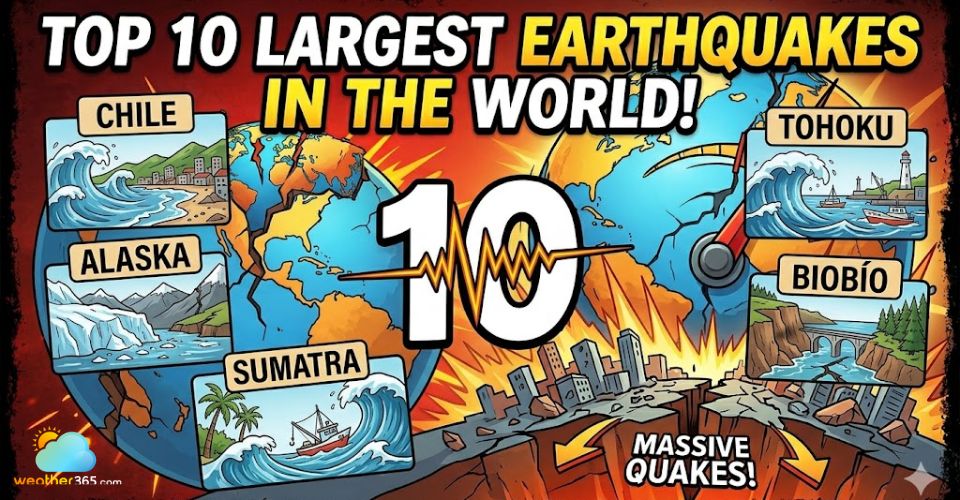
TOP 10 Largest Earthquakes In The World: Stats, Destruction & Aftermath
 1879
1879
 8
8
 4.8
4.8
 18/08/2026
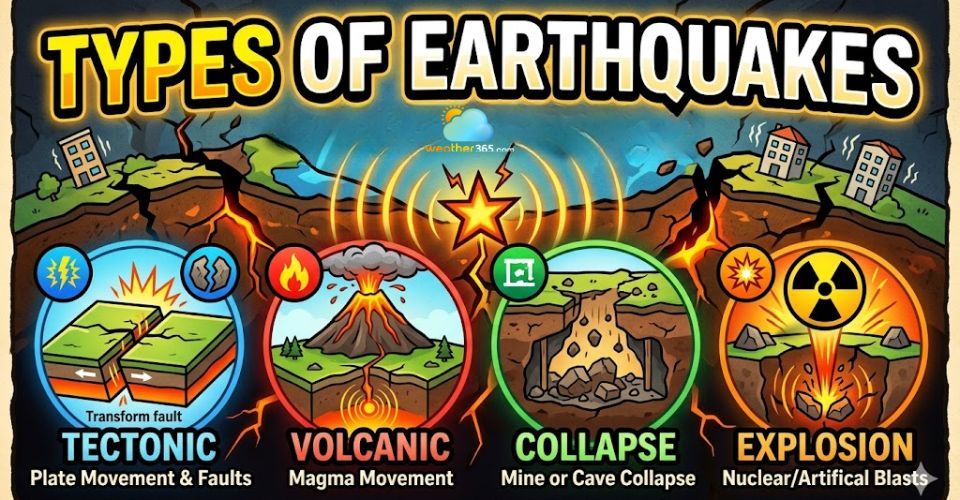
Types of Earthquake Explained: Discover How They Are Classified
1529
8
4.8
18/08/2026
Earthquake Safety Tips: What To Do Before, During, and After An Earthquake
1452
8
4.7
18/08/2026

8 Comment
Augustus Williams
Is “Drop, Cover, and Hold On” really the main thing you should remember during an earthquake?
weather365
Yes. The article recommends dropping to your hands and knees, covering your head and neck under sturdy furniture, and holding on until the shaking stops.
Davis Mills
Why are surface waves more destructive if they travel slower?
weather365
They move along the Earth's surface and can produce stronger rolling or side-to-side motion, which is why they tend to cause more damage to structures even though they travel more slowly than body waves.
Adrian Ward
Can humans really cause earthquakes? I always assumed earthquakes were completely natural
weather365
Most earthquakes are natural, but some human activities can trigger smaller or induced earthquakes. The article mentions mining, reservoirs, oil and gas operations, and hydraulic fracturing as examples.
Albert King
So are tectonic plates actually moving all the time, even when we don't feel anything?
weather365
Yep. They’re constantly moving, but usually very slowly. The problem starts when that movement causes stress to build up along faults and the rocks suddenly slip.
Leave a comment
Your email address will not be published. Required fields are marked *