




Types of Earthquake Explained: Discover How They Are Classified


Have you ever wondered how many types of earthquake, and how scientists define them? Earthquakes can be grouped by what triggers them, how deep they occur, their strength, and the waves they create. This article will explore each classification in clear terms, with real examples and why they matter. Let’s discover!
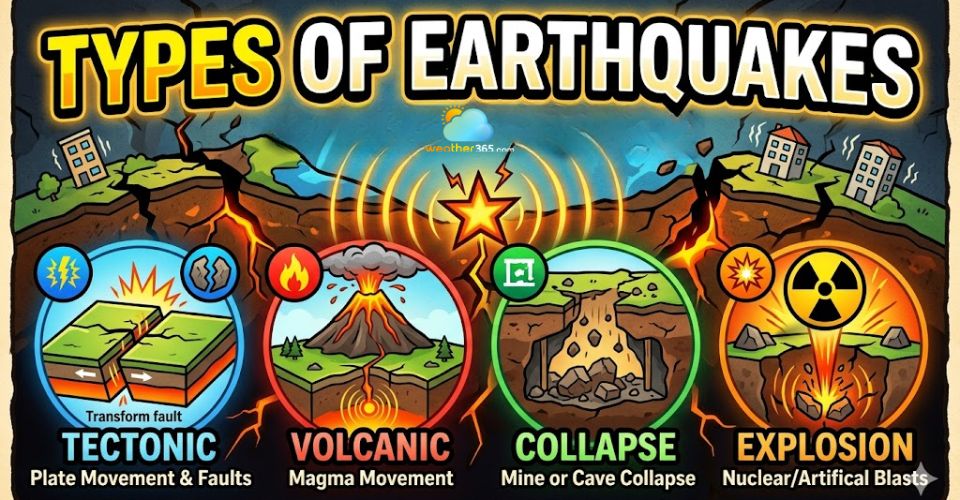
Types of earthquake
- What is An Earthquake?
- Why Do Earthquakes Happen
- Common Types of Earthquake
- Tectonic Earthquake
- Volcanic earthquake
- Collapse Earthquake
- Induced Earthquake (explosion earthquake)
- Other classifications of earthquakes
- Focal depth
- Magnitude
- Plate movement
- Types of Earthquake Waves/Seismic Waves
- Body waves
- Surface waves
What is An Earthquake?
An earthquake is a sudden shaking of Earth’s surface caused by rapid movement in the crust.
Seismic energy travels outward as waves and makes the ground vibrate.
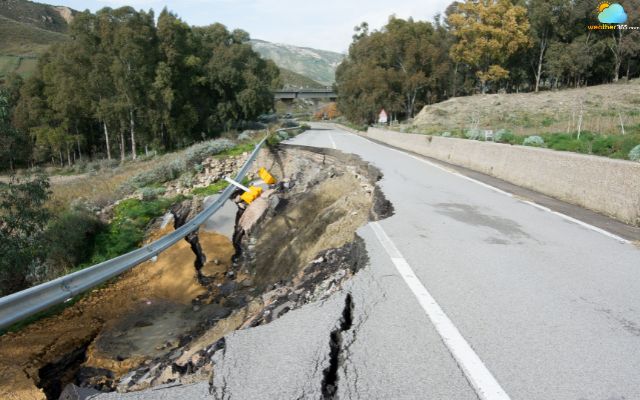
Earthquakes cause cracks on the Earth's surface
Earthquakes mostly happen along plate boundaries. The circum-Pacific “Ring of Fire” hosts the largest share of big earthquakes.
Another active zone runs from Java through the Himalayas to the Mediterranean (the Alpide belt).
You can track live global weather anomalies and seismic belt conditions on our Live Weather Radar. Quakes can also occur inside plates, but those are less common.
It is reported that about 500,000 detectable quakes occur worldwide each year. Nearly 100,000 of those can be felt, and only around 100 cause significant damage.
Earthquakes are among the costliest natural hazards. In the US, approximately tens of millions of people are living in areas with significant seismic risk.
Why Do Earthquakes Happen
Earthquakes occur because the earth is always in motion.
The crust sits on top of massive plates that shift slowly over the soft mantle.
These plates constantly collide, pull apart, or slide past one another. Stress builds where they meet.
When the rocks can no longer hold, they break suddenly and release energy as seismic waves.
This process creates the most natural earthquakes worldwide.
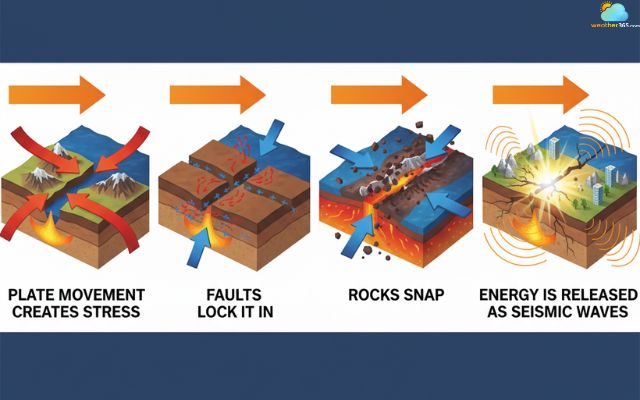
What causes an earthquake?
Volcanic activity is another natural trigger. Rising magma can fracture surrounding rocks and cause repeated small to moderate earthquakes.
Collapse within underground caves or old mines may also shake the surface locally.
Human actions can add to the problem. Mining, large dam reservoirs, and geothermal energy extraction change pressure conditions underground.
Oil and gas drilling, especially hydraulic fracturing, and deep wastewater injection have caused noticeable earthquakes in some regions.
These events are called induced earthquakes.
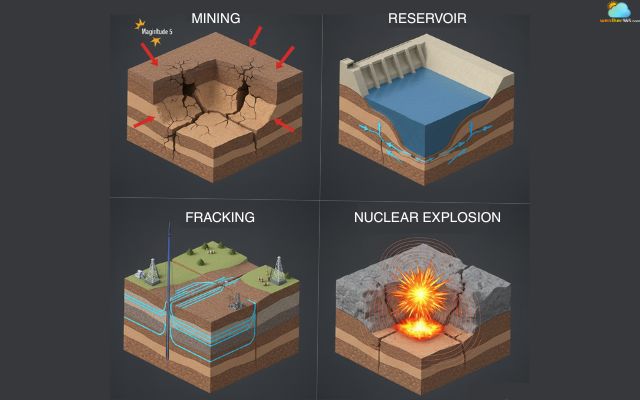
Humans’ activities also contribute to the formation of earthquakes
To explore this in more depth, see our comprehensive guide on What Causes an Earthquake!
Common Types of Earthquake
As many causes lead to earthquakes, this natural phenomenon is thus divided into various types.
Below are four of the most common types of earthquake, each with distinct characteristics and impacts.
Tectonic Earthquake
Tectonic earthquakes are the most frequent type of earthquake. It is responsible for about 90% of earthquakes worldwide.
Tectonic earthquakes occur when stress builds up between rock layers along a fault line.
Once the stress exceeds the rock’s strength, it suddenly breaks, releasing seismic energy.
The process follows the elastic rebound theory: faults are locked by friction, strain accumulates over time, and when released, rocks snap back to a less deformed position, generating seismic waves.
Tectonic earthquakes are usually powerful and affect large regions, often causing severe damage.
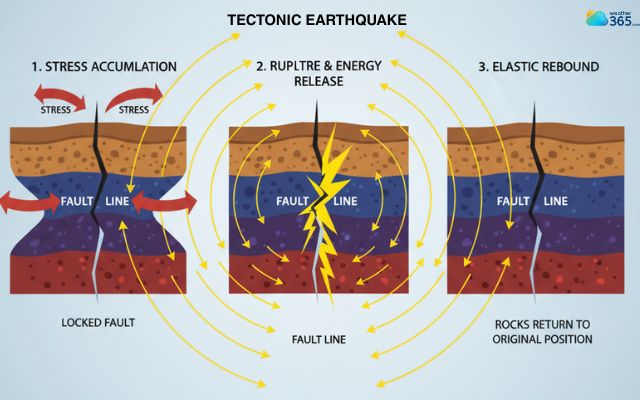
How are tectonic earthquakes formed?
The 2011 Tohoku Earthquake in Japan (March 11, 2011) is a typical example of a tectonic earthquake...
It triggered a massive tsunami, and caused around 20,000 fatalities, ranking it among the largest earthquakes in the world ever recorded.
It struck offshore Honshu, triggered a massive tsunami, and caused around 20,000 fatalities with billions in damages.
Volcanic earthquake
Volcanic earthquakes happen in regions with active magma movement.
When magma rises or pressure builds inside volcanic conduits, surrounding rocks may crack, producing seismic tremors.
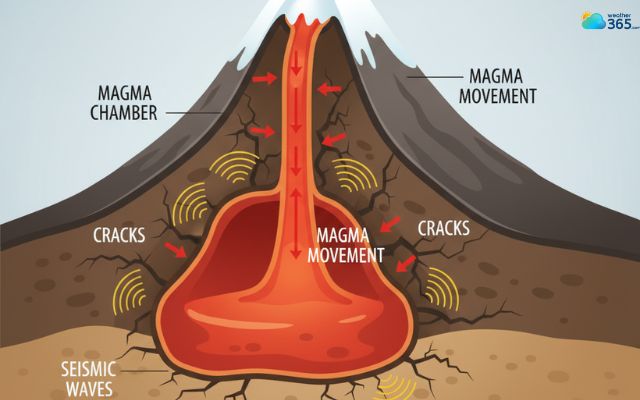
Volcanic earthquakes form when magma cracks surrounding rock
There are two main types of volcanic earthquakes:
Volcano-tectonic earthquakes (caused by both rock fracturing and magma pressure).
Long-period earthquakes (caused by pressure fluctuations in underground fluids). These quakes are generally weaker than tectonic ones, displaying characteristics of a difference between earthquake and tremor where minor vibrations act as important warning signs of possible volcanic eruptions.
Before the 1980 Mount St. Helens eruption in the United States, a series of volcanic earthquakes occurred as magma pushed upward.
The event led to a massive landslide and eruption, with 57 people lost and destroying hundreds of homes.
Collapse Earthquake
A collapse earthquake occurs when underground structures such as caves, mines, or sinkholes suddenly cave in.
Their impact is often localized and limited in scale - for example, a mine shaft collapse or a sudden sinkhole.
Although less destructive, they are significant in areas with complex underground formations or heavy mining activity.
In 2001, a collapse earthquake in India’s Bhuj region occurred in areas with underground cavities and weakened geology after mining.
While small in magnitude compared to tectonic quakes, it caused localized destruction of infrastructure.
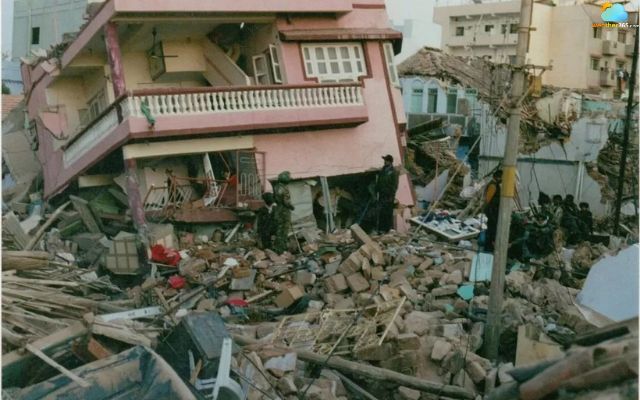
A collapse earthquake in Bhuj in 2001
Induced Earthquake (explosion earthquake)
Induced earthquakes (also called human-induced earthquakes) are those triggered by human activities.
Examples include oil and gas extraction, deep wastewater injection, or reservoir impoundment behind large dams.
These activities can alter underground pressure and stress, leading to seismic events.
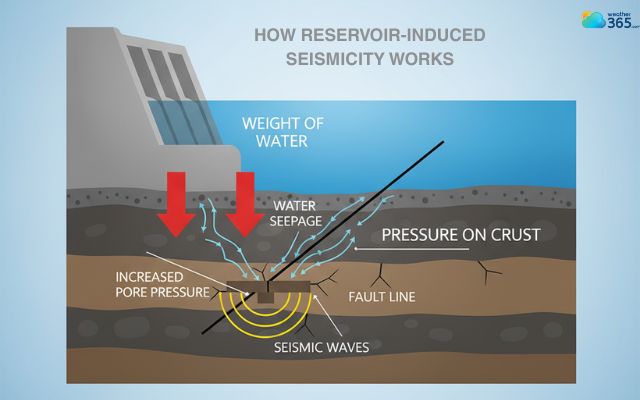
Dams and reservoirs can trigger seismic activity by increasing crustal stress.
One well-known case is the Xinfengjiang Reservoir in China.
This earthquake reached a magnitude of 6.1 and damaged thousands of buildings, displacing tens of thousands of people.
Other classifications of earthquakes
Besides being classified by causes, earthquakes are also defined by their characteristics in terms of focal depth, magnitude, and plate movement.
Focal depth
Focal depth (or hypocenter depth) is how far below the surface the quake starts. Accordingly, earthquakes are classified into the following types:
Shallow-focus earthquakes (less than ~70 km deep) are most common and usually cause more damage near the epicenter.
Intermediate-focus earthquakes occur between ~70 and ~300 km deep.
Deep-focus earthquakes (300-700 km) occur mostly in subduction zones, where one plate sinks under another. Scientists debate the exact mechanism, as rock behavior at such depths differs.
Deeper quakes are usually felt over a wider area, but tend to cause less surface damage than shallow ones because seismic waves attenuate on their path upward.
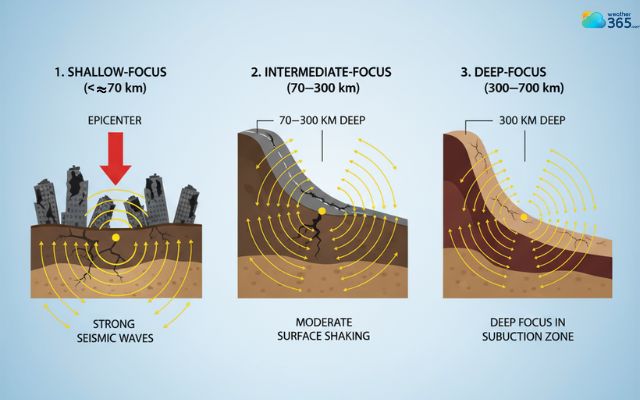
Earthquake types by depth
Magnitude
Scientists also classified types of earthquake based on their magnitude using earthquake magnitude scale:
Microseismic earthquakes (M < 2.0): Too small to be felt by humans but recorded by seismographs.
Minor earthquakes (M 2.0-3.9): Often felt lightly, with no significant damage.
Moderate earthquakes (M 4.0-5.9): Can cause shaking noticeable to people indoors and minor structural damage in vulnerable buildings.
Strong earthquakes (M 6.0-6.9): Produce severe shaking, damaging poorly built structures over wide areas.
Major earthquakes (M 7.0-7.9): Cause widespread destruction, collapsing buildings and infrastructure.
Great earthquakes (M ≥ 8.0): Extremely destructive, affecting entire regions; often linked to subduction zones.
Magnitude Range | Category | Typical Effects |
M < 2.0 | Microseismic | Not felt by humans, detected only by instruments. |
M 2.0 – 3.9 | Minor | Weak shaking, rarely causes damage. |
M 4.0 – 5.9 | Moderate | Noticeable shaking indoors; minor damage to weak structures. |
M 6.0 – 6.9 | Strong | Severe shaking; structural damage to poorly built buildings over a wide area. |
M 7.0 – 7.9 | Major | Widespread destruction, collapse of buildings and infrastructure. |
M ≥ 8.0 | Great | Catastrophic; regional devastation, often linked to massive subduction earthquakes. |
Plate movement
Earthquakes are also classified by the way tectonic plates move against each other. Each type of movement creates a distinct kind of fault and earthquake:
Convergent earthquakes: Formed when two plates collide. One plate may subduct beneath the other, creating very powerful quakes, often deep-focus. Many of the world’s strongest earthquakes, such as those in subduction zones, belong to this type.
Divergent earthquakes: Occur where plates move apart, usually along mid-ocean ridges. They are typically shallow-focus and less destructive, but frequent.
Transform earthquakes: Happen when plates slide past each other horizontally. Fault-line strike-slip earthquakes dominate tectonic activity recorded on California weather condition portals, with California's San Andreas Fault being a classic example.
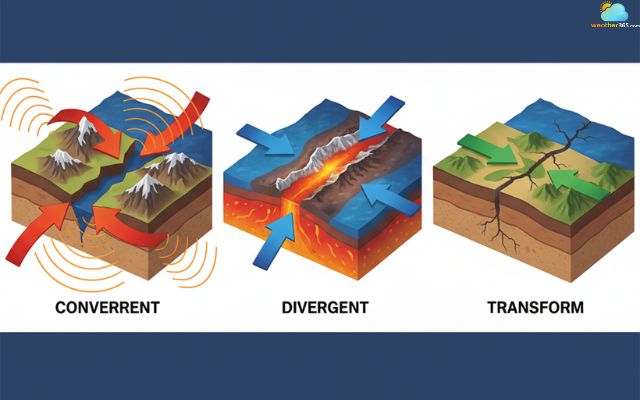
Different types of plate movements lead to distinct types of earthquake
Types of Earthquake Waves/Seismic Waves
When an earthquake occurs, energy travels through and across the Earth in different wave types.
These waves explain how shaking is felt in different places.
Scientists group them into body waves and surface waves.
Body waves
Body waves travel through Earth’s interior. They reach seismic stations before surface waves. There are two kinds:
P-waves (Primary waves): Fastest seismic waves. They compress and expand rock in the direction they travel (push/pull). They move through both solid and liquid layers.
S-waves (Secondary waves): Slower than P-waves. They shear rock perpendicular to the direction of travel (up/down or side-to-side). S-waves travel only through solids, not fluids.
Because body waves move through the interior, scientists use their arrival times and behavior to locate the earthquake’s epicenter and depth.
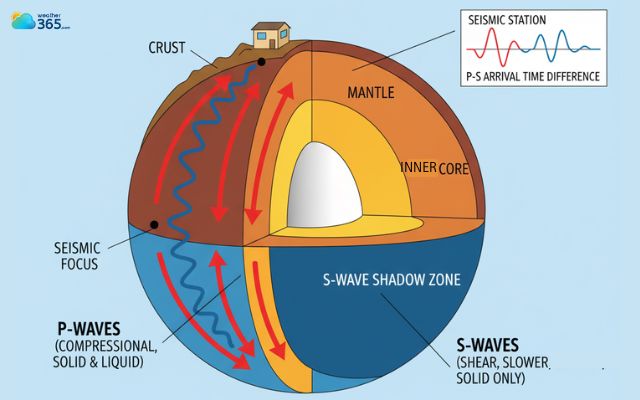
Body waves travel through Earth’s interior
Surface waves
Surface waves travel along Earth’s exterior. They usually arrive after body waves and often cause the strongest shaking at the surface. Two main types of surface wave are:
Love waves: Move the ground side-to-side in a horizontal plane perpendicular to wave direction. These waves often cause severe horizontal shaking, especially damaging to buildings.
Rayleigh waves: Create rolling motion - combining vertical and horizontal movement like ocean waves. They’re slower but felt over larger distances and can cause both up-down and side-to-side motion.
Surface waves decay more slowly with distance and often dominate what people feel during an earthquake.
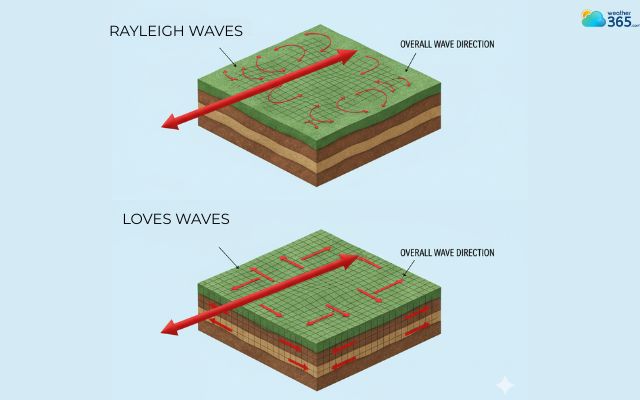
Surface waves cause the strongest shaking on Earth’s surface
Conclusion
Different types of earthquake show that no two quakes are exactly the same. By learning about their categories and impacts, we gain insight into how the Earth works. Since these disasters can strike at any moment, it is essential to learn vital earthquake safety tips to better prepare your household for natural hazards.
Frequently Asked Questions (FAQs)
Related post
Signs of Earthquake: How To Tell If Earthquakes Are Coming?
 1583
1583
 8
8
 5.0
5.0
 18/08/2026
What Causes An Earthquake: Uncover the Science Behind Quakes
1382
8
4.6
18/08/2026
Earthquake Preparedness: Easy Steps to Minimize Risk and Stay Safe
1382
8
4.8
18/08/2026

8 Comment
Quinn Moore
Why are surface waves usually the ones people feel the most?
weather365
Because they travel along the Earth's surface and can produce strong horizontal or rolling motion. Love waves move the ground side to side, while Rayleigh waves create a more rolling motion.
Elise Gross
Can human activity really cause an earthquake?
weather365
It can. The article mentions things like wastewater injection, oil and gas extraction, mining, and large reservoirs as activities that can change underground pressure and trigger induced earthquakes in some areas.
Scarlett Barrett
What's the actual difference between a shallow and a deep earthquake?
weather365
It mainly comes down to where the earthquake starts underground. Shallow earthquakes occur less than about 70 km deep and can cause more damage near the epicenter, while deeper ones can be felt over a wider area but usually lose more energy before reaching the surface.
Maeve James
Are tectonic earthquakes really responsible for most earthquakes?
weather365
Yep. The article says tectonic earthquakes account for about 90% of earthquakes worldwide. They're caused by stress building up along faults until the rocks suddenly slip.
Leave a comment
Your email address will not be published. Required fields are marked *