



What Is the Coriolis Effect? Definition, Causes, and Impacts


What is the Coriolis effect, and why does it make winds, oceans, and even storms move in curved paths instead of straight lines? This invisible force, caused by Earth’s rotation, plays a crucial role in shaping global weather and climate. Let’s break it down in a simple, clear way with us!
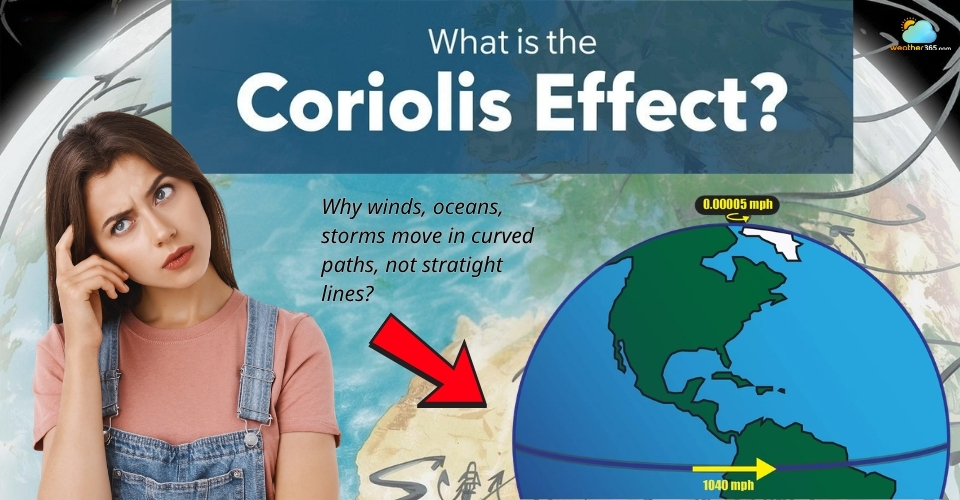
What is the Coriolis effect?
The Coriolis effect is the apparent bending or deflection of moving objects caused by the Earth’s rotation.
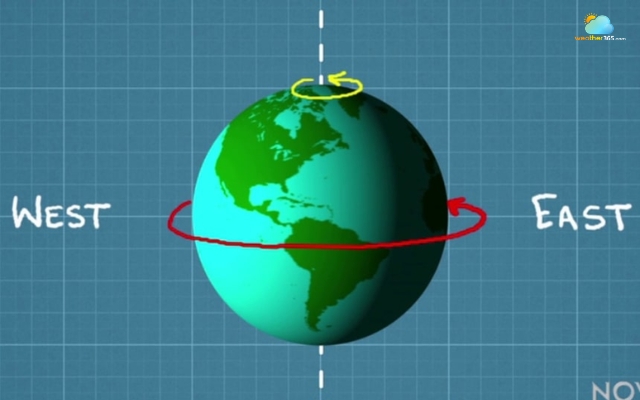
The Coriolis effect is caused by the Earth’s rotation
Instead of heading directly from point A to point B, their paths appear curved when viewed from the surface of the Earth.
Imagine standing on a spinning platform and trying to roll a ball straight across.
From your perspective, the ball seems to curve.
But if someone were watching from outside (not spinning), they would see the ball move in a straight line.
That difference in perspective is exactly what creates the Coriolis effect.
Key features of the Coriolis effect
Large Scales
First, the Coriolis effect only becomes noticeable at large scales. You won’t see it when kicking a ball or driving a car.
But when air masses travel thousands of kilometers across the planet, the effect becomes strong enough to change their direction.
Dependent strength
Second, its strength depends on speed. The faster something moves, the more noticeable the deflection becomes.
That’s why fast-moving winds in the upper atmosphere are strongly influenced by it.
Variable effect
Another important feature is that the effect varies by location. It is weakest at the equator, where the deflection is almost zero, and strongest near the poles.
This difference is one of the reasons weather systems behave differently depending on latitude.
Perpendicular
Finally, the Coriolis effect always works perpendicular to the direction of motion.
Instead of slowing things down or speeding them up, it simply changes their direction.
This is why it plays such a crucial role in shaping movement patterns rather than stopping them.
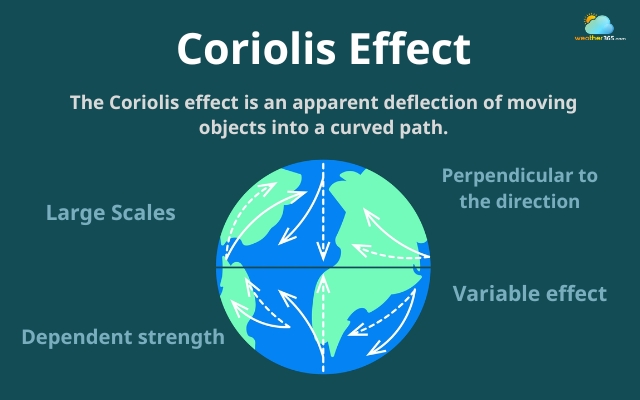
Features of the Coriolis effect
What causes the Coriolis effect?
The Coriolis effect is caused by the rotation of the Earth.
But to really get it, we need to look a bit deeper at how that rotation works.
Rotational speed difference
The Earth spins from west to east, completing one full rotation every 24 hours. However, not every point on Earth moves at the same speed.
This is where things get interesting.
Areas near the equator travel much faster because they have a larger distance to cover in one rotation, while areas near the poles move more slowly.
Now imagine a mass of air starting near the equator and moving toward the north. That air is already carrying the faster eastward speed of the equator.
As it travels into regions where the Earth is rotating more slowly, it keeps that original momentum.
And the result is that it gets ahead of the ground beneath it and appears to curve to the right.
The same idea works in reverse. If air moves from higher latitudes toward the equator, it enters a region where the Earth is moving faster.
Since it can’t instantly match that higher speed, it appears to lag behind, which also creates a curved path.
This difference in rotational speed across latitudes is the core reason the Coriolis effect exists.
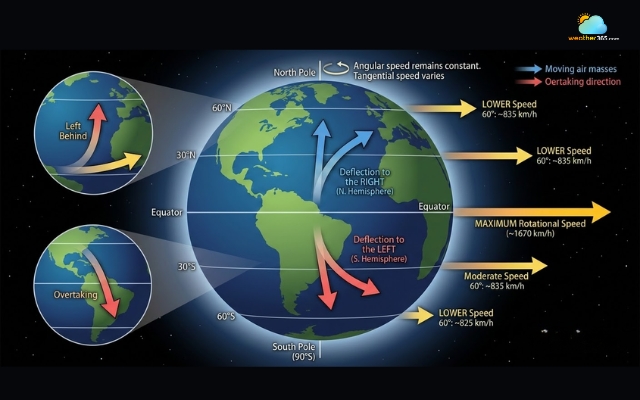
The difference in rotational speed results in the Coriolis effect
Observing perspective
Another important factor is that we are observing all of this from a rotating frame of reference, the Earth itself.
From space, the path of moving air or water would look much more straightforward. But from our perspective on the spinning planet, those paths appear bent.
That’s why the Coriolis effect is often described as an “apparent” force rather than a real one.
How does the Coriolis effect impact?
The Coriolis effect doesn’t create motion by itself, but it changes the direction of movement.
That small change ends up having massive consequences when applied to large-scale systems like the atmosphere and oceans.
Shaping global wind patterns
One of the most important impacts of the Coriolis effect is on global wind circulation.
Air naturally moves from high-pressure areas to low-pressure areas, but instead of flowing directly between them, the Earth’s rotation causes the air to curve.
For instance, Earth’s rotation deflects moving air masses to the right in the Northern Hemisphere, driving US atmospheric weather dynamics.
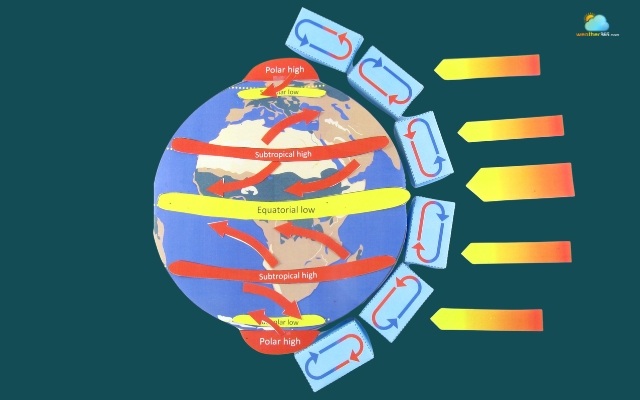
The Coriolis effect shapes global wind patterns
Controlling the rotation of storms
The Coriolis effect is also responsible for the spinning motion of large storm systems such as hurricanes and cyclones.
As air rushes toward a low-pressure center, it does not move straight inward. Instead, the airflow curves and begins to rotate.
Because of this effect, storms spin counterclockwise in the Northern Hemisphere and clockwise in the Southern Hemisphere.
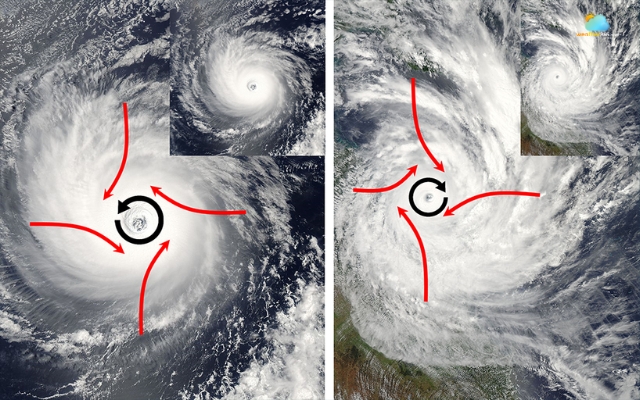
The Coriolis effect causes the storm to rotate
Driving ocean circulation patterns
Ocean circulation is strongly shaped by the Coriolis effect. When winds push surface water across the ocean, the water does not travel in a straight path.
Instead, it curves due to Earth’s rotation.
Over time, this deflection helps form large circular current systems known as ocean gyres, which dominate the movement of surface water in the world’s oceans.
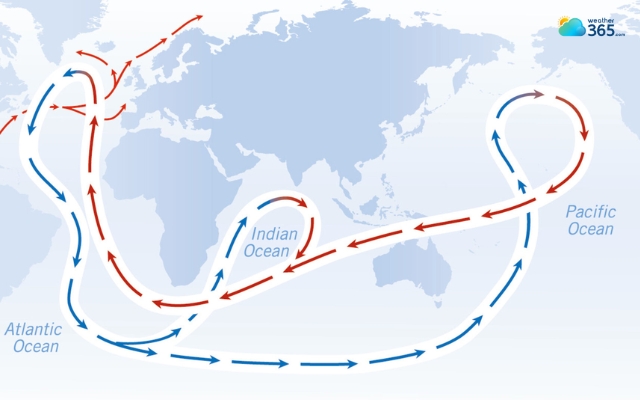
The Coriolis effect helps form ocean gyres
Influencing climate and temperature distribution
Because both winds and ocean currents transport heat around the planet, the Coriolis effect indirectly influences climate.
Warm and cold currents redistribute energy between the equator and the poles, helping regulate temperatures across different regions.
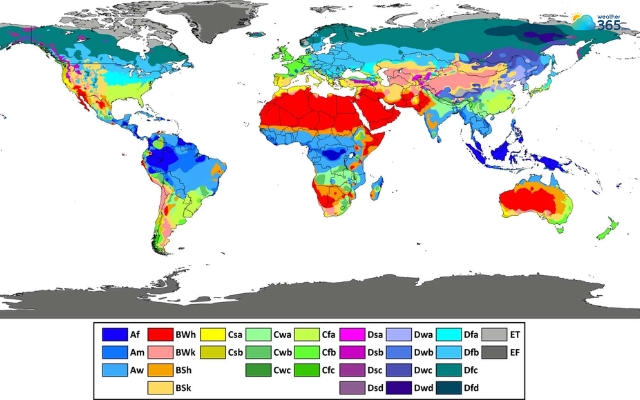
The Coriolis effect indirectly impacts the climate distribution
Affecting long-distance movement on Earth
The Coriolis effect can also affect human activities, especially when objects travel long distances.
Aircraft routes, ship navigation, and even long-range projectiles may need to account for this deflection.
While the effect is very small over short distances, it becomes noticeable when movement covers hundreds or thousands of kilometers.
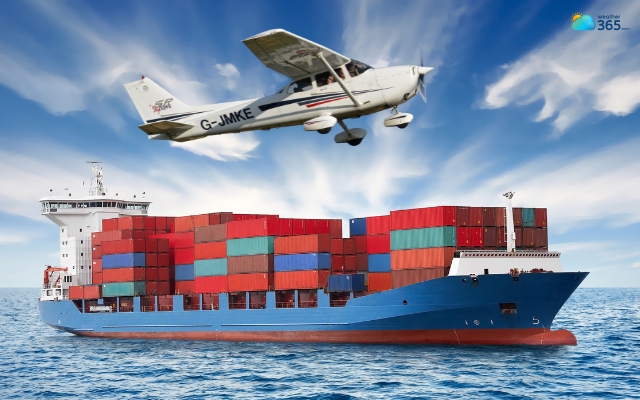
Aircraft routes and ship navigation are heavily affected by the Coriolis effect
Applications of the Coriolis effect
The Coriolis effect has many practical uses in understanding and working with real-world systems.
Technology and Engineering
Devices like Coriolis flowmeters use this principle to measure fluid flow precisely, while gyroscopic systems rely on similar ideas to maintain direction and stability.
Military ballistics
In military applications, long-range projectiles must consider the Coriolis effect to avoid small but critical errors in targeting.
Nature
Even in nature, large-scale environmental systems like ocean circulation and atmospheric patterns are influenced by the Coriolis effect.
And this indirectly affects ecosystems and life on Earth.
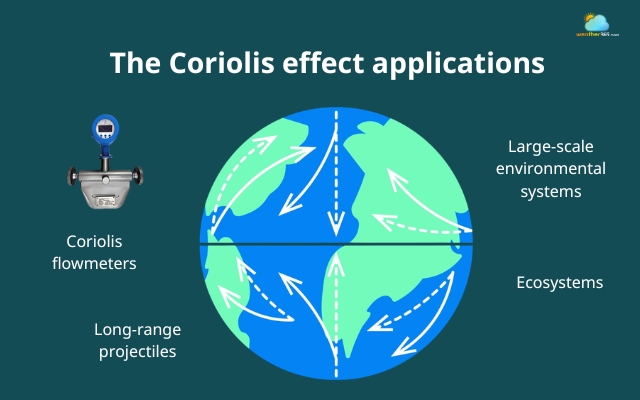
The Coriolis effect dictates the motion of our world
Wrap up
The Coriolis effect is a fundamental concept that explains why moving objects on Earth don’t travel in straight lines. Caused by the planet’s rotation, it influences winds, ocean currents, storms, and even modern technology. Once you understand it, many patterns in weather and climate suddenly make much more sense.
Frequently Asked Questions (FAQs)
Related post
What Is a Polar Vortex? Definitions, Causes, and Weather Impacts
 238
238
 8
8
 4.8
4.8
 18/08/2026

8 Comment
Victoria Ruiz
The examples make this much less abstract. I finally have a better idea of why large-scale weather systems rotate the way they do.
Ainsley Garcia
It’s pretty wild that Earth’s rotation can influence the direction of moving air and ocean currents. You don’t really notice it in everyday life.
Nyla Briggs
Why is the Coriolis effect important for weather forecasting?
weather365
It helps explain the movement and rotation of large-scale atmospheric systems, including winds, storms, and pressure patterns.
Winter Floyd
Is the Coriolis effect the same in both hemispheres?
weather365
No. Moving air is deflected to the right in the Northern Hemisphere and to the left in the Southern Hemisphere.
Gabrielle Floyd
Does the Coriolis effect change the direction of moving air?
weather365
Yes. Earth’s rotation causes moving air and other large-scale flows to appear deflected from a straight path.
Leave a comment
Your email address will not be published. Required fields are marked *