




Weather Change is Spreading Fungal Storms, Valley Fever Across America


Many people outside the Desert Southwest have never heard of Valley Fever, but the soil-based fungal illness is gradually spreading into more regions across the United States. Scientists warn that shifting weather patterns could allow the disease to reach areas that previously faced little or no risk.
The term “fungal storms” does not describe a new type of storm system. Instead, it refers to situations where tiny fungal spores are carried through the air by dust storms, hurricane-force winds or even floodwaters.
Experts say climate change may accelerate the spread of these spores as hotter, drier conditions become more common and are interrupted by periods of intense rainfall. Together, these changing environmental patterns are helping the hard-to-detect fungus expand its range and potentially expose more communities to serious health risks.
Weather change increases the risk of valley fever
From Desert Southwest To Canadian Border
Valley Fever cases have traditionally been most common in Arizona, California, New Mexico, and parts of Texas, where the coccidioides fungus naturally grows in dry desert soil.
Dr. John Galgiani, director of the Valley Fever Center for Excellence at the University of Arizona College of Medicine in Tucson, explained that weather conditions play a major role in how the fungus spreads.
“When rainfall arrives, the fungus tends to grow in the soil and inside rodent burrows. Once the ground dries out again, the spores can become airborne,” Galgiani said.
“Shifts in rainfall patterns, heat, and drought conditions all influence where exposure risks increase. We’ve observed these changes from year to year, but there could also be longer climate cycles lasting decades or even centuries.”
According to California health data, the state has already recorded at least 2,197 Valley Fever cases in 2026, approaching the total of 2,996 infections reported throughout all of 2025.
Health experts are also detecting more cases in Oregon and Washington, raising concerns that the disease may continue spreading farther north and east.
Researchers believe the fungus could eventually expand into parts of the Midwest and possibly even Canada over the coming decades.
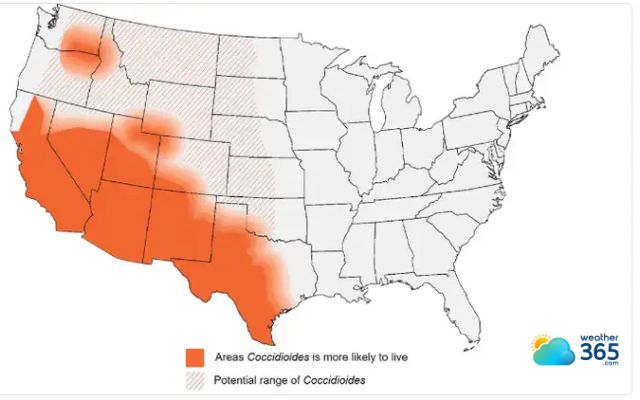
The map illustrates where valley fever is found in the United States
A Disease That Devastates
Valley Fever is far more serious than a typical respiratory illness.
Although its symptoms often resemble those of the flu or a common cold, the fungal infection can persist for weeks or even months, making it difficult to identify without specialized blood testing.
Dr. John Galgiani explained that the illness usually lasts much longer than standard viral infections and frequently behaves more like pneumonia than a short-term cold.
“One of the key differences with Valley Fever is that symptoms can continue for an extended period, sometimes lasting weeks to months rather than just a few days,” Galgiani said.
He also warned that in a small number of cases, the infection can spread beyond the lungs through the bloodstream and affect other parts of the body.
When it reaches the brain and causes meningitis, the condition can become life-threatening if not treated properly.
A National Disease In Disguise
Dr. John Galgiani believes Valley Fever should be viewed as a nationwide health concern, largely because millions of tourists travel through the Southwest every year.
According to Galgiani, visitors to states such as Arizona can unknowingly inhale fungal spores during their trips and only begin experiencing symptoms weeks after returning home.
In many cases, doctors outside the Southwest may not immediately recognize the illness, which can delay proper diagnosis and treatment.
Galgiani hopes Valley Fever eventually becomes as widely recognized as Lyme disease. Although Lyme disease is also concentrated in certain regions, public awareness of it is far greater nationwide.
“I believe awareness is the best protection,” Galgiani said. “The sooner people recognize the illness and receive an accurate diagnosis, the better the chances of protecting their health.”
Related post

Miami Grand Prix start time moved up due to thunderstorm risk, F1 confirm
 244
244
 0
0
 4.7
4.7
 06/05/2026

PGA championship weather: Aronimink day-by-day weather forecast
173
0
5.0
13/05/2026

Spring Heat in Fresno Sparks Health Warnings Across Central Valley
169
0
4.7
12/05/2026

0 Comment
Leave a comment
Your email address will not be published. Required fields are marked *